Tag Archives: history

Dictionary to slaughter cool archaic words

TimesOnline (UK) is trying to save them:

It may appear agrestic to ask, but The Times is calling on its readers to come to the rescue of words that risk fading into caliginosity.

Dictionary compilers at Collins have decided that the word list for the forthcoming edition of its largest volume is embrangled with words so obscure that they are linguistic recrement. Such words, they say, must be exuviated abstergently to make room for modern additions that will act as a roborant for the book.

[Story tip and panel: Dinosaur Comics]

The integrated circuit’s golden anniversary

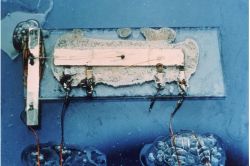
Jack Kilby\'s first integrated circuitRaise a glass, folks – fifty years ago, Jack Kilby of Texas Instruments demo’d the first ever integrated circuit [pictured – from Wikimedia Commons]. From Custom PC:

In July 1958, Kilby took it upon himself to find the answer to small-scale modules with large numbers of transistors. As a new recruit at Texas Instruments he wasn’t able to take a two-week leave while his other colleagues were off sunning themselves. Instead, he confined himself to his lab alone where he came up with the idea of fabricating all of a circuit’s components with a single block of the same material. Two months later, the first integrated circuit was demonstrated, and technology has never looked back.

Thanks for the memories, Jack. 😉

Backing up languages

History may only just be beginning, but we already have a lot of data stashed away as a species, and as we know, it’s always good practice to back it up.

But if you’re thinking in terms of centuries or millennia, it might also be a good idea to record information about our languages so that future historians won’t have to contend with undecipherable writings, like Rongorongo, due to linguistic drift.

The Long Now Foundation has created a modern day Rosetta Stone to help solve this problem, here is a description from Kevin Kelly’s website:

One side of the disk contains a graphic teaser. The design shows headlines in the eight major languages of the world today spiraling inward in ever-decreasing size till it becomes so small you have trouble reading it, yet the text goes on getting smaller. The sentences announce: “Languages of the World: This is an archive of over 1,500 human languages assembled in the year 02008 C.E. Magnify 1,000 times to find over 13,000 pages of language documentation.”

This graphic side of the disk is pure titanium. A black oxide coating has been added to the surface. The text is etched into that, revealing the whiter titanium. This bold sign board is needed because the pages of genesis which are etched on the mirror-like opposite side of the disk are nearly invisible.

This business side of the disk is pure nickel. Picking it up you would not be aware there were 13,500 pages of linguistic gold hiding on it. The nickel is deposited on an etched silicon disk. In effect the Rosetta disk is a nickel cast of a micro-etch silicon mold. When the disk is held at the right angle the grid array of the pages form a slight diffraction rainbow. You need a 750-power optical microscope to read the pages.

Kelly’s description of the project is fascinating, and it seems like a wonderful project, both in practical terms and in artistic terms.

[story via Slashdot]

Algorithms to reveal secrets of East Germany

In Spring 2006, I spent a week in Berlin with some friends from university. As part of a city tour highlighting the Berlin’s Cold War heritage, the guide made a passing reference to plans for the digital reconstruction of files shredded by East German secret police.

As this project entered its pilot stage in May 2007, Germany’s Spiegel Online reported on the finer details;

[W]ith the looming collapse of the Communist regime becoming increasingly evident [in 1989], agents of the East German Staatssicherheitsdienstfeverishly plowed millions of active files through paper shredders, or just tore them up by hand.

Rights activists interrupted the project and rescued a total of 16,250 garbage bags full of scraps. But rescuing the history on those sheets of paper amounted to an absurdly difficult jigsaw puzzle. By 2000, no more than 323 sacks were legible again — reconstructed by a team of 15 people working in Nuremburg — leaving 15,927 to go. So the German government promised money to any group that could plausibly deal with the remaining tons of paper.

The Fraunhofer Institute won the contract in 2003 … Four hundred sacks of scraps will be scanned, front and back, and newly-refined software will try to arrange the digitized fragments according to shape, texture, ink color, handwriting style and recognizable official stamps.

This week, as the pilot phase of the project reached completion, the BBC’s radio programme Digital Planet picked up on the story;

“It will be a long job – but that’s the interesting part,” said the Fraunhofer’s Jan Schneider.

“First we have to digitise all the pieces from the bags. This is done by a special high-speed scanning device.

“The next step is to segment the image itself from the raw scan – we need the outline of the pieces, pixel-wise, to perform the reconstruction process after that.

“Then all digitised pieces of paper are stored in the database. After that we reconstruct a lot of the descriptive features of the pieces.”

However, at the former Stasi prison Hohenschonhausen, the main place political prisoners were held and subjected to torture, there are criticisms that the process has already taken too long.

“I think it comes a little bit late,” said Hubertus Knabe, director of the memorial at the site, which is also a museum.

“Nearly 20 years after the fall of the Wall we start to reconstruct these Stasi files, which are really important: the most important files were the ones they destroyed.

“I am happy that now it is going forward, but it is late.”

[2nd story via the BBC]