
Tag Archives: history

Making Our Future as Better Ancestors

StonehengeIt seems to be the custom for new Futurismic posters to introduce themselves. I don’t see race, sex, age, residence, politics, or preferences. But people tell me I’m a 53-year-old white guy who lives in Arizona, leans to the left, and likes fiction, history, journalism, science, The Loud Family and The New Pornographers, and I believe them.

The birth of yet another niece puts me in mind of Samantha Powers’ recent commencement advice: “Be a good ancestor.” One way to do that might be to start treating the environment as part of the economy, by putting a dollar value on it. A report to the U.N. Commission on Biodiversity estimates that humans do at least $78 billion worth of damage each year, “eating away at our nature capital” through deforestation and pollution. Sobering to consider that about 40% of the world economy is still based on biological products and processes.

In light of the likely first contact with an uncontacted seminomadic Amazon tribe on the borderlands of Brazil and Peru, we probably need to factor cultural diversity into the equation, too. There’s something poignant and human about that AP photo of tribespeople firing arrows at an aircraft.

Think about all our ancestors have done for us. The origin and purpose of Stonehenge is no longer a total mystery, according to recent investigations: it served as a cemetary for at least 500 years beginning 5,000 years ago. It may have functioned for 20 or 30 generations as the resting place of a ruling dynasty. At least 300 surrounding homes made it one of the largest villages in northwestern Europe.

Ancestor-worship as big business? If that’s not old enough for you, consider a 375-million-year-old ancestor called the placoderm fish, with a fossil embryo attached with an umbilical cord. It’s the oldest known instance of live birth. Now think what our moms put up with, bringing us into the world. [Image by Danny Sullivan]

Liquidity – economics and data visualization

Hydraulic Computer - Phillips MachineTo coincide with the mechanical rumblings of the Bank of England a couple of weeks back, the Guardian published a piece about the Phillips machine – an early hydraulic computer;
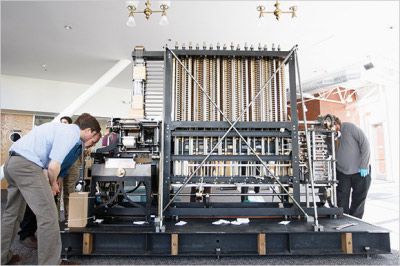
A sensation when it was unveiled at the London School of Economics in 1949, the Phillips machine used hydraulics to model the workings of the British economy but now looks, at first glance, like the brainchild of a nutty professor. Where the Bank’s team of in-house economists are equipped with state-of-the-art digital computers, the profession’s first stab at modelling was very much a do-it-yourself affair with a whiff of the Heath Robinson about it.

When combined with a nifty visualization of American consumer spending from the New York Times, the whole idea of data visualization kicked my cranial cogs into action. This interactive graphic provides a visual breakdown of spending, highlighting price changes over the previous 12 months. This enables us to see that eggs are almost 30% more expensive than in March 2007, while the average American spends more on chicken than computers.

While nifty, this visualization could easily be the tip of a great big iceberg of usefulness. If our day-to-day spending was logged and recorded (be it through anal retention or RFID), we’d be able to visualize and interact with our domestic spending through a similar framework as that used by the New York Times. Essentially, we’d be looking at some kind of virtual, personalised Phillips machine.

Want to compare the breakdown of your expenses for February with that of the average urban-dwelling male in the 26-30 age bracket? Want to add a dynamic element, and watch your financial fortunes ebb and flow over the past ten years? Perhaps isolating the precise moment at which things started to go wrong?

The potential utility of this kind of service could be vast, allowing the cash-blind and mathematically challenged to grok the intricacies of home economics.

Something to include in the next office software bundle, perhaps?

[image from the Science Museum]

Playing games with time

Timewarp Time has a strange attraction for many people – it’s the one dimension that we can perceive but can’t control. But we can hack at the edges of it, like the Time Nuts: a 400-strong geek clade who collect high-precision atomic time-pieces. If you find you never have enough time to spend with your family, you may want to look into their methods – it’ll help you scrape up a few precious extra nanoseconds. [Awesome ‘shopped image by fdecomite]

Other people are trying to map time, instead – MetaFilter points out Miomi, a web2.0 startup with the tagline “user generated history” that aims to round up all the information in the world and assemble it into one coherent browsable time-line. Insert your own joke about conspiracy theorists and alternate history writers here.

On the subject of writers and time, the relentlessly provocative and controversial Mundane SF blog reminds us of DeSmogBlog’s “100 Year Letter” project, and decries the fact that science fiction writers seem to have taken no interest in it at all. Of course, they may simply not have know about it – this is the first I’ve heard of it, at least – but the Mundanistas lay a much weightier charge:

“… here, in 2007, the Science Fiction community has abandoned the future; or the future has abandoned it and gone on its merry way, following the laws of physics and thermodynamics with absolutely no consideration for our fantastic dreams. What a shame.”

What do you think – is it science fiction’s duty to deal with contemporary issues, or is it just for escapist purposes?

[tags]time, clocks, history, mundane, science fiction[/tags]

Old-school bioweapons – sick sheep

Ram with curly horns Biological warfare would appear to be a much older idea than we thought. New translations of ancient Middle Eastern texts suggest the Hittites had hit upon the idea of weakening their enemies with diseases by sending them rams “cursed” with a bacterial infection called tularemia – over 3 millennia ago. Tularemia is still a potentially lethal agent today … whether or not a sheep would be a successful delivery system in our modern age is an unknown quantity, but I wouldn’t be surprised if there were parts of the world where it could still be very effective. [Image by Dave-F]

On a lighter note, I can’t help but be reminded of the Sheep Cannon from the hilarious and addictive Worms computer games.

[tags]warfare, biological, disease, history[/tags]