“… nuclear weapons may come to be seen as a strange fetishistic behavior by nations at a certain period in history. They were insanely expensive and thoroughly useless. Their only function was to keep a bizarre form of score.” – Richard Rhodes [link and video via Chairman Bruce]
Tag Archives: history
The in-jokes from way out
Today’s XKCD may not be one of the funniest ever, but as is often the way, it’s the not-so-funny ones that tend to get me thinking:
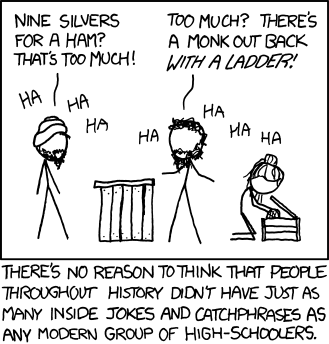
And as always, it’s the mouseover text that gets to the real point:
“I’ve looked through a few annotated versions of classic books, and it’s shocking how much of what’s in there is basically pop-culture references totally lost on us now.“
Now, that’s a pretty ubiquitous aspect of popular culture he’s on about, but I think we can suggest that sf will suffer more strongly than regular mimetic novels from this problem when appraised by the readers of the future. Making sense of, say, Jane Austen’s work demands an understanding of the sociopolitical milieu in which it was written, but imagine trying to read Paolo Bacigalupi’s The Windup Girl a century from now (assuming, of course, that there’s still someone capable of reading it at that point). To fully grok the story and its commentary, the reader would need to understand not just the historical situation of the Noughties, but also the way the Noughties looked at the future, and (to a perhaps lesser extent) the way in which a work of sf tends to engage in a dialogue with its antecedents and contemporaries.
Of course, that’s partly true of almost any cultural sub-genre. And this here blog will read rather strangely in a century’s time, but (again assuming it’s still around to read, stuffed into a corner of a diamondite teracube in 2110’s equivalent of the Wayback Machine) there’d at least be the links there for context. But that assumes that the links aren’t dead either, of course… and that the reader would be bothered about checking that context. Hmmm. I seem to have just argued my way out of my own hypothesis; maybe Noughties sf in retrospect won’t look any weirder than any of its contemporary media. In fact, thinking about the music videos I’ve seen recently, it might get off quite lightly…
Even so, I quite fancy the job of knocking up hypertext Cliff’s Study Notes-style annotated versions of modern sf novels for the benefit of the cultural anthropologists of the near future… would anyone like to pay me to do that, please?
Related: Douglas Coupland pops in to the New York Times to coin some much-needed neologisms for the near future. I wonder if he has one for marginal book critics who portray popular post-modern authors as self-indulgent cynics?
Why isn’t there a gender-neutral pronoun?
Actually, there are dozens of gender-neutral pronouns, and that’s true even if you limit your search to the science fiction canon. But calls for a gender-neutral pronoun are much older than you might have thought, as the Oxford University Press blog explains, and we still haven’t managed to adopt one [via TheBigThink]:
Such discussions in the 1880s and 90s did nothing to shake up the pronoun paradigm, and nothing came of subsequent proposals for heer, hie, ha, hesh, thir, she (together with shis and shim), himorher, se, heesh, hse, kin, ve, ta, tey, fm, z, ze, shem, se, j/e, jee, ey, ho, po, ae, et, heshe, hann, herm, ala, de, ghach, han, he, mef, ws, and ze [a list with dates and sources for many of these pronouns can be found here].
Flash forward to 1978, when The Times (of London) prints a letter in response to yet another call for a new “unisex” pronoun set, advocating le, lim, ler, and lers. (And another correspondent tersely suggests it.)
Despite this wealth of coinage, there is still no widely-accepted gender-neutral pronoun. In part, that’s because pronoun systems are slow to change, and when change comes, it is typically natural rather than engineered.
For those of us who work with words, of course, there are canonical rulesets to which we are supposed to adhere. But it’s the ruleset of grammar that long forbade the use of the singular they:
… despite the almost universal condemnation of the coordinate he or she by supporters of gender-neutral pronouns, the rule books now opt for he or she and not an invented word to replace the generic he. Students who once were taught that the masculine pronoun must always be used in cases of mixed or doubtful gender are now taught instead to use coordinate forms, not for gender balance or grammatical precision, but simply because that’s the new rule. Those writers who question the rule, who realize that multiple he-or-she’s just don’t make for readable prose, won’t seek out a new gender-neutral pronoun. Instead they’ll recast some sentences as plural, and for the rest they’ll just take their chances with singular they. After all, if you, which is also gender neutral, can serve both for singular and plural, why can’t they do the same? In any case, after more than 100 attempts to coin a gender-neutral pronoun over the course of more than 150 years, thon and its competitors will remain what they always have been, the words that failed.
Regular readers may have noticed that I tend to use the singular they wherever possible – indeed, I’ve been called out on it in the comments here once or twice, so that grammatical rule dies hard. I really can’t remember when I started doing it, either; I’m not sure whether I was taught that way at school (though I doubt it, given the conservatism of my education).
All this, I suppose, makes gender-neutral pronouns a case study in the seemingly universal human urge to create multiple new rules in order to fix a problem that could be obviated by dropping or loosening a single old rule…
The Plato Code
Another weird announcement from academia… one that comes with the possibility of a tie-in novel, a subsequent Tom Hanks cinema vehicle and a whole raft of poorly-moderated discussion forums populated by users with names like *HemlockSpitter77*. Dr Jay Kennedy at the University of Manchester has cracked the secret code in Plato’s writings[via SlashDot]!
Some highlights from the press release:
The hidden codes show that Plato anticipated the Scientific Revolution 2,000 years before Isaac Newton, discovering its most important idea – the book of nature is written in the language of mathematics. The decoded messages also open up a surprising way to unite science and religion. The awe and beauty we feel in nature, Plato says, shows that it is divine; discovering the scientific order of nature is getting closer to God. This could transform today’s culture wars between science and religion.
That’s set my alarm bell to ringing… unless it’s the sound of bookstore cash registers I can hear.
Dr Kennedy explains: “Plato’s importance cannot be overstated. He shifted humanity from a warrior society to a wisdom society. Today our heroes are Einstein and Shakespeare – and not knights in shining armour – because of him.”
Yes; kind of; erm, not really.
Over the years Dr Kennedy carefully peeled back layer after symbolic layer, sharing each step in lectures in Manchester and with experts in the UK and US.
He recalls: “There was no Rosetta Stone. To announce a result like this I needed rigorous, independent proofs based on crystal-clear evidence.
“The result was amazing – it was like opening a tomb and finding new set of gospels written by Jesus Christ himself.
And there goes the Krank Klaxon. Awoooogah!
To be fair, I suppose it’s possible that there really is a code, and that Kennedy has ‘cracked’ it. Though I’m still inclined to think his theory is more likely a load of bollocks.
Best of all is the selection of Plato aphorisms included at the end of the press release for lazy science hacks, because it includes this aposite little gem:
“Wise men talk because they have something to say; fools, because they have to say something.”
Maybe there’s a secret code in there for you, Dr Kennedy?
Hidden histories: Afghanistan
We all know about Afghanistan – a poor and predominantly Muslim nation that’s never really made it out of the Middle Ages, right?
Well, it turns out that’s simply not the case: retconning Afghanistan as a backward barbarian enclave has probably been useful for the global psyops propaganda machine (because what does one do with backward nations but export some much needed corporate democracy, in the hope of neutralising the threat that our earlier meddlings have created?), but as recently as the 1960s, Afghanistan was a modern progressive country… and to look at photographs from that era, you’d be hard pressed to tell at a glance that you weren’t looking at the science classrooms, record stores or factories of some Western nation [via MetaFilter].
Makes you wonder how much of our own national mythology has been carefully constructed retrospectively in order to tell a story we find comforting. For example, I’ve read quite a few books that suggest Britain’s “stiff upper lip” during World War Two was a long way from being as universal as we like to imagine. We’re also pretty fond of mentioning how we stopped the slave trade, but the fact that we played a large part in kickstarting that particular transAtlantic business model is usually left unvoiced…
So, a user-contribution opportunity for a Friday: share a conveniently glossed-over moment from the history of your preferred nation-state!