Tag Archives: history

A sci-fi rock’n’roll odyssey at Clarkesworld

Long-term readers of this here site are probably aware that my other huge cultural obsession (besides science fiction literature, natch) is rock music, and that I’ve spent some amount of time in the last few years on drawing comparisons and connections between the two scenes.

So imagine my joy (if you will) when I saw that this month’s issue of Clarkesworld contains an article by Jason Heller that traces the history of science fictional futurism and narrative through the canon of rock music since Bowie’s “Space Oddity”! And better still (because this is the multimedia information super-content-highway-tubes, kids) it’s full of embedded video so you can actually hear and see what he’s on about.

Not for the first time (though almost always at moments when I have more than enough pressing demands on my time), I find myself thinking that there’s enough scope for me to write a non-fiction book on the cross-pollination of sf/f/h and rock music… anyone want to crowdfund me to spend a year on that? Maybe Heller would like to co-write… *opens email client*

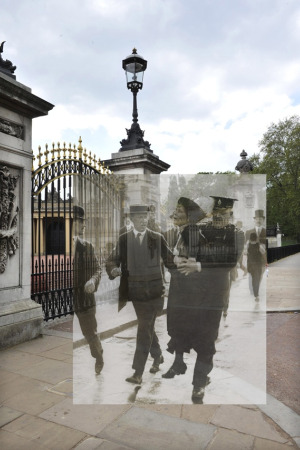
We can misremember it for you wholesale: historically layered Londons, and the past as palimpsest

Via Bruce Sterling, one of the more obvious augmented reality applications, done elegantly: historical archive images overlaid onto the real (present/baseline?) world. The older I get, the more I become fascinated with history; if someone did up layers like this for the whole country, I’d probably never switch it off. [image ganked from TechVert; please contact for takedown if required]

London Museum archive photo augmented reality app

Give it a couple of years (or maybe less), we’ll be doing the same with archive video. Another few years, generative CGI that is practically indistinguishable from archive video. Alternate history as real-time immersive gaming experience… think of the 80-hours-a-week WoW player, and it’s easy to assume that some people will pretty much live in AR environments full time. A subsection of those people will make their entire living in that space, geographically contigious with baseline reality but offset (or derailed completely) from historical temporal flow. Whose laws will they obey? Who will they pay taxes to? What will their game goals be? Imagine a Victorian London ARG that’s something like The Sims – your goal is, basically, to survive your chosen socioeconomic mileue for as long as possible without dropping out… or dying in the attempt.

Related bonus link: MeFi points out an experiment into the mutability of memory as manipulated by doctored ‘historical’ images and media artefacts. Apparently not a very rigorous experiment, but nonetheless, the implication is that it’s alarmingly easy to convince us that a fabricated event actually occured. This is, hopefully, a temporary problem. It’s going to take us a little while to evolve the sort of high-sensitivity bullshit filters that an impossible-to-police internet demands, and ubiquitous AR will raise the bar another few notches; I suspect we’ll get there eventually. But unless technological progress hits a brick wall fairly soon, I suspect we’ll never fully catch up. This is a little like what evolutionary science calls an “arms race”, I think… though we’re now in an arms race with the cultural and technological output of our own species.

Thinking about it again, I guess we always have been… I’m sure I’m reinventing the wheel here (and if you can point me toward more thinking alonmg these lines, please pipe up in the comments), but the enormity of this revelatory idea has pretty much scuppered my chances of concentrating on anything else for the rest of the day.

William Gibson on the cyberpunk obsession with brands

Having recently completed his forthcoming novel Zero History, William Gibson is kicking back at his blog and fielding questions from the intertubes; if you want an insight into the man’s attitudes and philosophies (toward his work, and the world in general), you’d be well advised to tune in.

This one particularly caught my eye, because it calls out a foible I’ve always noticed in Gibson’s writing (and Chairman Bruce’s, too, though to a different degree) – his fetish for explicitly dropping in brand names and obsessional detail about clothing, hardware and vehicles. Gibson’s justification is charming, not least because I’ve always had a similar sort of obsession*:

Q Why do you seem obsessed with brand name apparel et al in Pattern Recognition and Spook Country?

A You ain’t seen nothing, yet! Actually the new one may explain that, a bit. Or just further convince some people that I’m obsessed. It’s one of the ways in which I feel I understand how the world works, and there aren’t really that many of those. It’s not about clothes, though, or branding; it’s about code, subtext. I was really delighted, for instance, to learn who made George Bush’s raincoats. A company in Little Rock (now extinct, alas) but they were made of Ventile, a British cotton so tightly woven that you can make fire hoses (and RAF ocean survival suits) out of it. Which exists because Churchill demanded it, because the Germans had all the flax production sewn up. No flax, no fire hoses for the Blitz. The cultural complexities that put that particular material on Bush’s back delight me deeply; it’s a kind of secret history (and not least because most people would find it fantastically boring, I imagine).

Brands are stories, in and of themselves. I wonder if the cultural histories of consumer goods are one of the few types of narrative that can survive postmodern erosion?

[ * There’s a part of me that always hates noting similarities like this, because it feels like my brain trying to tell me “oh yeah, you’re just like him, bravo you!” Anyone else get that kind of feeling when they read author interviews or blogs? ]

Augmented reality fiction

augmented reality headset conceptHere’s another option to add to the list of new avenues for fiction writers worried about the possible demise of the novel – augmented reality fiction, as (quite literally) dreamed by Web2.0 maven Tim O’Reilly [via @globalculture; image by The Lightworks]:

Last night I dreamed that one of my authors (no name or face that I can recall – one of the phantasms created by the half-waking imagination) had sold me rights to a novel he’d written, and was eager for me to publish it as an ebook. It turned out that the “ebook” we were developing was actually a movie that took place in an augmented reality overlay projected directly onto the mind’s eye, mixing what the author had imagined with what the viewer was actually seeing and experiencing at the time. Every version of the movie was different, because the story had to be overlaid on what the viewer was encountering in the real world. At one point in the dream, Eric Schmidt of Google was particularly excited because a sailing scene in the story warned him about a hidden reef that his boat had to avoid.

I don’t often share dreams on this blog (at least not sleeping dreams), but this one seemed worth putting out there, because I do think that augmented reality could be an important component of a new kind of storytelling, making today’s 3D entertainments as dated as silent films.

[I guess you have to move in pretty rarefied circles to have Google’s CEO appear in your dreams…either that, or have the sort of extreme tech fetish that warrants medical attention.]

I very much doubt that O’Reilly’s the first to think of AR fiction, but having someone that influential kicking the idea around in public can only be a good thing; the dead-tree book may have a finite lifespan ahead of it, but storytelling will probably last as long as humanity itself, in one form or another.

O’Reilly continues with an anecdote about an intriguing format for theatre he once experienced, which (more so than the AR fiction idea alone) threw all sorts of interesting switches in my head:

Many years ago, I saw a play in LA called Tamara, a story set in the mansion where WWI hero and author Gabrielle D’Annunzio was held under house arrest by Mussolini. A fascinating experiment in theater, Tamara took place in many different rooms of the house. As an audience member, whenever a scene ended, you had an opportunity to follow the character of your choice to another room. No audience member could see the entire play. My wife and I went with her parents (who were back for the third or fourth time, seeing parts of the play they’d missed on previous visits), and afterwards, we all compared notes for hours about what we’d seen, and what we’d missed.

Now that’s an interesting idea… not to mention a neat way of making history a more immersive and interesting experience. Someone needs to start pitching that structure to the museums-and-stately-homes sector… *reaches for rolodex*

Of course, the layered nature of augmented reality means that there’s all sorts of potential for weird and unforeseen overlaps and mash-ups – it’s easy to think of ways to add a game component to that immersive theatre idea, for example. But there’s nothing that says you have to get permission to mesh your game with another layer. Let’s say that someone makes an AR guide to Victorian-era London, for instance; it’d be pretty easy for someone to independently develop an extra layer that threaded in a Sherlock Holmes-esque game element to the proceedings. But just think of the IP headaches that sort of mash-up is going to produce – if you develop a game on top of a free-to-view ad-supported AR layer, should you have to pay the creators of that layer? Or should the extra traffic you’re sending to it be considered payment enough? That sound you hear is the hands of a thousand lawyers rubbing together in glee…

And let’s not forget that all games can and will be gamed – for instance, you’ve probably heard of FourSquare by now (if not signed up already), but that casual geolocational contest is easily fiddled, as demonstrated by one Jim “KrazyDad” Bumgardner [via @qwghlm]. Games that are played upon games, realities that are recursively layered upon realities… things are going to get a whole lot more meta in the not-to-distant future.
Bruce Sterling on atemporality

I’d be remiss in my fanboy duties if I didn’t repost this video of a keynote speech from Bruce Sterling at last week’s Transmediale Futurity Now! conference in Berlin.

Appropriately enough for a conference in Berlin, a city where history lays heavily in layers of physical and psychological flotsam and jetsam, Chairman Bruce is talking about atemporality – that curious and disorientating sense that modern media gives us of all times being somehow equal.

Atemporality is “a calm, pragmatic [and] serene skepticism about the historical narrative”; it’s “a philosophy of history with a built-in expiry date”; it’s the end of post-modernism, and the end of The End Of History. But enough with the sound-bite pull-quotes – it’s only 25 minutes long, so settle down comfortably and get your mind expanded.