
Tag Archives: history

Silvia Moreno-Garcia explains the origins of “Biting the Snake’s Tail”

Mexico City skylineSo, did you read Silvia Moreno-Garcia’s latest Futurismic story, “Biting the Snake’s Tail”, published here yesterday? Well, you should – go do it now.

One of the great joys of author blogs, for me at least, is getting an insight into how stories came to be – to find out what inspired them, how they progressed from initial idea to finished work. Silvia has written a post that opens a door on “Biting the Snake’s Tail”, which takes place in a near-future iteration of Mexico City:

It was two years in the making. I wrote the first half of it after dreaming two parts of it: the detective walking through the rainy streets with the dog and the murder. In the original, the murder took place at a public bath house and the victim was a gay man.

When I was a kid and there was no water (yep, this was a problem in Mexico City even years ago) for the day, we sometimes went to the public bath house in Santa Julia. This meant paying a few pesos and you got a bit of soap, some shampoo and access to a shower area. I remember we took our own towels, but towels might have been supplied at a cost. Last year, when I was in Mexico City, water issues were pretty bad. About 5 million people (a quarter of the city) was suffering from a drought and predictions for 2010 were that even the ritzy neighbourhoods would be affected. Think a third of the city without water this year, taps running dry for many days at times.

Having been lucky enough to visit Mexico City, I know it’s the sort of place where stories wait for you around every street corner. Ludicrous wealth and grinding poverty live cheek by jowl, and history howls hungrily from beneath layered and crumbling facades of modernity… much like any big city, I suppose, but they don’t come much bigger than El D. F., and that history is marbled with conflict and the struggle to survive for as long as records have been kept. [image by alex-s]

For a privileged Euro like myself, Mexico City was a real eye-opener; I’ve been fortunate enough to have travelled a fair amount in my life, but few places have affected me quite so deeply. Travel is fatal to prejudice, as Mark Twain once said… I wonder if visiting new places in fiction can have the same effect? I certainly hope so – after all, as energy costs continue to increase, it’s going to be the only form of long-distance travel available to the vast majority of us… and there’s more than enough prejudice to go round.

The Exhumation Factor: just when you thought reality TV couldn’t get any weirder…

… you find a story that says the UK’s Channel 4 is seeking terminally ill volunteers who are willing to undergo embalming and mummification, Ancient Egyptian style, after they’ve died. [image by broma]

Granted, the piece is in the Daily Mail, whose knee-jerk revulsion toward such unpatriotic and liberal notions as truth and objectivity is almost a legend in its own right, but the absence of any blame being pinned on asylum seekers, homosexuals, single parents or Muslims (or some unholy combination of the four) suggests they may actually have dug up (arf!) a real story here. Curtain-twitching outrage is a certainty, though I can’t really see it as being any different to leaving one’s body to medical research… and if the subject gets paid enough to ease the discomfort of their last days, I guess everyone’s a winner.

It does make you wonder where reality programming will run out of steam, though. This mummification idea at least has genuine novelty by comparison to much of the current crop… though I might hold out for the commisioning of Celebrity Mummies Come Dancing on Ice in the Jungle Idol Factor.

Babbage’s Difference Engine, in action

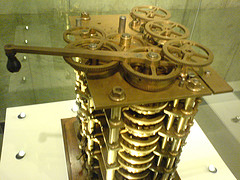
differenceA nice and accurate replica of Charles Babbage’s Difference Engine was built in California last year and is now on display at the Computer History Museum in Mountain View, CA.

Not newsworthy, but if you’ve never seen this machine in action, the short video is well worth a look. It’s fun to listen to it clatter, and to watch the helical patterns it makes.

National Public Radio did a story this morning:

The Difference Engine fills half a gallery and stands taller than most men. It’s 5 tons of cast iron, steel and bronze woven together from 8,000 distinct parts. Though it looks like it could be a sculpture, the machine is essentially a giant calculator. Tim Robinson, a docent at the museum, says it’s “the first automatic calculating machine.”

This engine — made from 162-year-old designs — doesn’t have a power pack; it has a hand crank. Robinson works up a sweat as he turns it. “As long as you keep turning that crank, it will produce entirely new results,” he says.

Most importantly, the machine produces accurate results. In Babbage’s time, England reigned over a vast global empire. To navigate the seas, captains used books filled with calculations — but these equations were all done by fallible human minds.

What if, indeed.

[Image: kalleboo]

David Brin: is America’s loss the world’s gain?

Marshall Plan propaganda posterY’know, I really like David Brin, even though I don’t always agree with what he says; he’s got a contrary stripe a mile wide, and he’s one of the few self-identifying conservative thinkers in science fiction who’s willing to break ranks with populism and call out the failings of his own side – something that is just as rare on the liberal side of the fence, IMHO.

Brin’s guest-blogging at Sentient Developments again, and his latest post is provocative reading, regardless of your personal politics. The thesis is roughly as follows: America may have spent itself into economic and political decline, but in doing so it leaves as its legacy a world lifted out of poverty thanks to the counter-mercantilist trade flows set up by the Marshall plan. [image by kafka4prez; orginal copyright status uncertain, so please contact for takedown if required]

You should go read the whole thing (there’s probably ten minutes worth of text there, so it’s one of his smaller rants), but here’s a few highlights for the impatient:

While Marshall crafted a historically unprecedented, receptively open trade policy called “counter-mercantilism” (I’ll explain in a minute), MacArthur vigorously pushed the creation of Japanese export-oriented industries, establishing the model of what was to come. Instead of doing what all other victorious conquerors had done – looting the defeated enemy — the clearly stated intention was for the United States to lift up their prostrate foe, first with direct aid. And then, over the longer term, with trade.

[…]

At the behest of Marshall and his advisors. America became the first pax-power in history to deliberately establish counter-mercantilist commerce flows. A trade regime that favored the manufactures of many foreign/poor countries over those in the homeland. Nations crippled by war, or by millennia of mismanagement, were allowed to maintain high tariffs, keeping out American manufactures, while sending shiploads from their own factories to the U.S., almost duty free.

Moreover, despite the ongoing political tussle of two political parties and sometimes noisy aggravation over ever-mounting deficits, each administration since Marshall’s time kept fealty with this compact — to such a degree that the world’s peoples by now simply take it for granted.

Forgetting all of history and ignoring the self-destructive behavior of other empires, we all have tended to assume that counter-mercantilist trade flows are somehow a natural state of affairs! But they aren’t. They are an invention, as unique and new and as American as the airplane, or the photocopier, or rock n’ roll.

[…]

Even if America is exhausted, worn out and a shadow of her former self, from having spent her way from world dominance into a chasm of debt, the U.S. does have something to show for it the last six decades.

A world saved. A majority of human beings lifted out of poverty. That task, far more prodigious than defeating fascism and communism or going to the moon, ought to be viewed with a little respect. And I suspect it will be, by future generations.

This should be contemplated, soberly, as other nations start to consider their time ahead as one of potential triumph. As they start to contemplate the possibility of becoming the next great pax or “central kingdom.”

If that happens — (as I portray in a coming novel) — will they emulate Marshall and Truman, by starting their bright era of world leadership with acts of thoughtful and truly farsighted wisdom? Perhaps even a little gratitude? Or at least by evading the mistakes that are written plain, across the pages of history, wherever countries briefly puffed and preened over their own importance, imagining that this must last forever?

I’m as guilty as the next man of casting American influence in a negative light, and Brin’s analysis provides an intriguing counterpoint to that nay-saying: an argument to the effect that history may remember that influence more positively than our proximity to it currently permits.

What do you think America will be remembered for in fifty years’ time? (And keep it cordial, folks; nation-bashing and racism will be deleted without hesitation, so keep a historical perspective, please.)