In a move that is somewhat unusual for a videogame column, I would like to ask you to consider not a game or a development in the gaming industry but a film… and not just any film, but an obscure art house film.
 Jaime Rosales’ The Hours of the Day (2003) (a.k.a. Las Horas Del Dia) tells the story of Abel. Abel lives with his mother and operates a decidedly unglamorous clothing shop in a run-down part of town. He has a low-intensity relationship with his girlfriend who wants them to move in together, he has a passive-aggressive relationship with his shop assistant who wants more severance pay than Abel can afford and he has a rather tense friendship with another man who wants him to invest in a marketing project.
Though these relationships dominate Abel’s life, he is distant from all of them; he bickers with his mother, he sabotages his girlfriend’s attempts to find them a flat and he ruins his best friend’s wedding day by casually revealing that the bride once made a pass at him. In all of his dealings, Abel comes across as weirdly detached and disconnected, as though the human world is somehow beyond his comprehension. This disconnection from every-day social reality makes Abel almost impossible to understand. We do not understand why he sabotages his relationships and we certainly do not understand the savage murders that Abel carries out seemingly at random throughout the film. Because Abel’s motivations are so completely impenetrable, it is remarkably difficult to extract anything resembling a human drama from the events depicted in The Hours of the Day. The film does not appear to be a comment upon unhealthy relationships or the absurdity of existence or even a portrait of one man’s descent into madness. It is simply a series of events presented in chronological order. Stuff happens. Continue reading Tell Your Own Damn Stories! Games, Overreading and Emergent Narrative →
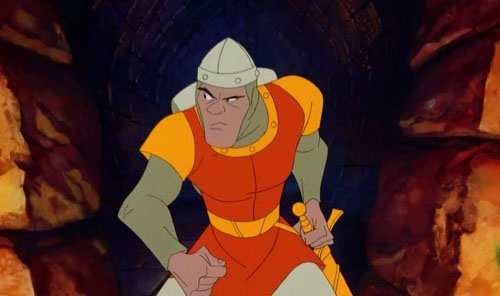 At a time when most video games were comprised of poorly animated coloured blocks, the cartoon imagery of Dragon’s Lair was ground-breaking. Here was a game that did not simply suborn the language and titles of films; it actually looked like a film too. The only problem was that when players fed their money into the machine, they soon discovered that they didn’t actually have control over the on-screen action.
  For example, if you are currently a teenager then the chances are that you would be most influenced by games like