Tag Archives: journalism

News cycle identified

lipstickonapSome glorious and fascinating reportage-porn at memetracker that shows how news stories are taken up and how long they last and what their impact is:

They found a consistent rhythm as stories rose into prominence and then fell off over just a few days, with a “heartbeat” pattern of handoffs between blogs and mainstream media. In mainstream media, they found, a story rises to prominence slowly then dies quickly; in the blogosphere, stories rise in popularity very quickly but then stay around longer, as discussion goes back and forth. Eventually though, almost every story is pushed aside by something newer.

There is something truly wonderful about seeing this information laid out in such an intuitive manner. This kind of analysis of the growth, spread, and retention of ideas is certainly an area that will expand and grow over time.

[via Physorg, from MemeTracker]

Does journalism need Arianna Huffington, or is it the other way round?

Doubtless you’ve already heard the hot new angle to the ongoing Death Of Journalism meme – Arianna Huffington of the Huffington Post blog (which is really way to big to be fairly labelled a blog any more, I think) has started a foundation to fund the ‘proper’ investigative journalism that has been so sorely lacking in recent years… with respect to, for example, the invasion liberation of oil-rich countries and the collapse of high-finance Ponzi schemes.

Jeff Jarvis sees this as a harbinger of things to come, suggesting that a small elite with money to spare will benevolently support investigative journalism for the benefit of all:

This, I believe, is how journalism will get money directly from readers—not through subscriptions, micropayments, and pay walls but from the generous contributions of the few who pay for efforts that benefit the many. That is the 1 percent rule behind Wikipedia: 1 percent of its readers write it. And that is how public broadcasting is supported today in the U.S. I can’t imagine the public wanting to pay to buoy the sinking Titanics of old-media failures; I don’t want to contribute to failed newspapers anymore than I want my tax money going to failed banks and auto companies. But I can imagine readers contributing to assure that government is watched.

Now, maybe I’ve just been over-trained to the cynical mindset of the science fictional thinker, but I’m really struggling to find any advantage in this idea by comparison to the status quo, above and beyond the fact that someone will be paying journalists to do something.

Nick Penniman, the fund’s executive director, vowed that the work produced through The Huffington Post Investigative Fund would be non-partisan. He said: “We care about democracy, not Democrats.”

Great institutions are built with the best of intentions… but once they become a system in their own right, they develop all the dark nooks and bolt-holes for corruption that their predecessors had. I honestly believe HuffPo cares about democracy, but that’s because the people running it still care. Time corrupts and disillusions us; systems and organisations expand, and idealism is diluted. The HuffPo foundation will still be an organisation with a pot of money that pays lumps of that money to journalists for what it considers to be good stories… which is different to newspapers how, exactly? Caesar hears what is pleasing unto Casear, after all… especially when he’s sitting on your paycheck.

Just to make it plain, I’m not throwing accusations of corruption, cynicism or partisanship toward anyone involved in what is evidently an admirable and philanthropic project. I’m merely suggesting that those things are emergent properties of any hierarchical system, and to imagine the same snowblindness that affects established ‘old media’ can be avoided simply by having one’s heart in the right place strikes me as a little naive.

Investigative journalism will always struggle while the majority of news consumers fail to realise how important it is; news consumers will only support investigative journalism financially when they can see tangible examples of it working directly for their benefit. So, I believe that foundations might be a solution, but only ones that are driven from the end-user level have even the remotest chance of not drifting onto someone’s party line.

Journalism doesn’t need the Huffington Post… but the top dogs of politically-focussed new media need the legitimacy of old-school journalism to cement their standing in the eyes of the politicians and their voters. Discuss.

What have cigarettes and climate change got in common?

burning cigarette tipWell, neither causes the other, for a start. But both the anti-smoking lobby and the climate change lobby have their moderates and their hard-liners. [image by Stewart]

For example, New Scientist reports on a schism in the anti-smoking field:

… Siegel has come under fire from colleagues in the field of smoking research. His offence was to post messages on the widely read mailing list Tobacco Policy Talk, in which he questioned one of the medical claims about passive smoking, as well as the wisdom of extreme measures such as outdoor smoking bans.

In front of his peers, funders and potential future employers, other contributors posted messages accusing Siegel of taking money from the tobacco industry. When Siegel stood his ground, the administrators kicked him off the list, cutting off a key source of news in his field. “It felt like I was excommunicated, says Siegel. “I was shocked: I’ve been a leader in the movement for 21 years.”

The similarities with climate change should be obvious, what with that scene also being full of people coming to a variety of conclusions based upon the same evidence. As with the smoking issues above, the end-result is a form of in-fighting, with the more moderate thinkers decrying the hard-liners for making the moderate view unpalatable by association – take climate ‘tipping points’, for example:

In reports released this month, both the World Bank and the United Nations Environment Program focused on tipping points as a prime concern. And last year, a team of European scientists published an influential paper in the Proceedings of the National Academy of Sciences compiling what is known and not known about various climatic tipping points — including the loss of summer sea ice around the North Pole and worrisome changes in the West African monsoon.

The authors said they wanted to reduce the chance that “society may be lulled into a false sense of security by smooth projections of global change.”

On the other hand, the United Nations Intergovernmental Panel on Climate Change, in its influential 2007 report, expressly avoided specifying tipping points and instead concluded simply that the gradient of risk for a host of “large-scale discontinuities” increased with each degree of warming.

[snip]

As policymakers try to address the risks facing the planet from a warming climate, some experts worry that focusing on tipping points and thresholds will perpetuate paralyzing debates over specifics — and obscure the reality that decisions need to be made, even in the face of uncertainty.

What this makes abundantly clear is that – as climate skeptics are always keen to point out – scientific consensus isn’t like a choir singing in unison from the same song-sheet. And nor should it be… but it makes things very confusing for the layman, as increasingly frantic (and often inaccurate) media coverage makes it progressively more difficult to see the wood from the trees. All the scientists quoted in the article above agree that climate change is real and that we must act in light of that prognosis; however, the different ways in which they choose to interpret and communicate that data make that commonality less obvious.

Perhaps I stand to be accused of credulity myself, but I’m of the opinion that the vast majority of scientists – even those who claim that climate change is not a threat – are acting sincerely on their own beliefs rather than shilling for commercial or political interests. Do scientists with extreme and/or entrenched viewpoints overstate the cases made by the available data? Almost certainly; listen to any conversation about sports or music to hear ordinary people doing exactly the same thing. But do those extreme interpretations invalidate the more moderate thinking of those whose conclusions they have built upon? Not for me, at least. YMMV.

Do newspapers have a future?

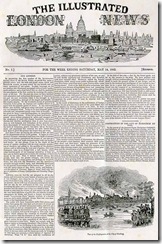
Illustrated_London_News_-_front_page_-_first_edition Newspapers are struggling everywhere; there have been a few posts on the subject here at Futurismic already. In Denver, the 150-year-old Rocky Mountain News recently ceased publication. The Seattle Post-Intelligencer has gone to an online-only version. And here in Canada, Canwest, which owns 13 daily and 26 community newspapers across the country, is so strapped for cash it’s ordered my own local newspaper, the Regina LeaderPost, to cut back on the work it doles out to freelancers. I should know, since my weekly science column, for which I was paid a paltry $25 a week, has been axed. Apparently the $1,300 a year that had been coming to me will make all the difference in stemming the tide of red ink. (I’m still writing the weekly column, by the way; it clings to life in a couple of smaller papers and you can read it on my blog or get it sent to you via email, if you’re interested.)

According to science writer Steven Johnson, however, speaking at the South By Southwest Interactive Festival in Austin, Texas, the lingering death-throes of newspapers will not spell the end of journalism. (Via PhysOrg.) Instead:

Steven Johnson equated newspapers to old growth forests, saying that under the canopy of that aged ecosystem blogging, citizen journalism, Twittering and other Internet-age information sharing is taking root.

“I’m bullish on the future of news,” Johnson said.

“I am not bullish on what is happening in the newspaper industry; it is ugly and it is going to get uglier. Great journalists are going to lose their jobs and cities are going to lose their newspapers.”

Johnson says the problem is that changes that should have happened over a decade are being crammed into a much shorter time frame, partly due to pressure for the global economic situation.  Johnson says the solution is to “stop killing trees” and “stop wasting information freely available online,” adding that “The business model sure seems easier to support if the printing goes away.” (Remember: it would be cheaper for the New York Times to give each of its subscribers a Kindle than to print the newspaper.) 

Johnson sees a future in which news weaves together the talents of professional journalists, bloggers, Facebookers and Twitterers. According to Johnson, the information mix will include direct online streams “such as webcasts from high-profile people such as US President Barack Obama.” (Forget webcasts, actually. Sounds like all you really need to do is hook his teleprompter up to stream his speeches in real-time to the ‘Net.)

Appropriately, Johnson has posted his entire speech on the topic to his own site.

International Data Group (IDG) chairman Patrick McGovern agrees; his company, which operated in 95 countries, owns some 450 publications, including PC World and InfoWorld, and many of them are only available online. “Print editions are yesterday’s news,” he says. “If it is news, people want to hear it as soon as they can.”

McGovern’s solution for newspapers? Drop print, and start on digging out hot local topics readers can’t find elsewhere:

“Find out the scandal in the mayor’s office; what the police are up to, and those other things that people love to talk about,” McGovern said. “It is easier and much less costly to put it online.”

McGovern believes people will pay monthly subscriptions for online newspapers that follow this model.

I’m a journalist by training and a former reporter, editor, photographer and cartoonist for a weekly newspaper. I’ve always loved newspapers. I don’t care about the medium of delivery; I just want them to survive. But I’m not sanguine about the willingness of readers to ante up, even for local content. Nor am I confident the people running the newspapers yet grasp that local dailies no longer need to cover national and international news to the extent they once did, and that their core product, their “killer app,” is local content.

The end of my newspaper column in Regina after almost two decades is proof enough of that.

Um, not that I’m bitter or anything.

(Image: FIrst edition of the Illustrated London News, May 14, 1842, via Wikimedia Commons.)

[tags]news, journalism, newspapers, media, Web[/tags]

Escaping the downward spiral of newspapers

printing pressYou know what they say about rats leaving sinking ships… but then again, you know what they say about rats being survivors. The sinking ship of newspapers is seeing a few of her passengers make a beeline for the portholes; now The Guardian has followed the lead of the New York Times and is opening itself up to the web with APIs rather than shutting the doors. [image by Baltimore City Paper, ironically enough]

As TechDirt points out, many Guardian staff are quite keen for competitors like the NYT to (as they keep threatening) start charging for access to content – because it would hand Teh Grauniad a naked advantage for no effort on their part.

That said, the NYT isn’t sitting on its hands:

“Paper is dying, but it’s just a device,” Bilton told Wired.com […] “Replacing it with pixels is a better experience.”

Bilton, a youthful technologist who programs mashups in his free time, is charged with inventing the future for the Gray Lady in an era of troubled times for newspapers. Fewer people are subscribing, classified ads are decamping for the internet and online revenues aren’t making up for lost print ads.

But Bilton envisions a world where news is freed from the confines of newsprint and becomes better.

It’s whether the shareholders and board of directors agree with him that counts, of course.

Also via TechDirt we see that Slate are using crowdsourced reportage (in this case photojournalism of Depression2.0, or whatever you prefer to call it) to lower costs and improve audience engagement at the same time. Contrary to the teeth-gnashing of industry pundits, newspapers aren’t going to die… but it’s clear the herd is going to be culled pretty seriously as it passes through the needle’s eye of technological and sociological pressure.

Unsurprisingly, younger members of the newpaper business believe that newspapers could save themselves by learning from the Silicon Valley approach – by embracing technology, change and way-out ideas rather than suppressing or ignoring them. They’d better move quickly, though.