Tag Archives: life

Should Mars be treated like a wildlife preserve?

MarsFinding life on Mars would be pretty awesome, right? Of course it would – but it would also mean we’d have to change the way we work on the red planet, because of the ethical can of worms presented by contaminating a whole new biosphere.

We’ve already contaminated it, though – all of our probes and landers are likely festooned with Earthside microbes. Now some planetary scientists recommend that, should life be found, we remove or destroy our Martian hardware and keep things pristine:

He warns that Earth life could be reawakened if weather conditions on the planet change. This could happen as a result of periodic swings in the planet’s tilt, or if humans purposely alter the Martian environment, which, ironically, they might do to make conditions cosier for any Martian life they might discover. Microbes on subsurface drills in search of liquid water could also contaminate potential Martian habitats.

Here’s Jamias Cascio’s response:

… if life is found, definitely. No question. If fossilized life is found, also definitely, since that could mean dormant life, waiting for a Mars Spring.

If there’s no evidence of past or present life found… the question becomes more difficult. I always kind of sympathized with the Reds over the Greens in Kim Stanley Robinson’s Mars trilogy, but I also believe that establishing a human foothold off of Earth is a wise long-term survival strategy.

Could we justify changing the Martian climate, knowing that — as with Earth — such changes are irreversible?

The answer to that will depend on circumstance, I guess; it’s worth considering that the sort of political climate that would lead to greater exploration of Mars might well be the sort of climate that produces colonial attitudes. And the colonial era was pretty big on resource exploitation… [image by chipdatajeffb]

What do you think – should Mars be preserved pristine?

Is there life on Mars? Atmospheric methane says ‘maybe’

MarsAfter last year’s long-awaited confirmed discovery of water on the red planet, David Bowie comes another step closer to finding the answer to his question: NASA called a press conference today to announce that they have, in partnership with some university science teams, “achieved the first definitive detection of methane in the atmosphere of Mars”.

So what’s the big deal with that? Basically, there’s two reasons you might find methane in a planetary atmosphere: geological activity or biological activity. It’s going to take a lot more work to discover which of the two is the culprit in the case of Mars (and the NASA announcement does a better job that I can of explaining it all), but either option is pretty exciting to space nerds… after all, it’s not all that long ago that we pretty much assumed the whole planet was inert.

And as a side-tangent, this is great political timing from NASA, whether accidental or deliberate – with a new president about to enter the White House with promises to shake things up, announcements like this get everybody talking about space with that old-school sensawunda I remember from my childhood… and given the bleak state of the news headlines at the moment, something to make us look up from the mundane for a moment can only be a positive. Something big to dream about. [image by chipdatajeffb]

I mean, just think – life on Mars! It’s like something out of a science fiction novel, isn’t it? šŸ˜‰

Equal rights for apes?

The Great Ape Project is a pressure group demanding a basic set of rights for hominids – and, as a side-effect, throwing up some questions about where the boundaries of rights for other living things should lie. [image by Frank Wouters]

Some countries already have legislation banning certain types of invasive experiments on apes, but GAP’s platform would also ban their exploitation for entertainment purposes as well as their use by profit-making ventures in general. After all, we wouldn’t allow a fellow human to be exploited (‘reality’ television shows notwithstanding – apparently people volunteer for those, and you can’t effectively legislate against stupidity).

Not everyone is keen on GAP’s rights-based approach, though, because it could lead to a moral ‘slippery slope’: once you’ve decided that apes need parity of rights, how can you then deny them to lesser mammals?

Activate asteroid defence shields!

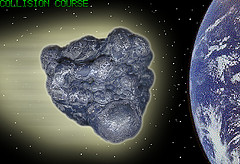
Earth-asteroid impactA lobby group of scientists have urged the United Nations to invest in a system for detecting near-Earth asteroids that could collide with the planet. We’ve got a lot of existential risks on our plate right now, of which being clobbered into a prehistoric state by a lump of space rock is just one – and a fairly remote possibility, thankfully. But it’s also one that we’d need every spare moment of advance warning to deal with… Bruce Willis will need time to put on a clean vest, if nothing else. Forewarned is forearmed, and all that. [image by goldenrectangle]

That said, space rocks striking planets might have their upsides… at least on currently uninhabited planets. A paper from a Japanese university suggests that meteorites colliding with Earth may have been the source of the amino acid groups that began the chain of life. Not quite as science fictional as panspermia, but still quite a mind-bending thought.

Mind bending discussion of life, the universe, and everything

The anthropic principle, arguably one of the most important intellectual topics of the 21st century, is explored in this intriguing article in Discover Magazine:

Physicists don’t like coincidences. They like even less the notion that life is somehow central to the universe, and yet recent discoveries are forcing them to confront that very idea.

Life, it seems, is not an incidental component of the universe, burped up out of a random chemical brew on a lonely planet to endure for a few fleeting ticks of the cosmic clock. In some strange sense, it appears that we are not adapted to the universe; the universe is adapted to us.

Call it a fluke, a mystery, a miracle. Or call it the biggest problem in physics. Short of invoking a benevolent creator, many physicists see only one possible explanation: Our universe may be but one of perhaps infinitely many universes in an inconceivably vast multiĀ­verse. Most of those universes are barren, but some, like ours, have conditions suitable for life.

[via Slashdot][image from RonAlmog on flickr]