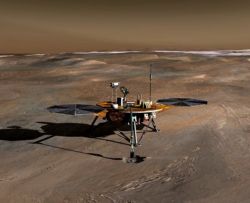
 OK, so we’re pretty positive about there being water on Mars now, but if you thought all was certainty in the realms of planetary exploration, you’d be wrong wrong wrong. [image courtesy NASA]
It’s all Aviation Week‘s fault, after they ran a story claiming that the White House had just been…
“… alerted by NASA about plans to make an announcement soon on major new Phoenix lander discoveries concerning the “potential for life” on Mars”.
As delightfully ambiguous as any pre-press-release announcement… and unsurprisingly (perhaps even as planned?) home-brew speculationists have been clogging the intertubes with theories about what NASA is (or was, or wasn’t) planning to announce.
So far, so unsurprising. Until you discover that the Phoenix lander itself* has announced that it definitely hasn’t discovered life and that there has been no such White House briefing. What gives?
Personally I suspect nothing more than the results of old-school media briefings and funky new methods (social-media-ZOMG!) getting a bit out of sync, but why spoil a potentially good conspiracy theory, eh? If you really want to burst that irrational bubble, Karl Schroeder has a pretty plausible explanation of what’s probably going on.
The recent discovery that the soil at the Phoenix lander site could support some earthly plants would appear to contradict the findings of the Viking landers from the 1970s. Those craft deployed sophisticated experiments to determine whether life is present on Mars, yet the instruments returned ambiguous results. There was a strong signal indicating life from some of the instruments, yet no evidence of biological material in the soil. The official interpretation that has become orthodoxy as a result, is that the Martian soil is highly oxidizing, ie. that it contains compounds such as hydrogen peroxide that destroy biological materials.
But if Phoenix has found that you could grow earthly plants in the soil at its site, doesn’t this cast serious doubt on that interpretation?
So, not so much “discovering life” as “possibly refuting a speculative negative interpretation of positive results gathered decades ago in support of the possibility of life”… but it doesn’t take a degree in journalism to see which of those two makes the better headline, AMIRITE?
[ * – Well, someone on the team, but you know what I mean. ]
 Scientists has discovered a new bacterial organism called desulforudis audaxviator that is an entirely self-sufficient ecosystem in and of itself, 2.8 km below the Earth’s surface the desulforudis audaxviator’s genome contains:
 The scientific community eagerly watches the progress as Pheonix lander scours Mars. They are hoping that there will be signs that there was once a supply of water on the planet that would give evidence that there may have once been life on the planet. Most scientists seem to conclude, though, that data from the Opportunity indicates that the water was a toxic mix of salty water and minerals that would have been unsuitable for Earth-like lifeforms. [photo courtesy