Tag Archives: media

Murdoch and the paywalls – charging for online tabloids

Oooh boy, I’m revving up my schadenfreude engines now, I tell ya. Rupert Murdoch, global tabloid media mogul, has seen the future of internet news – and it’s hidden behind paywalls.

Encouraged by booming online subscription revenues at the Wall Street Journal, the billionaire media mogul last night said that papers were going through an “epochal” debate over whether to charge. “That it is possible to charge for content on the web is obvious from the Wall Street Journal’s experience,” he said.

Asked whether he envisaged fees at his British papers such as the Times, the Sunday Times, the Sun and the News of the World, he replied: “We’re absolutely looking at that.” Taking questions on a conference call with reporters and analysts, he said that moves could begin “within the next 12 months‚” adding: “The current days of the internet will soon be over.”

“The current days of the internet will soon be over?” At least we now know where the tautological house style of Murdoch’s papers originates from… and, y’know, people pay for the Wall Street Journal because it actually contains some factual reporting and informed opinion pertinent to their careers or investments; I really don’t think people read The Sun for the same reason.

But please, Mr Murdoch, do go ahead with this bold entrepreneurial move. Anything that reduces the amount of crap your media empire spews into people’s eyes (and that hastens your potential destitution and bankruptcy – financial rather than moral, of course) is absolutely fine in my book.

Framing cloning – the media and genetic science

mannequin clonesCloning stories are like buses; you wait for ages, then three come along at once. This has been one of those weeks, it appears, with the tale of yet another outsider scientist claiming to have successfully cloned a human being taking the lion’s share of the spotlight. [image by antmoose]

New Scientist takes a look at the way self-styled pioneers like Zavos court media attention for their activities, and calls them out as – at best – manipulative and misleading:

It doesn’t help that the latest coverage includes a picture of a little girl killed in a car crash – and whose cells were cloned through hybridisation purely for study – alongside a headline in the paper describing her as “The little girl who could ‘live’ again”.

This perpetuates the cruel myth and widespread misconception that cloning is a way of raising the dead. In fact, if it worked, it would simply be a way of creating an identical twin of whoever was cloned, but separated in time.

To some extent, science fiction can be blamed for misconceptions about cloning. The more serious and thoughtful books on the subject have been somewhat overshadowed by sensationalist TV and movie plots or the technophobia of writers in the Michael Crichton mould.

But that’s not for want of the facts being available; as the known sf geek in my local social circle, people ask me about topics like cloning quite a bit, and I try to give them the most realistic overview of the topic I can. It rarely works. The truth is not as compelling a story as a rogue-science thriller or a riff plucked out on the heart-strings. Perhaps I’m just not a good enough storyteller.

But hey – at least we get some cute headlines alongside the shock-horror stories and emotional grandstanding of hucksters. Look – glow-in-the-dark puppies!

All together now: aaaawwwww!

The other side of Dubai

Last week I linked to a lengthy article on Dubai that didn’t paint it in an attractive light at all; it was pointed out in the comments (not to mention in many other places around the web) that said article was a bit of a hatchet job.

Via BoingBoing (from whom came the original story) comes a response from Joi Ito, a recent arrival in Dubai:

I’m still new to the region so I can’t speak definitively as a native, but I do know that the picture that is sketched is pretty biased and I think could be rightly called “bashing”. As far as I can tell there is a crunch going on, just like everywhere else, and the government and businesses are trying to figure out what to keep and what to shut down. There are a lot of solid businesses and a lot of solid business people in Dubai and like anywhere else, consolidation and downsizing is taking its toll.

[…]

I don’t want to sound too defensive about Dubai or the Middle East in general, but one thing I’ve learned from my still brief time is that it’s much more complicated than it appears. Just calling Muslim law and governance “medieval” and writing it off is ignorant. It’s very different and isn’t in sync with what many of us might think is “fair”. They treat bounced checks and drug smuggling very seriously. Moving to the Middle East casually and assuming that everything should be just like home is dangerous and I wouldn’t recommend it. However, I knew about the drug thing even before I visited and I learned about the “bounced checks land you in jail” thing on my first day.

He’s got some important points there; current media coverage is definitely playing to the backlash against conspicuous consumption and weird financial doings. I lived in Saudi Arabia for three years when I was a kid, and that part of the world operates very differently to the West – culturally, religiously and politically. It’s probably not fair for us to judge entirely based on our own standards.

That said, I don’t think it’s entirely out of line to point out that Dubai is still a very weird set-up indeed, and will quite possibly become an emblem of the attitudes and approaches that led us to our current economic situation.

Climate change: Can’t the media do better than this?

george-willChris Mooney, author of the forthcoming Unscientific America, asks:

Can we ever know, on any contentious or politicized topic, how to recognize the real conclusions of science and how to distinguish them from scientific-sounding spin or misinformation?

Congress will soon consider global-warming legislation, and the debate comes as contradictory claims about climate science abound. Partisans of this issue often wield vastly different facts and sometimes seem to even live in different realities.

In this context, finding common ground will be very difficult. Perhaps the only hope involves taking a stand for a breed of journalism and commentary that is not permitted to simply say anything; that is constrained by standards of evidence, rigor and reproducibility that are similar to the canons of modern science itself.

He’s looking at George Will (there’s a link to his column if you want to follow it):

Will wrote [among other things] that “according to the University of Illinois’ Arctic Climate Research Center, global sea ice levels now equal those of 1979.” It turns out to be a relatively meaningless comparison, though the Arctic Climate Research Center has clarified that global sea ice extent was “1.34 million sq. km less in February 2009 than in February 1979.” Again, though, there’s a bigger issue: Will’s focus on “global” sea ice at two arbitrarily selected points of time is a distraction. Scientists pay heed to long-term trends in sea ice, not snapshots in a noisy system. And while they expect global warming to reduce summer Arctic sea ice, the global picture is a more complicated matter; it’s not as clear what ought to happen in the Southern Hemisphere. But summer Arctic sea ice is indeed trending downward, in line with climatologists’ expectations — according to the Arctic Climate Research Center.

Mooney ends with a tall order:

Readers and commentators must learn to share some practices with scientists — following up on sources, taking scientific knowledge seriously rather than cherry-picking misleading bits of information, and applying critical thinking to the weighing of evidence. That, in the end, is all that good science really is. It’s also what good journalism and commentary alike must strive to be — now more than ever.

[George Will picture: Wikimedia Commons]

Along the same lines, now that a volcano in Alaska is spewed smoke and ash at least five times in the last day or so, shouldn’t Gov. Jindal feel dumb about mocking volcano monitoring as wasteful spending?

Do newspapers have a future?

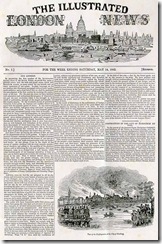
Illustrated_London_News_-_front_page_-_first_edition Newspapers are struggling everywhere; there have been a few posts on the subject here at Futurismic already. In Denver, the 150-year-old Rocky Mountain News recently ceased publication. The Seattle Post-Intelligencer has gone to an online-only version. And here in Canada, Canwest, which owns 13 daily and 26 community newspapers across the country, is so strapped for cash it’s ordered my own local newspaper, the Regina LeaderPost, to cut back on the work it doles out to freelancers. I should know, since my weekly science column, for which I was paid a paltry $25 a week, has been axed. Apparently the $1,300 a year that had been coming to me will make all the difference in stemming the tide of red ink. (I’m still writing the weekly column, by the way; it clings to life in a couple of smaller papers and you can read it on my blog or get it sent to you via email, if you’re interested.)

According to science writer Steven Johnson, however, speaking at the South By Southwest Interactive Festival in Austin, Texas, the lingering death-throes of newspapers will not spell the end of journalism. (Via PhysOrg.) Instead:

Steven Johnson equated newspapers to old growth forests, saying that under the canopy of that aged ecosystem blogging, citizen journalism, Twittering and other Internet-age information sharing is taking root.

“I’m bullish on the future of news,” Johnson said.

“I am not bullish on what is happening in the newspaper industry; it is ugly and it is going to get uglier. Great journalists are going to lose their jobs and cities are going to lose their newspapers.”

Johnson says the problem is that changes that should have happened over a decade are being crammed into a much shorter time frame, partly due to pressure for the global economic situation.  Johnson says the solution is to “stop killing trees” and “stop wasting information freely available online,” adding that “The business model sure seems easier to support if the printing goes away.” (Remember: it would be cheaper for the New York Times to give each of its subscribers a Kindle than to print the newspaper.) 

Johnson sees a future in which news weaves together the talents of professional journalists, bloggers, Facebookers and Twitterers. According to Johnson, the information mix will include direct online streams “such as webcasts from high-profile people such as US President Barack Obama.” (Forget webcasts, actually. Sounds like all you really need to do is hook his teleprompter up to stream his speeches in real-time to the ‘Net.)

Appropriately, Johnson has posted his entire speech on the topic to his own site.

International Data Group (IDG) chairman Patrick McGovern agrees; his company, which operated in 95 countries, owns some 450 publications, including PC World and InfoWorld, and many of them are only available online. “Print editions are yesterday’s news,” he says. “If it is news, people want to hear it as soon as they can.”

McGovern’s solution for newspapers? Drop print, and start on digging out hot local topics readers can’t find elsewhere:

“Find out the scandal in the mayor’s office; what the police are up to, and those other things that people love to talk about,” McGovern said. “It is easier and much less costly to put it online.”

McGovern believes people will pay monthly subscriptions for online newspapers that follow this model.

I’m a journalist by training and a former reporter, editor, photographer and cartoonist for a weekly newspaper. I’ve always loved newspapers. I don’t care about the medium of delivery; I just want them to survive. But I’m not sanguine about the willingness of readers to ante up, even for local content. Nor am I confident the people running the newspapers yet grasp that local dailies no longer need to cover national and international news to the extent they once did, and that their core product, their “killer app,” is local content.

The end of my newspaper column in Regina after almost two decades is proof enough of that.

Um, not that I’m bitter or anything.

(Image: FIrst edition of the Illustrated London News, May 14, 1842, via Wikimedia Commons.)

[tags]news, journalism, newspapers, media, Web[/tags]