Tag Archives: media

Maybe the media isn’t doing such a great job covering global warming

beckLiverpool media researcher Neil Gavin doesn’t think so.

Our research suggests that the media is not treating these issues with the seriousness that scientists would say they deserve. The research company lpsos-MORI found that 50% of people think the jury is still out on the causes of global warming. The limited amount of media coverage – which tends to be restricted to the broadsheets – means that this statistic is unlikely to alter in the short-term.

Bit of a rant: Isn’t “climate change” just a weasel term for global warming? And, regrettable thouhg it is to see newspapers dying, could it be that one reason is that they’re not doing a very good job?

[Image: Fox News host Glenn Beck in 2007 (his low-rated show was on CNN then) by The Rocketeer]

Hype and headlines: looking beyond the abstract

immigration hate-hype in a UK tabloid newspaperWe try our best here at Futurismic to look beyond the sensational aspects of the news and dig into the real implications. Over at his place, Charlie Stross dissects the latest alcohol and cancer risk stories as covered in the mainstream media, and points out why it’s important to do so:

Alas, the Journal of the National Cancer Institute keeps the actual text behind a paywall; which makes it hard for me to check this takedown by Junkfood Science. However, I feel the need to quote two chunks of that post (which you really ought to read):

… there was no dose response between the number of drinks the women consumed and their risk for all cancers. Women drinking no alcohol at all had higher incidences for all cancers than 95% of the drinking women. The actual incidents of all cancers was 5.7% among the nondrinkers. The cancer incidents were lower among the women drinking up to 15 drinks a week: 5.2% among those consuming ≤2 drinks/week; 5.2% of those drinking 3-6 drinks/week; and 5.3% among those drinking 7-14 drinks a week. [Table 1.]

In other words, women drinking as many as two drinks a day were associated with lower actual incidences of all cancers compared with the nondrinkers.

In other words, the abstract of the paper was radically at odds with the substance of the study’s findings.

In other words, good news doesn’t sell newspapers… nor say what certain groups may want us to hear.

One can’t help but wonder how much of this is to do with the way the state funds scientific research; Ceaser hears what is pleasing unto Ceaser, AMIRITE? I’m guessing a lab or body that consistently finds results opposite to the ones desired isn’t going to get so many gigs offered to it further down the line… which isn’t to accuse scientists of lying so much as to accuse the bureaucracy that surrounds science of making concessions to external forces. [image by secretlondon123]

But then I wonder if I’m slipping into the conspiracist paranoia of my youth again. Who can we trust to tell us truth? Does the new multiplicity of news sources with different ideological filters make this problem smaller or larger?

Genre and storytelling in video games

This month in Blasphemous Geometries, Jonathan McCalmont takes a look at the roles of genre narratives and storytelling in the still-young media of computer and video games, questioning the received wisdom that that the form has matured noticeably from is simple puzzle-solving and goal-reaching roots.

Blasphemous Geometries by Jonathan McCalmont

###

We exist in a world of brands. These days you can watch a film, read a book or comic, play a game, drink a cup of coffee and even have sex without ever leaving the vice-like economic grip of your favourite brand. As the darling of the monstrous cultural artefacts that are summer blockbusters, science fiction is at the cutting edge of what Media Studies theorists call Remediation.

Remediation is the idea that, rather than existing along a fixed technological time-line with new forms emerging fully-formed from new technology, new forms of media are produced via a process of back-and-forth between new technology and older mediums. As video game designers draw more and more hungrily upon literary and cinematic works of science fiction, it is important to think about what the process of remediation does to these works and how the process might be improved. Continue reading Genre and storytelling in video games

Stephen King, Amazon’s Kindle and the death of publishing as we know it

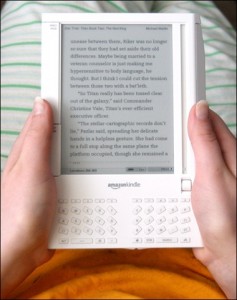
Amazon Kindle ebook readerWe’ve been mentioning ebooks a lot lately here at Futurismic, as the big publishing companies have suddenly woken up to the fact that the 21st Century has well and truly arrived… and isn’t going to go away.

One can look at the ebook as a way for the publishers to move away from the increasingly expensive and wasteful dead-tree model and reinvigorate themselves in the process. But there is a flipside, of course, as pointed out by The Guardian‘s Naomi Alderman:

if ebook readers took off, big-name authors such as [Stephen] King may be able to move to self-publishing. And that could mean the end of our current publishing system. Because of the way the publishing business is structured, big-name authors who sell millions of books are, in effect, supporting the industry. I’ve heard various estimates of the percentage of books that actually turn a profit. One agent I spoke to said 95% of published books make a loss. Others have put the figure lower. Either way, everyone agrees that a large majority of profits come from a small minority of authors.

If King, Dan Brown, JK Rowling and Patricia Cornwell were all to decide to move to selling their books online themselves, rather than going through a publisher, they’d certainly benefit financially. Typically, an author only receives about £1 for every copy of their book sold. Rather than relying on a publisher, big-name authors could afford to simply employ an editor, a PR person, a typesetter and a designer. They could price their books at only £2 or £3 and still make much more money than under the current system.

There’s obviously a few flaws in Alderman’s reasoning here: first of all she’s discounting the nurturing aspect of the publishing industry, its ability to bring the next generation of Kings, Cornwells and (universe forfend) Browns up through the ranks; secondly, a shift to ebooks should see the loss margins on a title by a smaller author drop considerably, as there’ll be no massive pile of unsold books to pulp (not to mention much smaller distribution costs).

But what is plain is that book publishing needs to learn in adavance from the messy lessons that the record companies are still struggling with now. A look at the music industry blogs will show you that Alderman’s speculation above is an almost perfect mirror of what’s already happening with middle-band musicians as they (and their fanbase) realise the labels are primarily concerned with wringing the last few drops of profit out of a dead business model, and decide to leave them behind.

As has been pointed out before, the principle difference between the publishers and the record labels is that publishers haven’t yet been forced to innovate by the pressures of piracy. It looks as if they’d be wise to jump ship and start swimming for shore right now, rather than waiting to be made to walk the plank. [Image coutesy Wikimedia Commons]