Tag Archives: media

Open-source DRM? WTF?

If there are two concepts in the computing world that could be more antithetical than Open Source and Digital Rights Management, I can’t imagine what they might be[1]. But it’s real: an outfit called Marlin say they’re ready to take on the software behemoths with DRM systems that “works in a way that doesn’t hold consumers hostage [… and] allows you to protect and share content in the home, in a way that people own the content, not the devices.”

Well, bravo to them for making the effort. I give it a maximum of two weeks of the system being out ‘in the wild’ before someone cracks it open like a seasonal hazelnut.

[ 1 – Unless you count ‘Apple’ and ‘Value For Money’, I guess… 😉 ]

A Brief History of the Twenty-first Century

Chuck Klosterman tells all. Snip:

JUNE 11, 2041: In a matter of weeks, the entire Internet is replaced by “news blow,” a granular microbe that allows information to be snorted, injected, or smoked. Data can now be synthesized into a water-soluble powder and absorbed directly into the cranial bloodstream, providing users with an instantaneous visual portrait of whatever information they are interested in consuming. (Sadly, this tends to be slow-motion images of minor celebrities going to the bathroom.) Now irrelevant, an ocean of Web pioneers lament the evolution. “What about the craft?” they ask no one in particular. “What about the inherent human pleasure of moving one’s mouse across a hyperlink, not knowing what a simple click might teach you? Whatever happened to ironic thirty-word capsule reviews about marginally popular TV shows? Have we lost this forever?” “You just don’t get new media,” respond the news-blowers. “You just don’t get it.”

[2005 map of the Internet by matthewjethall]

More political science: Misinformation keeps on working

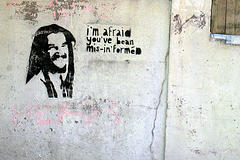
misinformedA body of studies promises to explain a lot. In politics, people are willing to believe misinformation that reinforces their beliefs. And correcting misinformation sometimes seems to reinforce it.  Examples exist from both major U.S. parties, so let’s pick on the Democrats for a change:

[Yale poli-scientist John] Bullock found a similar effect when it came to misinformation about abuses at the U.S. detention facility at Guantanamo Bay, Cuba. Volunteers were shown a Newsweek report that suggested a Koran had been flushed down a toilet, followed by a retraction by the magazine. Where 56 percent of Democrats had disapproved of detainee treatment before they were misinformed about the Koran incident, 78 percent disapproved afterward. Upon hearing the refutation, Democratic disapproval dropped back only to 68 percent — showing that misinformation continued to affect the attitudes of Democrats even after they knew the information was false.

[story tip: dday; image: Glutnix]

Looking back on 9/11

911-memorialImagine trying to exit a burning building.

Based upon conversations with the WTC survivors, researchers from the Universities of Greenwich, Ulster and Liverpool concluded that more than half of them delayed evacuating because they wanted to gather information about what was happening; those intent on getting more info about the attacks before exiting took between 1.5 and 2.6 times longer to begin evacuating than others; and congestion in stairways was the main cause of delay in getting out, even though the towers were less than one-third occupied that day.

Also: Al-Qaeda HQ has harsh words for AQ in Iraq:

Taken in context, Zawahiri’s latest memos seem to indicate that al-Qaeda’s oft-cited “central front” is a persistent if increasingly difficult management challenge for the movement’s front office.

And some angry leftist observes:

Aside from everything else, 9/11 was the day our mainstream news people promised they’d stop focusing on the trivial.

Oh well.

[Bayonne, NJ 9/11 memorial, Sister72]

It’s here, just not evenly distributed…

When I imagine what life will be like in ten, twenty, or thirty years time one of the few things I’m pretty certain of is that every flat surface will eventually turn into a video screen of some kind (and will probably be used to advertise stuff).

And here we have an early example of this trend from Esquire magazine:

To commemorate Esquire’s 75th Anniversary, we have published an experimental limited-edition of the October 2008 issue that features something called electronic ink, with moving words and flashing images … It is available at some major bookstores and newsstands.

The most elegantly-described science fictional use of electronic ink-like display technologies that comes to mind are the “mediatrons” in Neal Stephenson’s Diamond Age. Described here:

…a thin film of nanobar coupled with a layer of rod-logic nanocomputers and light filters to produce a flexible graphic displayer in the form of a piece of paper, a poster or even wallpaper. Cheap and plentiful, with a higher pixel-count than the human can resolve…

According to the information provided by Esquire we’re not at this stage yet, with the whole setup requiring elaborate arrangements to manufacture.

A helpful individual has created a flickr set showing detailed photographs and detailed video of the limited edition magazine.

[via Slashdot]