Tag Archives: medicine

First artificial organelle

artificial_organelleResearchers have developed an artificial cellular organelle to aid in the development of artificial synthesis the life-saving anti-clotting drug heparin:

Scientists have been working to create a synthetic version of the medication, because the current production method leaves it susceptible to contamination–in 2008, such an incident was responsible for killing scores of people. But the drug has proven incredibly difficult to create in a lab.

Much of the mystery of heparin production stems from the site of its natural synthesis: a cellular organelle called the Golgi apparatus, which processes and packages proteins for transport out of the cell, decorating the proteins with sugars to make glycoproteins. Precisely how it does this has eluded generations of scientists.

To better understand what was going on inside the Golgi, Linhardt and his colleagues decided to create their own version. The result: the first known artificial cell organelle, a small microfluidics chip that mimics some of the Golgi’s actions.

As well as the utility of being able to produce drugs in this way, it is impressive the degree of control that can be exerted over the matter:

The digital device allows the researchers to control the movement of a single microscopic droplet while they add enzymes and sugars, split droplets apart, and slowly build a molecule chain like heparin.

[from Technology Review, via KurzwailAI][image from Technology Review]

A cure for radiation sickness?

radioactive materials hazard signHey, great news! A group of researchers have discovered a medicine that can alleviate the damaging effects of radiation sickness… at least in mice and monkeys:

The first series of tests included experiments on more than 650 monkeys. Each test featured two groups of monkeys exposed to radiation, but only one group was given the medication. The radiation dosage was equal to the highest dosage sustained by humans as result of the Chernobyl mishap.

The experiment’s results were dramatic: 70% of the monkeys that did not receive the cure died, while the ones that survived suffered from the various maladies associated with lethal nuclear radiation. However, the group that did receive the anti-radiation shot saw almost all monkeys survive, most of them without any side-effects. The tests showed that injecting the medication between 24 hours before the exposure to 72 hours following the exposure achieves similar results.

Isn’t that brilliant news? Think of all the great things we could achieve if we could prevent radiation from damaging the human body! As its lead hook, Ynetnews gleefully trumpets about the geopolitical edge that this medicine will give to Israel in dealing with their ongoing paranoia about uppity Muslims with nuclear weapons, but follows with a more broadly humanitarian application:

Gudkov’s discovery may also have immense implications for cancer patients by enabling doctors to better protect patients against radiation. Should the new medication enable cancer patients to be treated with more powerful radiation, our ability to fight the disease could greatly improve.

Think also of clean-up operations in locations with similar problems to Chernobyl, or time spent in space beyond the Earth’s handy and life-saving magnetosphere. The list of places that people can’t go just got shorter. [via SlashDot; image by 7263255]

Long lived flies

flyA company called Genescient is developing a method for finding genes that affect human longevity using the power of the gene:

Genescient has identified over 100 gene networks (∆’s) that are altered in long lived strains of Drosophila melanogaster and that are also linked to longevity and age-related diseases in humans.

Genescient has sophisticated software that cross links gene function in Drosophila with possible human therapeutics for age-related diseases. Drosophila is an excellent model system of aging and age-related disease that has many genetic pathways that are highly conserved in humans. Therefore, therapeutic substances that act on genetic pathways in Drosophila often work similarly in humans.

It is truly exciting to live in this era when increasing human longevity is a serious area of research.

[via Next Big Future][image from AmpamukA on flickr]

Vein-crawling robot insect

vein crawling robotFeeling tiny insects crawling through your veins sounds like some sort of Burroughs-esque junk withdrawal nightmare (and with good reason), but Israeli scientists are hoping that a millimetre-diameter robotic bug could be used to diagnose and treat artery blockages and cancer in human patients without the need for major invasive surgery:
The little robot – with a diameter of just one millimeter – has neither engine nor onboard controls, instead being propelled forward by a magnetic field wielded on it from outside the patient’s body.

Controlling the tiny bot externally means boffins have been able to shrink it to a previously impossibly tiny scale […]

Scientists reckon the mini bot can even withstand massive blood flow and is able to push forward regardless of the magnetic field actuation direction, doing away with any need for exact localisation and direction retrieval.

A controller can move the little crawly creature in increments, with its speed of up to nine millimeters a second regulated by varying external magnetic field frequencies. Outside control also means the robot can be made to work for an unlimited amount of time, rather than suddenly – not to mention inconveniently – keeling over to die of battery failure in the middle of a medical procedure.

Promising… but still pretty freaky. You can thank regular reader and commenter Robert Koslover for grossing you out with this one. [image borrowed from linked article]

Celebrity skin?

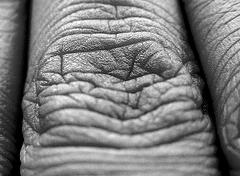
wrinkled skinGot epidermis? Researchers at the Fraunhofer Institute in Germany sure have – they’ve developed an automated system for producing two-layer artificial skin at a commercial scale:

The process starts with small pieces of skin, which are sterilised and then cut into pieces, modified with enzymes and isolated into two cell fractions. These are then grown separately on cell culture surfaces, before being combined into a two-layer sheet. The whole process takes about three weeks.

The flexible lower layer gives the tissue natural elasticity, but two-layer skins have until now been too expensive to mass produce.

The synthetic skins currently available are eventually rejected by the human body because they don’t contain blood vessels. Jörg Saxler, Fraunhofer’s technology manager, told Wired.co.uk that they have created skin with blood vessels using pig cells, and are working on a fully synthetic version.

Obviously the first take-up of this stuff will be medical in nature – grafts for burn victims, so on and so forth. But once it gets cheaper, the street will find its own use for the same technology. First up will be rough-and-ready elective cosmetic grafts: replace your aged original skin, or maybe go patchwork with different shades and levels of melanin!

But some sort of generic off-the-shelf skin won’t be sufficient for the glitterati. Will we be able to buy celebrity-endorsed brands and strains of skin? Will famous models and musicians have their skin cloned as the ultimate high-price catalogue-cap of their personal clothing labels? Will you be able to literally wear Armani or Hugo Boss or 50-Cent? [image by /charlene]