Tag Archives: medicine

My heart no longer beats

HeartMateIIPhysicians have successfully implanted an artificial heart that does not beat:

Salina Mohamed So’ot has no pulse. But she is very much alive.

The 30-year-old administrative assistant is the first recipient here to get a new artificial heart that pumps blood continuously, the reason why there are no beats on her wrist.

An interesting development. I wonder if the efficiency and reliability of such artificial hearts will ever be such that people elect to replace their existing hearts with them even before their biological hearts wear out?

[via Slashdot, from The Straits Times][image from on Technology Review]

Medical insurers impressed by electronic smoker detector

cigarette buttsNot, that’s not a typo. A team of Australian scientists have built a device that can identify tobacco smokers without the need for bodily fluid samples:

[They] tweaked a commercially available e-nose so that it would detect the volatile organic compounds (VOCs) in the breath of a person who had smoked a cigarette.

The e-nose uses an array of 32 sensors whose electrical resistance changes as different VOCs are detected. The resultant “smellprint” correctly identified 37 out of 39 volunteers as either smokers or non-smokers.

Obviously the insurance companies are pretty interested in this little development – it would allow them to weed out those smokers who try to keep their premiums down by concealing their habit. There’s no news yet on devices that can detect the “pre-existing condition” of domestic abuse, though. [image by Saudi…]

Your Warren Ellis moment for the week: snorting stem cells

Medical boffins looking for the best way to deliver therapeutic stem cell treatments to the brain have come up with something that sounds like a Spider Jerusalem habit: snorting stem cells into the nose like cheap speed.

Other options all have their drawbacks. Drilling through the skull and injecting the stem cells is painful and carries some risks. You can also inject them into the bloodstream but only a fraction reach their target due to the blood-brain barrier.

The nose, however, might be a viable alternative. In the upper reaches of the nasal cavity lies the cribriform plate, a bony roof that separates the nose from the brain. It is perforated with pin-size holes, which are plugged with nerve fibres and other connective tissue. Since proteins, bacteria and viruses can enter the brain this way, Lusine Danielyan at the University Hospital of Tübingen in Germany, and her colleagues, wondered if stem cells would also migrate into the brain through the cribriform plate.

[…]

When the researchers pre-treated the nasal membrane of the mice with an enzyme called hyaluronidase to loosen the junctions between epithelial cells, even more stem cells entered the brain through the nose.

Other researchers have shown that you can also deliver therapeutic proteins such as neural growth factor into the brain in this way. If the results of this study can be repeated in humans, snorting stem cells might be a way of getting large numbers of cells into the brain without surgery. Repeated doses could also be given in the form of nasal drops.

I seem to remember a band of musicians in William Gibson’s Bridge trilogy who injected fetal tissue for kicks; snorting it would have been just that little bit more rock’n’roll, don’t you think?

Utility-belt artificial kidney module

OK, so it actually takes up the entire belt at the moment… but given a few more years of miniaturization the Wearable Artificial Kidney could end up no bigger than the holster for your cellphone:

A miniaturized dialysis machine that can be worn as a belt, the WAK concept allows patients with end stage renal failure the freedom to engage in daily activity while undergoing uninterrupted dialysis treatment.
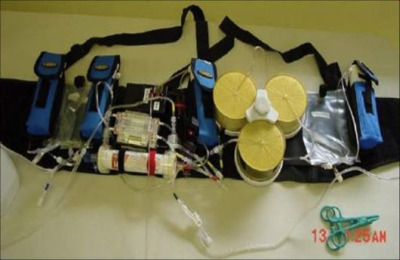
Wearable Artificial Kidney

Worn as a belt, the device weighs just ten pounds (4.5kg), including the two nine-volt batteries that power it. The compact design, unlike conventional dialysis machines, will leave patients free to engage in the activities that normal kidney function would ordinarily allow them to enjoy. Walking, working and riding a bike can all be actively pursued without restriction while undergoing gentle, uninterrupted treatment 24 hours a day, seven days a week.

This really brings home the rapidity of progress for me; a teacher at my secondary school used to have to undergo dialysis treatment for kidney failure, and once a year he’d do a show-and-tell with the machine, which was roughly the size of a three-drawer filing cabinet. That was back in 1992… he was a PE teacher, too – no quitter, this guy – so he’d have loved the idea of the WAK.

How many more organs might we be able to replace with belt-worn machines? They’re probably not an ideal long-term solution, but this technology might keep people alive and active during the long wait for suitable transplant organs to come available. Or perhaps we’ll just go the route of the Mechanists – why wait for a biological organ if you can swap it out for a mechanical device that offers a greater degree of control? [image borrowed from linked article]