Tag Archives: narrative

Shock: re-engineering science fiction, socially, as an RPG?

Damien G Walter has discovered something that sounds very interesting indeed: Shock, a ‘social science fiction’ roleplaying game. Go to the linked site for the full low-down, but for now, Walter explains:

Shock is a framework that has its players improvise science fiction scenarios based on the interactions and conflicts of certain Issues (slavery, imperialism etc etc) and Shocks (replicants, mind transfer) and Minutia. Or in other words, the gamut of tropes drawn from more than a century of science fiction.

[…]

As i read the handbook Shock is making me think some things. It is making me think that science fiction is powered by a small number of essential processes, and Shock does a good job of pinpointing what they are. It also makes me think that if we can accurately describe the meta framework of science fiction this way, then the task for science fiction writers is not to keep filling that framework with more stuff, but to start reengineering the framework itself. Don’t keep churning the same old products out of the factory. Don’t even build a new factory. Conceptualise a whole new manufacturing process and see what it produces.

Further unpacking of that last paragraph occurs here:

when we talk about innovation and experimentation, and about moving the SF genre forward, what we tend to mean is inventing new Shocks and exploring new Issues, or using old Shocks to explore new Issues or vice versa. So in Metropolis the Robot shock is used to explore the dehumanising process of industrialisation. A few decades later Philip K Dick uses the same shock to explore human empathy. Or Vernor Vinge describes the Singularity and introduces a brand new shock which a host of other writers then adapt to different uses. And in such ways does the genre advance.

Definite echoes of Superstruct, there… not to mention a new way (or at least a new old way) of thinking about tropes and premises and characters in the context of the genre. Anyone in the audience know anything more about this game?

Did the Iranian “Twitter Revolution” actually happen?

You know, I’m always advising people not to believe everything they read, but I’m just as bad at doing it as anyone else – we all give credence to the stories we want to believe, I guess (and hell knows that media companies know how to exploit that).

So, remember the Twitter Revolution in Iran? That there was a revolution is not in question, but that the revolution was powered by social media? That’s not so clear [via MetaFilter]:

… it is time to get Twitter’s role in the events in Iran right. Simply put: There was no Twitter Revolution inside Iran. As Mehdi Yahyanejad, the manager of “Balatarin,” one of the Internet’s most popular Farsi-language websites, told the Washington Post last June, Twitter’s impact inside Iran is nil. “Here [in the United States], there is lots of buzz,” he said. “But once you look, you see most of it are Americans tweeting among themselves.”

A number of opposition activists have told me they used text messages, email, and blog posts to publicize protest actions. However, good old-fashioned word of mouth was by far the most influential medium used to shape the postelection opposition activity. There is still a lively discussion happening on Facebook about how the activists spread information, but Twitter was definitely not a major communications tool for activists on the ground in Iran.

[…]

To be clear: It’s not that Twitter publicists of the Iranian protests haven’t played a role in the events of the past year. They have. It’s just not been the outsized role it’s often been made out to be. And ultimately, that’s been a terrible injustice to the Iranians who have made real, not remote or virtual, sacrifices in pursuit of justice.

I’m starting to wonder if a faith in the hierarchy-corrosion of modern communications systems isn’t becoming a core plank of what, for want of a less contentious or partisan label, we might call the postmodern progressive liberal platform. Maybe because we feel ourselves to have been liberated from something by the internet (even though we’re not sure what it is that we’ve been liberated from), we think that it can deliver liberation to others from things that are far more oppressive and powerful (at least at the level of curtailment of individual freedoms) than we have the context and experience to understand? That political revolution can be as safe, easy (and fun!) as our spare time whiled away on social media? (See also: the illusion of participation produced by slacktivism.)

Or maybe it’s just old-fashioned and fallacious Golden Age pulp technophilia: “Twitter is the future! The future is something we progress toward! Democracy in Iran would be progress! Therefore Twitter will help create progress toward democracy in Iran!”

I’m having a weird week; I’ve been spending a lot of time thinking about how we make pretty much everything into a story that reflects what we already believe to be true. The trouble with dwelling on that for a while is that you reach a point where you realise that, if that assumption is true, then that assumption is also part of a narrative that’s reinforcing itself through you. Which is a pretty weird psychological and philosophical paradox… not to mention being remarkably unconducive to getting anything practical done.

We can misremember it for you wholesale: historically layered Londons, and the past as palimpsest

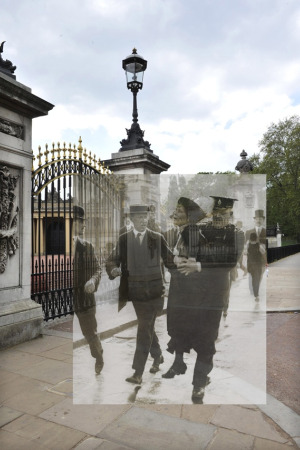
Via Bruce Sterling, one of the more obvious augmented reality applications, done elegantly: historical archive images overlaid onto the real (present/baseline?) world. The older I get, the more I become fascinated with history; if someone did up layers like this for the whole country, I’d probably never switch it off. [image ganked from TechVert; please contact for takedown if required]

London Museum archive photo augmented reality app

Give it a couple of years (or maybe less), we’ll be doing the same with archive video. Another few years, generative CGI that is practically indistinguishable from archive video. Alternate history as real-time immersive gaming experience… think of the 80-hours-a-week WoW player, and it’s easy to assume that some people will pretty much live in AR environments full time. A subsection of those people will make their entire living in that space, geographically contigious with baseline reality but offset (or derailed completely) from historical temporal flow. Whose laws will they obey? Who will they pay taxes to? What will their game goals be? Imagine a Victorian London ARG that’s something like The Sims – your goal is, basically, to survive your chosen socioeconomic mileue for as long as possible without dropping out… or dying in the attempt.

Related bonus link: MeFi points out an experiment into the mutability of memory as manipulated by doctored ‘historical’ images and media artefacts. Apparently not a very rigorous experiment, but nonetheless, the implication is that it’s alarmingly easy to convince us that a fabricated event actually occured. This is, hopefully, a temporary problem. It’s going to take us a little while to evolve the sort of high-sensitivity bullshit filters that an impossible-to-police internet demands, and ubiquitous AR will raise the bar another few notches; I suspect we’ll get there eventually. But unless technological progress hits a brick wall fairly soon, I suspect we’ll never fully catch up. This is a little like what evolutionary science calls an “arms race”, I think… though we’re now in an arms race with the cultural and technological output of our own species.

Thinking about it again, I guess we always have been… I’m sure I’m reinventing the wheel here (and if you can point me toward more thinking alonmg these lines, please pipe up in the comments), but the enormity of this revelatory idea has pretty much scuppered my chances of concentrating on anything else for the rest of the day.

Lost the plot: has the television serial run out of creative lebensraum?

This week, I’ve mostly been feeling like the only person in the world who’s never seen an episode of Lost. That said, observing the reactions to the final episode has been an enjoyable people-watching spectacle; as an outsider, I can only conclude that, while Lost‘s ending has annoyed quite a few people, it satisfied many others, and compared to the scathing vitriol directed against the closing episode of Battlestar Galactica, the whole business has been fairly civilised.

As a writer and critic who doesn’t watch much television (I don’t actually own one, and haven’t for over a decade), it’s interesting to watch the debate around popular serials for emerging commonalities… and in the more science fictional franchises especially, much discussion is given to the matter of endings, and their frequent failure to fully satisfy the logical and sf-nal mechanics of the plot as well as the need for emotional closure. (It’s worth noting that these complaints are rarely heard outside the sf community, at least in my experience; this is presumably because the genre field has a canon of works which obey the unwritten rules of extrapolation and explanation to draw on for comparison, and because sf tropes are now seen as a convenient toolkit for adding weirdness to TV serials – a toolkit with which the average watcher isn’t yet sufficiently familiar to be able to call cliche or deus ex machina when they see it.*)

But enough of my hypotheses; n+1 Magazine has an interesting and timely article about “how the television serial achieved the status of art“… and how that achievement may mark the end of its creative trajectory [via MetaFilter]. To put it another way: the format may have run out of ways to raise its game and wow the viewers.

It’s quite a long piece, so I’m just going to pull two quotes – though it’s well worth taking the time to read the whole thing. The first makes the point that serial storytelling is actually an old and very successful format from the era before television, and one that helped define what we think of as the canon of classic novels:

Today, we study nineteenth century novels as whole texts, and as a result we don’t think about how they were originally read and written. Novelists, for one thing, wrote on deadline. When Dickens produced The Pickwick Papers in thirty-two page installments, it wasn’t because he preferred thirty-two pages to thirty-one or thirty-three, but because that’s how many pages the Fourdrinier cylindrical paper-making machine could impress at once. Serialization also came to shape plot itself: the end of chapter cliff-hanger (which could be called the “to be continued” effect) was invented to ensure that today’s readers would be tomorrow’s readers as well.

Hold that thought. Now, skip to near the end of the article:

This is the final season of Lost, and while new dramas will continue to find both enthusiastic fans and critical acclaim, it is hard to avoid the feeling that something important is winding down. After all, the great dramas of the last decade are great precisely because they found certain limits of the form, because they figured out what it was possible to do with the available tools. That leaves future shows with few places to go, even when they are excellent (Breaking Bad) or promising (Treme). There just isn’t much new ground available. Mad Men is our current would-be aspirant to television greatness, but that show looks to me like a Frankenstein’s monster, cobbled together from bits of The Sopranos and Sex and the City, dressed up and staggering around in a Banana Republic suit. We will someday be embarrassed by the amount of attention paid to that show during its run; perhaps we already are.

Now I’m going to bring on Peter Watts, a man renowned for calling it how he sees it; here, he repeats something that I (and doubtless many others) have been saying for years about television serials.

You know what the creators of epic, multiyear-arc television shows need? They need a novelist or two on staff. Or a playwright. Somebody who understands that an epic tale needs to be planned in advance, that plot is not something you work out after you’ve already written 90% of the story, that you can’t just throw a bunch of kicks and clues into individual chapters unless you have some idea what they fucking mean. It doesn’t matter how gobsmacking your twists are, or how effectively they entice your viewers to tune in next week: the reason we come back is because we want to see how all these intrigues fit together, what the payoff is. These guys can be absolute geniuses when it comes to microwriting: why haven’t they figured out that you gotta use that arsenal you’ve assembled on the mantelpiece, sometime before the end of the tale?

My guess is that they’ve never learned to because there’s never been a need for them to do so. And I find it interesting that the two TV serials I’ve enjoyed enough to really engage with in recent years were not written in response to the production schedule: Dexter, for instance, was based on the novels of Jeff Lindsay, and – despite its initially ridiculous premise – blew me away with its narrative tightness, and Sons Of Anarchy – which has some lumpy moments and clunky cliches, but otherwise moves very smoothly – is on many levels a retelling of Hamlet.

Of course, this could just be me grafting my own preference (for novel-like plots that tie everything up neatly) onto a market where that preference isn’t a prime factor in audience satisfaction. But I think it’s fair to suggest that the microwriting approach to serial television makes the unsatisfying or cop-out ending an inevitability; a novelist can wrap up the tale and then go back an make sure everything fits before the audience sees it, but if you start releasing the story before you know how it’s going to end (or even how long it’s going to run), you’re forced to do things by the seat of your narrative pants.

We keep being told the novel is dying, and that the television networks are struggling to fund good serials. Maybe it’s time the two forms started to meet in the middle?

[ * Though it may sound like it, this isn’t meant as special pleading for sf readers; rather than describing genre fans as an elite, I’m trying to describe them as veterans from the early stages of a culture war that has started to conscript a much wider and less experienced audience. ]
The near future is not amenable to fiction writers

That may seem like an odd thing for the editor of a near-future science fiction magazine to say, but if you won’t take it from me, here’s Charlie Stross explaining how real-world changes have twice scuppered a near-future fictional work-in-progress, the most recent problem being that unexpected election result here in the UK:

What sandbagged me was the fact that for the first time in a British general election, more people voted for minority parties than for any of the major players; a coalition or a (weak) minority government was inevitable. Then the libertarian arm of the Conservative party went and formed an alliance with the Liberal Democrats in an utterly unprecedented realignment, and according to the latest polls a majority of the population look set to vote “yes” to electoral reform in a year or so. (Link missing because I can’t find the URL I read last night …) So it’s back to the trenches on “Rule 34”, because I have to do a complete re-appraisal of the world-building scenario underlying it in order to figure out whether it’s still plausible; and if not, I have a lot of patching to do.

The unexpected hits you between the eyes, as Our Cilla once sang. Or in the words of Mark Twain: “Truth is stranger than fiction, but it is because Fiction is obliged to stick to possibilities; Truth isn’t.”

I’m tempted to say that the rise of steampunk and other alternate history modes may be a writerly response to the increasing difficulty of guessing ahead over a short temporal distance; if you immediately frame your story as being set in a reality/timeline different to that inhabited by the reader, you’re safe from those sandbags.

And then you’ve got the mode that William Gibson seems to be pioneering with his latest novels, a sort of “alternate yesterday”, a way of looking at the very near past in a way that throws light on the future that will (or rather should, or might) follow on from it. All well and good… but perhaps we’re reaching a point of extreme social and cultural flux where the notion of media products that can maintain their relevance over long stretches of time is an anachronism.

To put it another way: will the classic books/movies/TV of the twenty-teens be celebrated for their ability to capture something timeless about human nature, or for their amber-trapping of a moment in human time that can no longer be revisited in any other way?