Tag Archives: panopticon

UK police to deploy military UAV drones, snoop more effectively

US Air Force UAV droneFuturismic readers resident outside the UK may wonder why exactly it is that I keep battering on about the omnipresent surveillance systems that are saturating this silly little island. After all, if I’m not doing anything wrong, I should have nothing to fear, right?

Well, if believing that helps you sleep at night, then you carry on. In the meantime, I hope you’ll not object to me becoming steadily more nervous about such systems being put into the hands of a clueless, corrupt bureaucracy of a government. Am I overstating the case here? I don’t know – but how would you feel if you heard your police force were investing in the same sort of UAV surveillance drones that have proven so popular with the “peacekeeping” forces currently stationed in Afghanistan and Iraq?

Better yet, wait until you hear exactly what they want them for:

… for the ­”routine” monitoring of antisocial motorists, ­protesters, agricultural thieves and fly-tippers, in a significant expansion of covert state surveillance.

I suppose we should at least be grateful that the ubiquitous yet hollow catch-all of “terrorism” doesn’t turn up in that list. But there’s more:

… the partnership intends to begin using the drones in time for the 2012 Olympics. They also indicate that police claims that the technology will be used for maritime surveillance fall well short of their intended use – which could span a range of police activity – and that officers have talked about selling the surveillance data to private companies. A prototype drone equipped with high-powered cameras and sensors is set to take to the skies for test flights later this year.

The Civil Aviation Authority, which regulates UK airspace, has been told by BAE and Kent police that civilian UAVs would “greatly extend” the government’s surveillance capacity and “revolutionise policing”. The CAA is currently reluctant to license UAVs in normal airspace because of the risk of collisions with other aircraft, but adequate “sense and avoid” systems for drones are only a few years away.

I try very hard to keep Futurismic free of my soap-boxing these days, and I hope you’ll accept my apologies if this post has bored, baffled or offended you. But Futurismic‘s also the biggest soap-box I have access to, and I honestly believe this sort of creeping totalitarianism must be called out in public at every available opportunity. Governments that profess to be democracies should remember that respect is a two-way street. [image by ebrkut]

Potential outcomes of pervasive surveillance

CCTV camerasSometimes it really feels like science-fictional thinking is becoming a much more mainstream thing to do. Following on from yesterday’s mention of CCTV control software that can learn to recognise suspicious behaviour (as defined by operator feedback, natch), out-bound BoingBoing guest blogger Paul Spinrad decided to think out loud about what might happen in a society where you were always under surveillance in public. Granted, BoingBoing isn’t exactly aloof from the sf-nal mindset, but even so…
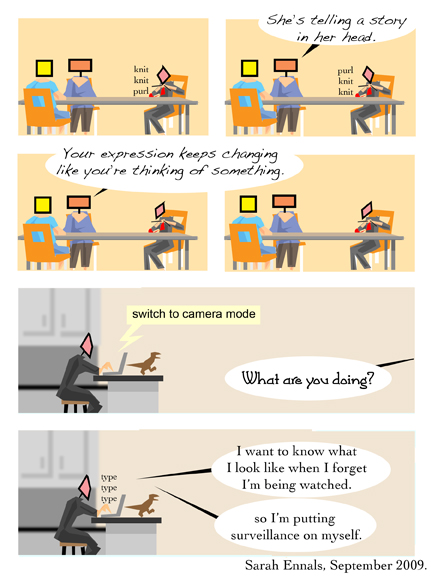
Teenage girls become statistically less fearful about body image, and anorexia rates drop. Rifts develop between groups with different attitudes towards concealment. A tipping point is reached, and in the Prisoner’s Dilemma of female modesty, power is taken back by the unionized-sisterhood strength of concealment over the winner-take-all competition of the freer playing field. Male attitudes toward women change as a result.

Meanwhile, law enforcement and the intelligence community don’t want faces covered, with all their face-recognition and tracking software. So anti-concealment laws are put in place. The cool rebel kids (along with true criminals) also push in the direction of concealment. A mini industry springs up of wearable concealing devices, analogous to radar jammers and license plate concealers, with a similar “arms race” between laws and the innovations designed to circumvent them. Welcome to the see-easy; check your headcover at the door.

The comment thread quickly knocks down the female modesty theory, but I think we can see the beginnings of that cold-war-ish escalation of technological advancement from the second paragraph happening right now… certainly in my RSS feeds, anyway.

I’m reminded again of David Brin’s Transparent Society, and remain convinced that sousveillance would be of great social benefit in the longer run. Private and gubernatorial surveillance, on the other hand, is terrifying me more and more as the months go by; the only upside I can see is that I’ll get my naive teenaged wish of living in a Gibsonian cyberpunk dystopia… [image by Caveman 92223]

Facebook as your alibi

We’ve surely heard enough stories about how posting status updates on social networks can give away more information about you than you intended, so here’s the positive flipside of that: Rodney Bradford was a suspect in a Brooklyn mugging case, and it’s partly thanks to a Facebook status update made from his father’s apartment that the charges against him were dropped. [via TechDirt]

Of course, such alibis could be faked, if you had the time and intelligence to plan it all out and the help of a close-lipped accomplice… expect a lot more mystery and crime plots involving status updates, IP addresses and server timestamps to crop up in the next couple of years.

But perhaps this means that lifelogging is the ultimate way to protect yourself from accidentally being accused of something you didn’t do – if every second of your life is open to public scrutiny, you’re not going to commit a mugging and get away with it, after all.

But what happens when we’re all lifelogging, in some almost unimaginable combination of the participatory panopticon and David Brin’s transparent society? When every moment, when every minor indiscretion is a matter of public record, will we simply cease to sin? Or will we develop a kind of social blindness to the sort of unethical actions that we all take every now and again?

Crime may not pay, but perhaps watching for it might

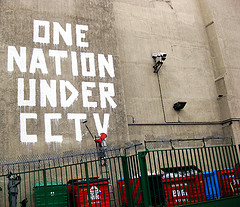
"one nation under cctv" by BanksyAs much as things may be tough in the States right now, at least you can all get a good laugh watching the UK slide towards becoming a pseudo-totalitarian panopticon state. [image by JapanBlack]

Via Cheryl Morgan comes news of the latest iteration of our enthusiastically participatory society of snoops and spies – crowdsourced CCTV crimespotting, with fabulous monetary prizes to be won!

The cameras’ owners will pay a fee to have users watch the footage. The scheme, Internet Eyes, is being promoted as a game and is expected to go “live” next month with a test run in Stratford-upon-Avon.

Subscribers will be able to register free and will be given up to four cameras to monitor.

Eventually the consortium behind the idea hopes to have internet users around the world focused on Britain’s 4.2 million security cameras, waiting to see and report a crime in return for cash prizes.

[…]

Subscribers will try to collect points by monitoring cameras in real time. If they see anything suspicious, they will click a button to send a still picture and text message to the camera’s owner.

The owner will then send a feedback e-mail to the person reporting the incident, indicating whether there has been a crime or suspected crime.

Users will be awarded one point for spotting a suspected crime and three if they see an actual crime. They can also lose points if the camera operator decides that the alert was not a crime.

Good grief… it’s much like the crowdsourced surveillance of the US border with Mexico, only with cash incentives. And the thing is, recent research suggests that cash incentives are actually counterproductive in situations where our ethical stance plays a part [via TechDirt]:

incentives affect what our actions signal, whether we’re being self-interested or civic-minded, manipulated or trusted, and they can imply—sometimes wrongly—what motivates us. Fines or public rebukes that appeal to our moral sentiments by signaling social disapproval (think of littering) can be highly effective. But incentives go wrong when they offend or diminish our ethical sensibilities.

This does not mean it’s impossible to appeal to self-interested and ethical motivations at the same time—just that efforts to do so often fail. Ideally, policies support socially valued ends not only by harnessing self-interest but also by encouraging public-spiritedness. The small tax on plastic grocery bags enacted in Ireland in 2002 that resulted in their virtual elimination appears to have had such an effect. It punished offenders monetarily while conveying a moral message. Carrying a plastic bag joined wearing a fur coat in the gallery of antisocial anachronisms.

However, no one in the upper echelons of the business and gubernatorial spheres seems to have taken any notice of this, or of any of the other psychological research of the last few decades that has continually flagged up the same problem… I guess that a clear conscience is no suitable incentive for removing one’s own pre-existing incentives package. Go figure.