 The world may be becoming something of a panopticon, but you can always buy yourself a safe haven… provided you’ve got the necessary cash, of course. Russian billionaire businessman Roman Abramovich isn’t feeling the credit crunch, it seems, as one of the latest additions to his private “yacht” (which looks bigger than most commercial passenger ferries, to be honest) is a laser-screening system for preventing sneaky photography:
The 557-foot boat Eclipse, the price tag of which has almost doubled since original plans were drawn to almost $1.2 billion, set sail this week with a slew of show-off features, from two helipads, two swimming pools and six-foot movie screens in all guest cabins, to a mini-submarine and missile-proof windows to combat piracy.
It might not seem like somebody with such ostentatious tastes would crave privacy, but along with these expensive toys, Ambramovich has installed an anti-paparazzi “shield”. Lasers sweep the surroundings and when they detect a CCD, they fire a bolt of light right at the camera to obliterate any photograph. According to the Times, these don’t run all the time, so friends and guests should still be able to grab snaps. Instead, they will be activated when guards spot the scourge of professional photography, paparazzi, loitering nearby.
Now, you’ll not see me shedding any tears for the poor paparazzi, but that’s some potentially nasty technology right there. For example, the UK government has become obsessively paranoid about photography of late – where might they decide to install something similar? Y’know, to prevent terrorism?
Somewhat further down the financial scale (and hence more accessible to the anxious middle classes), technologies are now available to surveil your own children at all times – like a GPS-enabled wristwatch that will plot your youngster’s location on Google Maps [via SlashDot]:
The watch, which is designed in bright colours to appeal to children, can be tightly fastened to a child’s wrist and sends an alert if forcibly removed.
Parents can see the location of their child on Google maps by clicking ‘where r you’ on a secure website or texting ‘wru’ to a special number. Safe zones can also be programmed with parents being alerted if their child strays outside this zone.
The makers of the num8 watch claim it gives peace of mind to parents and makes children more independent but critics say tagging children like this is a step too far in paranoia about child safety.
File me under the latter bracket, please – although I suppose tracking your kids via GPS is slightly preferable to keeping them shut in the house all the time in response to tabloid-inflated fears about predators. Whichever smart and exploitative bugger manages to mash up this technology with an overlay map of suspected paedophiles will be raking in the money… probably enough to buy a photo-screened yacht. [image by killbox]
Which highlights the real problem, I think – the supposed security of real-time surveillance, and the immunity to it, are both functions of affluence. Will the gap between rich and poor become increasingly defined by the degree to which one can chose one’s place in the panopticon?
 Sometimes it feels like there’s a camera watching us everywhere we go… and maybe the next step will be cameras watching us as we go between places, too. If you thought the idea of
  One of my favourite[1] plausible science fictional tropes is that of tiny robotic insects. The latest step towards their instantiation has been taken by researchers in Sweden, Spain, Germany, Italy, and Switzerland as they put forward their conception of how
 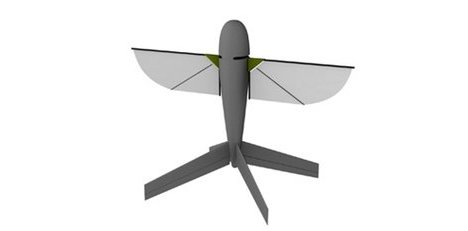 The world’s smallest free-flying device has successfully flown. The
  What could be better than complete panopticon-level surveillance over everything you own? Well,