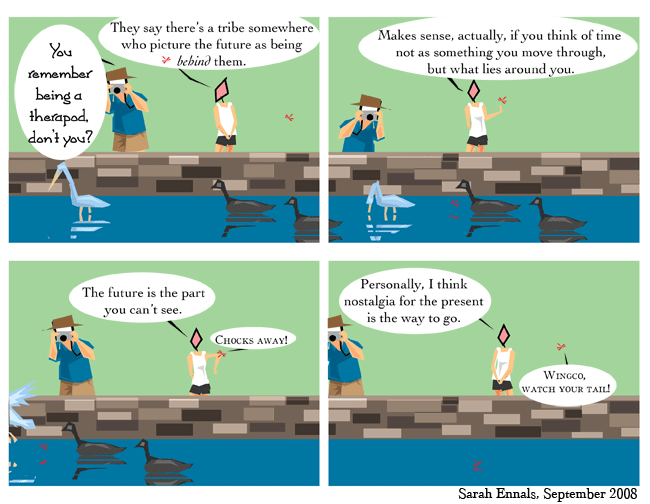
Does Not Equal is a webcomic by Sarah Ennals – check out the archives, or see Time, Part 1 from last week.
Does Not Equal is a webcomic by Sarah Ennals – check out the archives, or see Time, Part 1 from last week.

Does Not Equal is a webcomic by Sarah Ennals – check out the archives. Part 2 next Sunday!
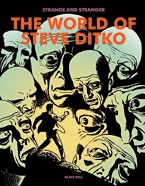 The New York Times has a review of Strange and Stranger: The World of Steve Ditko, a biography and critical study by Blake Bell (Fantagraphics). Stan Lee always knew how to promote himself, and the late Jack Kirby is getting the props he deserves. Ditko is less well known to the public, but of course every comics fan knows he was the original Spider-Man artist. (Tobey Maguire was such a great casting choice, capturing the antiheroic geekiness of the early Peter Parker.)
Ditko now seems now to be leading a strange, sad life, recounts Times reviewer Douglas Wolk:
He split with Lee and Marvel in 1966. By then, he’d fallen under the spell of Ayn Rand and Objectivism, and started producing an endless string of ham-fisted comics about how A is A and there is no gray area between good and evil and so on. “The Hawk and the Dove,” for instance, concerns two superhero brothers who … oh, you’ve already figured it out. Ditko could still devise brilliantly disturbing visuals — the Question, one of his many Objectivist mouthpieces, is a man in a jacket, tie and hat, with a blank expanse of flesh for a face — and his drawing style kept evolving, even as his stories tediously parroted “Atlas Shrugged” and “The Fountainhead” at the expense of character, plot and ultimately bearability.
He drew Transformer coloring books and Big Boy comic books, almost as if he followed John Galt on strike.
(Self-indulgent note: Rand is always good for starting an argument, in my experience…)
[Image: book cover from Fantagraphics]
 There’s a lengthy (but well worth the read) article at COSMOS Magazine about the prospect of functional human immortality, which – thanks to fairly recent scientific advances – now looks plausible as opposed to impossible. Unlike many articles of its kind, it looks at the psychosocial implications of such a change:
“Our relatively brief lives and our routine proximity to the deaths of ourselves and others are the foundations of everything we have ever thought or believed. Neither religion nor philosophy necessarily promises immortality, but each offers ways of coming to terms with or giving meaning to death and, therefore, life. If death is to be postponed indefinitely, then both religion and philosophy face fundamental crises.”
Well, at least we’ll have the leisure time to talk it all out! [image by brunkfordbraun]
On the flip-side, an article at Wired takes a look at a new computer game wherein the bodies of your slain opponents don’t disappear:
“Over the years, I’ve noticed that most of the seriously violent games I love deal with the corpses by simply whisking them away. […] After I’d killed my way through about seven battles, I experimentally backtracked all the way to the beginning, and sure enough – every body was still lying there, every blood fleck on the ceiling intact.
Now, did this change the emotional, or even moral, timbre of the game?
In some ways, yes. You really do get a better sense that you’re a sociopath when the evidence of your crimes is stacked around you.”
Perhaps, rather than being the training grounds for murderers that some might claim them as, violent games could actually encourage their players to think harder about the consequences of their actions in the real world? That could come in handy – especially if we ever find we can live forever.
 Our sf-nal brothers-in-blog over at SF Signal have managed to score an interview with the occasionally controversial but always entertaining pop-science writer Dr. Michio Kaku.
The SF Signal gang ask Dr. Kaku a bunch of questions (including what he thinks about Mundane SF, believe it or not), but what I found most interesting was his response when asked whether humans stood a chance of becoming a Kardashev Type I civilisation:
“I see evidence of our historic transition from a Type 0 civilization to a Type I civilization. For example:
- English is rapidly emerging as the most likely candidate for a planetary language.
- The internet is an emerging Type I telephone system.
- The EU, NAFTA, etc. are the seeds of a planetary economy.
- A planetary culture is gradually emerging, based on youth culture (e.g. rock and roll, rap), fashion, movies.
But there is also a backlash against this historic transition. Anything this monumental is bound to create a counter force. These are the terrorists (who instinctively dislike a planetary civilization, which is necessarily multicultural, scientific, progressive, and tolerant). Also, we have the forces of chaos and destruction, such as nuclear proliferation and designer germs.”
So rock music is a sign of an advanced civilisation? I feel vindicated! 🙂
More seriously, it seems Dr. Kaku is cautiously optimistic about our progress so far – perhaps uniting in opposition to the “forces of chaos” will crystallise us into a Type I planetary civilisation?
That said, Karl Schroeder isn’t convinced by the Kardashev Scale – it’s inherently homocentric, meaning that what applies to us hairless monkeys is unlikely to apply to any other species. So perhaps we’re trying to classify the unclassifiable?
I love the smell of philosophy in the morning! [image by Shayan]