
Tag Archives: piracy

Pirates are underserved customers, says games executive

A pirate, yesterdayThe gaming community is all a-flutter over some comments from Jason Holtman, the business development guy for games corporation Valve. [via TechDirt] The quote that’s got lips flapping is this one:

“There’s a big business feeling that there’s piracy,” he says. But the truth is: “Pirates are underserved customers.”

“When you think about it that way, you think, ‘Oh my gosh, I can do some interesting things and make some interesting money off of it.'”

Such a statement is naturally considered heresy by the gaming industry, which sees mammoth endemic piracy as eating away at its profit margins. Valve are well placed to understand digital distribution, though, thanks to their Steam service, and Holtman has evidently seen the writing on the wall as regards selling intangible products in tangible venues… perhaps he’s been learning from the mistakes of Hollywood and the record labels? [image by ioerror]

Whether piracy of digital content will ever be defeated remains an open question, of course (and seems unlikely), but it has been pointed out before that the most effective method of curbing the impact might be to minimise the reasons it happens – the biggest of which is surely the high prices. If every $80 game could be bought online for $10, would they sell eight times as many copies? How thin does that margin need to get before people stop taking the risks inherent in using cracked software?

And what ever happened to the flurry of interest in in-game advertising as a monetising strategy?
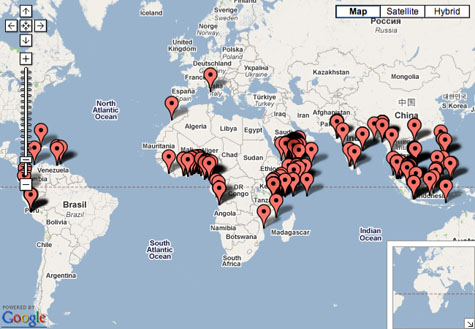
The Live Piracy Map

The ICC’s Live Piracy Map does exactly what its name suggests – it collates reports of modern piracy (the ocean-going sort, not kids using peer-to-peer networks), and plots them out as a Google Maps layer:

screenshot from Live Piracy Map

What’s interesting to me (as someone who works in maritime history) is how some of the hotspots are comparatively new, but others are almost as old as ocean-going commerce itself – a reminder that geography remains unconquered by technological progress, at least as far as supply chains of physical goods are concerned. [story and screenshot via the indispensable BLDGBLOG]

It also suggests that Sven’s armed cruise ship story wasn’t quite as implausible as some seemed to feel…

Viropiracy – because safeguarding ‘intellectual property’ is more important than saving lives

embroidered flu virus cross-sectionThis is just a *face-palm* of epic proportions – welcome to the concept of “viral sovereignty.

This extremely dangerous idea comes to us courtesy of Indonesia’s minister of health, Siti Fadilah Supari, who asserts that deadly viruses are the sovereign property of individual nations — even though they cross borders and could pose a pandemic threat to all the peoples of the world.

Before anyone jumps down my throat, yes, there is a precedent for developing nations protecting the intellectual property implicit in their native biome – the West has shafted them in the past, after all. But as Jamais Cascio points out:

… it’s extraordinarily important for information about potential pandemic diseases to be made as open as possible, if we want to avoid a global health disaster. Withholding viral data, and refusing to provide samples of the viruses, out of a misplaced fear of viropiracy (or more paranoid fantasies), is simply criminal.

I think you’d have to be very paranoid to not see the logic there, really. But anyway – if you catch a virus, it replicates in your body, right? So if viropiracy became a part of international legislation, would you technically be infringing the IP of a nation if you caught a unique disease there but crossed the border before the symptoms started to show, and end up liable to be prosecuted for piracy as well as smuggling? Probably not… but it highlights just how bloody stupid an idea it is, doesn’t it? [image by Noii]

Revenge of the Sneakernet

sneakers-from-powerlinesBuilding on Paul’s post on writing and piracy, I thought I’d flag an article by Rasmus Fleisher (of Sweden’s Piratbyrån) on the future of copyright;

According to one recent study 95 percent of British youth engage in file sharing via burned CDs, instant messaging clients, mobile phones, USB sticks, e-mail, and portable hard drives.

Such practices constitute the “darknet,” a term popularized by four Microsoft-affiliated researchers in a brilliant 2002 paper [opens pdf]. Their thesis is simply that people who have information and want to exchange it with each other will do just that, forming spontaneous networks which may be large or small, online or offline…

One early darknet has been termed the “sneakernet”: walking by foot to your friend carrying video cassettes or floppy discs. Nor is the sneakernet purely a technology of the past. The capacity of portable storage devices is increasing exponentially, much faster than Internet bandwidth, according to a principle known as “Kryder’s Law.” The information in our pockets yesterday was measured in megabytes, today in gigabytes, tomorrow in terabytes and in a few years probably in petabytes (an incredible amount of data)…

In other words: The sneakernet will come back if needed. “I believe this is a ‘wild card’ that most people in the music industry are not seeing at all,” writes Swedish filesharing researcher Daniel Johansson. “When music fans can say, ‘I have all the music from 1950-2010, do you want a copy?’ – what kind of business models will be viable in such a reality?”

And there’s something about the idea of the sneakernet which, particularly when approached from a speculative angle, really captures my imagination.

Imagine – five years from now. With the internet collapsing under the bandwidth-distorting weight of iPlayer streams and mobile videoblogs, you watch the sun rise from the dovecot, anxiously fiddling with your (slightly battered) GPS-enabled iPhone as you await the feathernet delivery of a USB primed with the entirity of Gollancz’s SF Masterworks collection. For many, the most important question – was the USB in ordered directly from the publishers, or a copy from a mate?

[Image by kookalamanza]

Writing and piracy – Stoddard pops Pogue’s balloon

Did you read David Pogue’s post about why he doesn’t release electronic versions of his books?

“Unfortunately, I’ve had terrible experiences releasing my books in electronic form. Twice in my career, ‘blind’ people e-mailed me, requesting a PDF of one of my books. Both times, I sent one over–and both times, it was all over the piracy sites within 48 hours, free for anyone to download.

I’ve got a mortgage and three kids to put through college, and it broke my heart! Unfortunately, the bad apples have once again spoiled it for everyone else.”

Now watch as Jason Stoddard pops it with the pin of pragmatism:

“When Mr. Pogue hand-wrings about revenue lost to piracy, he uses his mortgage and his kids’ college bills to justify his income stream. He doesn’t talk about the value of his work, or the time he put into it, but instead resorts to a petty and rather petulant sense of entitlement. “I worked hard to get here! I deserve this moolah!”

Well, who says? Who says anyone has any right to any kind of revenue multiplication scheme?

It’s not a story any creative worker who’s already making a good living wants to hear, but that doesn’t make it any less true. This isn’t some neo-hippie “information wants to be free” agenda either. It’s an observation, nothing more; the genie is out, and you can’t re-cork a bottle when the bottle itself has vanished.

Two choices present themselves: sit back and bitch as your business model dies around your ears, or search for a way forward. Piracy is progressive taxation; knowing as many hungry writers and musicians as I do, I feel that perhaps Mr Pogue should be proud that he’s well enough known (and his work well enough valued) that people want to pirate it.