Tag Archives: politics

Welcome to the Dropout Economy

American pride?This one’s doing the rounds everywhere at the moment (I spotted it thanks to Chairman Bruce and John Robb), and with good reason: it’s a provocative piece, especially coming from Time Magazine. Welcome to the Favela Chic future, American style:

Middle-class kids are taught from an early age that they should work hard and finish school. Yet 3 out of 10 students dropped out of high school as recently as 2006, and less than a third of young people have finished college. Many economists attribute the sluggish wage growth in the U.S. to educational stagnation, which is one reason politicians of every stripe call for doubling or tripling the number of college graduates.

But what if the millions of so-called dropouts are onto something? As conventional high schools and colleges prepare the next generation for jobs that won’t exist, we’re on the cusp of a dropout revolution, one that will spark an era of experimentation in new ways to learn and new ways to live.

Go read the whole thing, and see Reihan Salam predict the rise of roll-your-own web-based homeschooling, resilient sub-communities based on the exchange of labour rather than money, backyard farming and permaculture, mend-and-make-do and hardware hacker attitudes, and a complete volte-face away from institutional politics.

Exaggerated for controversy and effect? Almost certainly… but grown from more than a single grain of truth, I think, and just as likely to happen over here in the Eurobloc, though maybe not so soon or so hard. [image by emseearr]

The Privatisation of America

Key West conch republic bumper stickerJohn Robb has just re-posted USA Inc.“, a speculative future-history essay he wrote back in 2007, meant to be read as if “written from the perspective of a think tank that’s operating in support of the status quo economic elites in 2025.” He saw the recession coming, predicted an increasing entrenchment of US forces in unwinnable open-source guerrilla conflicts, and riffed on these themes to predict a future where massive government debt leads to the privatisation of… well, pretty much everything. [image by szlea]

Roads, waterworks, military bases, schools, parks, and much more were quickly sold at appropriate prices. Attempts by government’s to retain ownership and rent them as multi-year leases were initially successful, but as the crisis deepened the market cooled to these schemes. Within a year of the start of what is incorrectly but popularly termed “The Great Theft,” outright sales of assets to global investment funds, corporations and individuals were by far more common. The speed of this transfer in ownership has been unmatched by any example prior or since. By 2015, less than three years after the panic began, upwards of 60% of all public assets from the national to the local levels were formally in private hands.

Note that Robb says this is not a future he desires or advocates, but that it seems nonetheless more plausible as events develop; for extra chewiness, compare and contrast with Tim Maly’s “The Free Freeways” Futurismic essay about the seccession of the US highway system.

I think I can safely predict that a lot of you will say Robb’s USA Inc. could never happen, and those of you who are American citizens would be better qualified to make that judgemnet than I… but I’d be very interested to hear your reasoning. Is Robb’s style of doomsaying just a symptom of the inherently self-critical character of American politics, and hence an indication that the problems he’s flagging up are already being grappled with at a subliminal level?

Or is the feeling that it couldn’t happen merely a form of knee-jerk wishful thinking and denial – “too big to fail” scaled up to a whole nation?

Swapping the Senate for Reddit, and other daft ideas about digital democracy

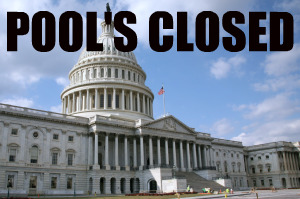
Pool's closed (due to extropianism)For the sake of change-around, I’m gonna let someone else propose the wild idea this time. So, how’s about you US citizens swap your Senate for something like Reddit.com? [image adapted from a photo by cliff1066™]

Let’s abolish the Senate! Replace it with something truly new and egalitarian, a system that gives us thrilling optimism and empowerment, something far more representative than the so-called “House of Representatives” […] My proposal is to replace the moldering Senate with an electronic plebiscite system, i.e., something like Reddit.com.

Here’s how it works.

  1. Everyone who reaches voting age gets a log-in ID and a password.
  2. All bills advanced by the House of Representatives are posted on “reddit.com” for approval.
  3. Upvote or Downvote, voters get two weeks to cast their ballots and to state their opinions in comments as lengthy and as often as desired.
  4. The millions of comments are categorized in an efficient way so that the curious public can read all existing viewpoints. They are, in turn, also upvoted and downvoted as people find them more or less relevant.
  5. At the end of two weeks, all proposals that have received 60% (or another agreed-upon number) approval are enacted into law.

That would be just the start, apparently… :-s

Look, I’m a proponent of the idea of digitising democracy, but Reddit itself is a great example of why it wouldn’t work for major policies at a national scale. The tyranny of the minority, a banal hegemony of kneejerk special-interests NIMBYism and me-too-gimme-gimme… not entirely unlike a lot of the Western world as it already stands, in other words, albeit with more cat videos (which would admittedly be something of an improvement).

But if you can’t see how easily that sort of plebiscite framework could be gamed (let alone hacked)… well, you were a bit bold naming your website “Extropism”, let’s put it that way. Rhizomatic digital democracy could work, sure, but only in small numbers over small areas. You wanna go national with plebiscite, you need to think again, especially in a territory as large as the US – and you’re going to have to think about representatives in some shape or form, because there’s too much law and too little time for us everyday Josephines to deal with it at the same time as holding down a job. Now, if you want to talk about ways of building a representation system with total transparency and full-duplex discussion between the people and the rep, though, that’s another argument entirely…

That said, it’s hard not to be sucked in by the illusion of participation that the internet already offers – I’ve signed more petitions in the last two years than I have in my entire life, just because it’s so damned easy to do online. But things easily done are easily ignored, and that nice warm glow you get afterwards is the glow of complacency. You may not believe me, but the big charities and campaign groups are certainly waking up to it:

“… underlying slacktivism isn’t enough — you can’t just turn your profile green. If you show support you are lazy? No. But there has to be a number of people taking actions in the real world, too.” Anderson said.

It is this growing trend to show support via an online campaign that is threatening human rights movements across the globe, and the panel quickly picked up on the drawbacks of the internet in promoting false activism.

“I coined the phrase ‘mousy solidarity’ to explain how easy it is to click on a petition. We feel like we can participate.” said Professor Sreberny.

What was made clear from the event was that both sides — activists and regimes — can see the potential for technology to promote their cause. But it was the words of a press spokesman for hosts Amnesty International that really struck home, underlining the need to continue to fight across several platforms, rather than relying on new trends to promote the cause.

Speaking of supporting political protest against corrupt regimes, everyone seems a little stuck on this whole Iran business. Why don’t we just bombard Iran… with satellite internet signal!

This would be an invaluable help for a movement that the government can currently easily hinder with telecommunication cuts in the wake of large demonstrations. Most importantly, and from a US policy perspective, it would empower Iranians without committing troops or confronting the Iranian regime directly, solving the dilemma of American non-interference.

(Ah, non-interference is a dilemma, now? Is that another word for “knowing that there’s no legal way to pull it off, and remembering how badly it worked out last time?”)

Complications might, of course, arise. The Iranian government can crack down on the use of satellite dishes, as it has consistently done in the past, or attempt to jam the signal. The whole project might prove costly, perhaps cost more than the Voice Act’s $20m budget. But is a cyber war with Tehran’s regime not a more palatable route than the other “options” that remain relentlessly on the table?

Um. This chap somewhat misses the point of cyberwar – namely that the people opposing you on the web don’t necessarily have to be based in the country you’re trying to face down, or even care much about it beyond some vague and naive notion of religio-cultural brotherhood – but the idea itself isn’t entirely crazy.

In fact, if I wanted to destabilise a totalitarian regime with a censorship fixation, giving its people open internet access is one of the first things I’d want to be able to do… which leads me to suspect that toppling the Iranian regime probably isn’t as big a priority for the governments of the West as they might like us to think.

But maybe it would be, if we all just popped over to Reddit and clicked “upvote” enough times through multiple different proxy servers…

Ideological cyberwarfare and the marketing of intangible threats

Ars Technica points us to a BBC report that claims botnets are increasingly being deployed by ideological and political activist groups as well as the more traditional spammers ‘n’ scammers. There’s undoubtedly a kernel of truth here, but given that the data that informs this conclusion comes from Prolexic, a company whose profits depend on selling computer security solutions to businesses and governments, I find myself wanting to poke holes in the story. It’s easily done, too.

First of all, Anonymous are described as an “anti-Scientology group”, which is a massive oversimplification. If they can be said to be anything at all, Anonymous is an amorphous and capricious cloud of nihilistic pranksters, but framing them as a single-interest group makes them more understandable to the corporate mind-set, as well as portraying them as “something that could happen to you“.

Next item – look at this excerpt:

In one attack both large and small perfume firms were hit in an apparent attempt, said Mr Sop, by green activists to express their disquiet with the way the companies made and tested their products.

[…]

These techniques are far removed from those favoured by organised criminals. Some targeted databases behind a website in a bid to swamp that with bogus login attempts or lengthy search requests that would knock out the server and take out the website too.

Note the use of “apparent”, and the lack of any defined enemy. They have no idea who did it, in other words; the “green activists” thing is likely a guess, one that plays into current fears about ideological activism by companies whose business practices might put them in line for such. Isn’t it at least equally likely that the botnet was hired by another perfume business in order to throw some caltrops in the path of its competitors? Is it so implausible that “organised criminals” could have upped their technological game in recent months? It’s not an area in which I have great experience (or, indeed, any experience at all), but I’d imagine that staying on top in the world of international gangsterism involves making sure you’re using the best tools available… because if you’re not, your competition surely will be.

Furthermore, how many “green” activist groups with a special interest in perfumery have the spare money to waste on this sort of warfare? A big part of activist psychology is the desire to be seen to be doing something; this sort of clandestine skulduggery doesn’t sound like the work of placard-waving protesters to me, and I doubt they’d have the money or contacts to call down the botnet fist-of-god on their enemies. There’s nothing to say it couldn’t be, of course, but I’d want better proof – especially from a source who stands to benefit from setting up straw-man opponents which it can then offer protection from.

A few more bits from the bottom:

Mr Sop said Prolexic suspected that some of the attacks it had seen in recent months were being mounted by governments or their proxies in the hacking community as a way to demonstrate their cyber capabilities.

*cough* *wink* China *nudge* *cough* The Red Peril! The Other! The monsters under Western capitalism’s bed! They’re coming for you!

The resources being put into the attacks, some of which targeted very expensive pieces of net hardware, ruled out the involvement of organised crime, he said.

Really? Why would organised criminal syndicates not be interested in attacking “expensive net hardware” when political or ideological activists would be? And this hardware – what is so different about it that makes it expensive by comparison to “not-so-expensive” net hardware, exactly? Are the victim servers plated with gold, perhaps?

OK, so I’m going a bit overboard here, but everything about the report from these Prolexic people stinks of under-the-radar button-pushing infomercial. Ideologically-targetted botnets are certainly a real issue, and probably more so than they were a year ago… but I suspect this shift in PR focus by security firms to be born of the realisation that defined threats enable sales better than amorphous ones. Which is the more tangible risk, as perceived by a CEO – “scammers might hijack your server because it’s essentially a box that can do anything if instructed properly” or “people who object to your ideology or business practices could treat your network infrastructure as a weak point”? The former is a statistical long-shot; the latter plays on the fear of competition that is key to any successful business.

Getting back to the core point, though, the rise of ideological deployments of botnets is hardly surprising. The people who run botnets are mercenaries of the old school, renting out their services by the day (or maybe even by the hour) to anyone who can meet the price… and for those groups who can’t meet the price (or don’t like dealing with middle-men), it’s depressingly easy to build one yourself, if you’ve the time and motivation. But that’s the key – time and motivation, and the afore-mentioned visibility. Single-issue activist groups want their protests to be seen and attributed to them, because otherwise they’re wasting their time; the stealthy anonymous attacks are logically far more likely to originate from corporations (legitimate or criminal) and nation-states.

So, yes, ideological cyberwarfare is a real and rising threat… but I’m not convinced it’s as grass-roots a threat as it’s being portrayed. After all, if you want to sell your product to corporations and governments, you can’t go demonising your potential customers in your ad copy.

Neomedievalism

The Rocinha favela, Rio de JaneiroWhile I’m on the subject of Bruce Sterling, here’s a brief piece he flagged up at Foreign Policya bleak prediction that the world is reverting to a kind of technology-mediated econo-political feudalism. Call it Neomedievalism:

The state isn’t a universally representative phenomenon today, if it ever was. Already, billions of people live in imperial conglomerates such as the European Union, the Greater Chinese Co-Prosperity Sphere, and the emerging North American Union, where state capitalism has become the norm. But at least half the United Nations’ membership, about 100 countries, can hardly be considered responsible sovereigns. Billions live unsure of who their true rulers are, whether local feudal lords or distant corporate executives. In Egypt and India, democratic elections have devolved into auctions. Delivering security and providing welfare aren’t just campaign promises; they are the campaign. The fragmentation of societies from within is clear: From Bogotá to Bangalore, gated communities with private security are on the rise.

This diffuse, fractured world will be run more by cities and city-states than countries. Once, Venice and Bruges formed an axis that spurred commercial expansion across Eurasia. Today, just 40 city-regions account for two thirds of the world economy and 90 percent of its innovation. The mighty Hanseatic League, a constellation of well-armed North and Baltic Sea trading hubs in the late Middle Ages, will be reborn as cities such as Hamburg and Dubai form commercial alliances and operate “free zones” across Africa like the ones Dubai Ports World is building. Add in sovereign wealth funds and private military contractors, and you have the agile geopolitical units of a neomedieval world. Even during this global financial crisis, multinational corporations heavily populate the list of the world’s largest economic entities; the commercial diplomacy of emerging-market firms such as China’s Haier and Mexico’s Cemex has already turned North-South relations inside out faster than the nonaligned movement ever did.

There are positive sides to a world where every man can be a nation unto himself. Postmodern Medicis such as Bill Gates, Anil Ambani, George Soros, and Richard Branson take it upon themselves to cure pandemics, run corporate cities, undermine authoritarian regimes, and sponsor climate-saving research. But the Middle Ages were fundamentally a time of fear, uncertainty, plagues, and violence. So, too, their successor. AIDS and SARS, terrorism and piracy, cyclones and rising sea levels — it is no longer clear how to invest in the future, or what future to invest in. Figuring out how to respond to this new world will take decades at least. The next Renaissance is still a long way off.

Well, colour me vindicated – this sounds a lot like the world I’m trying to describe when I batter on about the death of geography, the decline of the nation-state and the rise of the corporate entity as political liege… albeit a more succinct (and distinctly more qualified) version thereof. [image by fabbio]

Coming as it does from a publication whose focus is international diplomacy, the screed above takes a bleak view of this imminent new world order – if you can see your profession withering on the vine, it’s bound to make you a bit glum. But I’m not so sure the neomedieval world is going to be a worse place for everyone… or even the majority. To be honest, the majority of people will notice no major changes in their lives at all – the proper nouns in the newsfeed headlines will change, and the adverbs will become more inflammatory (if that’s possible), but it’ll be business as usual in the global favela.

For those of us sat comfortably in our current states of privilege, however, a lot of things will change… or at least they’ll seem to, because we have the luxury of time and curiosity to watch it happening. The first thing we’ll lose is certainty…

… those of us who still have any certainty left, that is. 😉