Tag Archives: politics

Interventions in SF

Ace SF writer Ken MacLeod points to a compelling essay on intervention (as in “liberal intervention“) at The Cedar Lounge Revolution:

I guess anyone with even a glancing interest in science fiction might have noticed that contemporary issues are beginning to appear within the pages of recently published books. Sometimes these are clearly linked into near history.

Some familiar names as well as some authors I’m not familiar with – good stuff.

[via The Early Days of a Better Nation]

The Body Politic

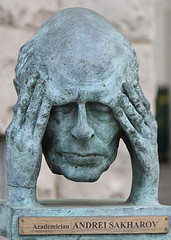
sakharovWe had a lively (but civil!) discussion about the psychology of political choices last week.  So how about physiologyScience published a report suggesting that people who respond most strongly to disturbing images seem to have political views that most people would call conservative.  The test used gadgets to measure skin moisture and blink intensity. Pictures included a big spider on a face and a guy covered with blood.

Yes, I’m skeptical too.  The subjects were Nebraskans, residents of one of the more conservative of these United States in terms of voting. And if you showed this arachnophobic left-leaning blogger some of those disturbing images he’d cry like — well, like a Wall Street banker, this week.

Meanwhile, in another poli-sci story: When vice-presidential candidate Sarah Palin’s email was easily hacked and screen-shots pasted all over the internets, she and her supporters immediately called for a repeal of the Patriot Act and warrantless surveillance, because now they know what it feels like to have their privacy invaded without warning and for no good reason.  Civil liberties enjoyed a resurgence in the U.S., and …

Sorry.  Dreaming on the job.

And just to confirm that, as The Posies sing, everybody is a frakking liar (video):

The world’s largest particle collider malfunctioned within hours of its launch to great fanfare, but its operator didn’t report the problem for a week.

[Bust of Dr. Andrei Dmitrievich Sakharov: photo by dbking]

More political science: Misinformation keeps on working

misinformedA body of studies promises to explain a lot. In politics, people are willing to believe misinformation that reinforces their beliefs. And correcting misinformation sometimes seems to reinforce it.  Examples exist from both major U.S. parties, so let’s pick on the Democrats for a change:

[Yale poli-scientist John] Bullock found a similar effect when it came to misinformation about abuses at the U.S. detention facility at Guantanamo Bay, Cuba. Volunteers were shown a Newsweek report that suggested a Koran had been flushed down a toilet, followed by a retraction by the magazine. Where 56 percent of Democrats had disapproved of detainee treatment before they were misinformed about the Koran incident, 78 percent disapproved afterward. Upon hearing the refutation, Democratic disapproval dropped back only to 68 percent — showing that misinformation continued to affect the attitudes of Democrats even after they knew the information was false.

[story tip: dday; image: Glutnix]

Dreaming about Sarah Palin

palinWe live in such a media-saturated age it’s rather surprising that we don’t have shared dreams more often. Because it’s Friday afternoon where I am, here’s a link to a Slate.com’s Your Dreams (and Nightmares) About Sarah Palin: She hands you a $20 bill. She marries you. She tells you to kill all the animals in the zoo. She’s your barista.

It’s a highly nonscientific (a-scientific?) survey of dreams readers have had since — Sweet Gene Vincent, was it only a week ago(Disclaimer: I have not had a dream about Sarah Palin.) My favorite from the Slate article (hardly the most Freudian of the batch, either):

“In my dream, I was with a group of people watching the election results on television. However, pundits weren’t announcing the results. Both candidates and their VP picks were sitting on two couches in a room full of journalists/pundits. McCain and Palin were on one couch, and Obama was on his couch with his VP pick, but it wasn’t Joe Biden, it was a woman in an emerald-green ball gown. In a way she resembled Doris Kearns Goodwin. What stood out to me is how insignificant McCain appeared. All attention, a spotlight even, was on Palin. It was like McCain was a sad old man on a park bench, and Palin was just soaking up all of the energy in the room. She seemed to be a magnet for all of the energy in the room—a bit like a Dementor from Harry Potter. Obama and his Doris Kearns Goodwin look-alike VP were also relatively insignificant, but not as much as McCain. Obama smiled graciously the entire time. At some point, Tim Russert‘s disembodied head appeared through a doorway in the room where I was, and I started to cry. Tim didn’t say anything, he just floated there observing the group. One of the journalists/pundits in the room was overheard whispering, ‘It’s McCain!’ It wasn’t an official announcement, but he let it slip, and it was true—McCain won the election.

“But McCain just sat there not moving. Palin stood up and started queen-waving. Obama got up to shake her hand—graciously—and Doris Kearns Goodwin sat on her couch, as I was sitting on my dream-couch, crying.”

[Sarah Palin in Kuwait by asecondhandconjecture]

Why do people vote Republican?

nixonPsychologist Jonathan Haidt explores the question on The Edge, with eight responses from the Reality Club. This self-described liberal suggests:

Democrats would do well to read Durkheim and think about the quasi-religious importance of the criminal justice system. The miracle of turning individuals into groups can only be performed by groups that impose costs on cheaters and slackers. You can do this the authoritarian way (with strict rules and harsh penalties) or you can do it using the fairness/reciprocity foundation by stressing personal responsibility and the beneficence of the nation towards those who “work hard and play by the rules.” But if you don’t do it at all—if you seem to tolerate or enable cheaters and slackers — then you are committing a kind of sacrilege.

Afterwards, Howard Gardner wonders why left-wing societies have lower crime rates and more stable marriages; Michael Shermer decries what he calls liberal bias in academia; James Fowler wonders why people vote at all; Alison Gopnik asks what about the children; Roger Schank gets the last word:

Republicans do not try to change voter’s beliefs. They go with them. Democrats appeal to reason. Big mistake.

[Nixon by Rockwell; story tip: Eric Alterman]

Update: In light of stuff like this, at least one of the U.S. Presidential candidates has a website to register to vote or to confirm registration.  I haven’t found it on the other guy’s site, but I’m probably just overlooking it. [Thanks again, Todd]