Tag Archives: politics

Diebold: Two minutes to vote

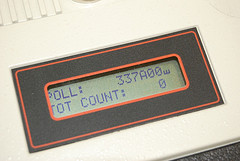
opening-countPrivatizing the elections was a great idea, as Black Box Voting reminds us:

Diebold/Premier says [it’s] too late to fix a new voting machine 2-minute warning and “time-out” feature which can kick voters off the machine, forcing them to accept a provisional ballot. “At least 15” voters were booted off the machine in Johnson County, Kansas recently, and Diebold/Premier says this is due to a software “upgrade” which sets a timer on voter inactivity. According to the company, the machines receiving the upgrade are used in 34 states and 1,700 jurisdictions.

The average voter takes 4-9 minutes to cast a ballot, according to studies. [Thanks, Todd]

Meanwhile, in Michigan, members of a certain political party say they will use lists of foreclosed homes to challenge the eligibility of voters.

You have till Oct. 15 to submit your 1,000-word Election Day horror story to Apex.

[Image: Opening Count, hyku]

U.S. Presidential science

politicsI try to keep partisan stuff out of these posts, but somebody needs to note that Obama has responded at some length to 14 questions on science policy issues posed to him by Sciencedebate 2008, representing a truckload of scientific associations. McCain hasn’t answered yet. NPR has a short item about both candidates’ health policies. And the AAAS just put out a “policy alert” on a few of Gov. Palin’s views on evolution, global warming, and other topics. Not always sexy issues to the media, but something for American voters to think about.

[Story tips: slashdot, Framing Science; Political Studies by minkymonkeymoo]

Surveillance state update: The war on documentation

big-brotherFormer FBI agent and current ACLU lawyer Michael German shares some insights into the mentality behind the arrests of journos and other mostly harmless people at some shindig or other that was going on in St. Paul, MN this week.
He cites guidelines issued to the LAPD:

It lists 65 behaviors that they say are behaviors related to terrorism, and the one that pertains here is “takes pictures or video footage.” [The entry on p. 40 reads: “Takes pictures or video footage (with no apparent esthetic value, i.e., camera angles, security equipment, security personnel, traffic lights, building entrances, etc.).”] “No apparent esthetic values?” So apparently they’re going to be sending police officers to art school to understand esthetic values.

But it actually mentions taking video footage of taking video footage of security personnel. So the mere taking of photographs or video footage of law enforcement – even law enforcement doing something improperly – they’ve identified that as a precursor to terrorism. So now you might understand why these police officers are focusing on people with cameras. It’s because it’s actual policy to do so.

[Interview: David Neiwert, firedoglake; image: mikecolvin82]

DRY FRUGAL WITH DEATH RAYS by Alex Wilson

This month’s slice of Futurismic fiction comes from the widely-published Alex Wilson. Dry Frugal With Death Rays is a dark satire of office politics, corporate bureaucracy, thwarted ambition and revenge gone awry – enjoy!

Dry Frugal With Death Rays

by Alex Wilson

The ergonomic cubicle gel came up to Sal’s chin. Five hours of immersion had left the pads of his fingers wrinkled and slimy. He couldn’t wipe his eyes without making it worse. It was the most important morning of his life, and he was stuck in his cubicle corral with a computer that insisted he wasn’t.

“And you’ve looked, right?” Tech support asked, clearly siding with the computer on this one. “At the latch? You’ve tried turning around and looking to see whether it’s open or closed?”

“Yes,” Sal said. “I’ve looked.” He tried emphasizing the urgency with his arms. In training videos, they iterated how body language carried over into the voice, even though Sal found sloshing around in gel more distracting than helpful on client calls.

Continue reading DRY FRUGAL WITH DEATH RAYS by Alex Wilson

Smart mobs – more smart, less mob, says Rheingold

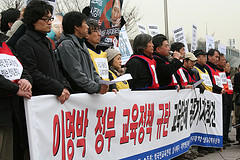
Korean political protestorsWeb anthropologist and elder statesman Howard Rheingold got invited to address South Korea’s citizen journalism website OhmyNews by video, in light of the protests currently ongoing there in opposition to the importation of US beef. The video and a transcript are available for everyone to see, and Rheingold has some sensible things to say about the Pandora’s Box of smart mobs:

A smart mob is not necessarily a wise mob.

The technology itself does not guarantee peace or democracy. It really requires a literacy. It requires an informed citizenry. Journalism plays a role in that. Journalism brings to the people news they need to know about the workings of the State. And it helps bring public opinion to the policy makers to know that they cannot make policy that goes against the majority of opinions of the citizens.

Wise words, for sure – but the inference is that Rheingold recognises that smart mobs are simply one emergent property of recent technological advances … and that the same technology, with a very slight adjustment of attitude or motive by its users, can be used for oppression just as easily as liberation. [image by hojusaram]

New technologies, same old problems.