Tag Archives: prosthetics

Transhuman equality? Athletes with a prosthesis do not have an unfair advantage

Remember all the fuss last year about Oscar ‘Bladerunner’ Pistorius, the amputee athlete who was banned from competing against able-bodied runners in the Olympics because the authorities were concerned that his prosthetics might give him an unfair advantage? Well, it turns out that the authorities guessed wrong – recent research suggests that, far from conferring a performance edge, Pistorius’ blades are more likely to be putting him at a disadvantage:

Simon Choppin, a sports engineer at Sheffield Hallam University, said the Pistorius controversy rested on whether his prosthetics increased the efficiency of his limbs, allowing him to achieve higher speeds for less effort.

“So, simply, you can move the prosthetic quicker and you’re ready for the next step faster than someone who has a leg,” said Choppin. Another possible advantage was that the prosthetics might allow the athlete to get back more of the energy they put into the track compared with able-bodied athletes. “But this [Grabowski] paper suggests you’re at a disadvantage if you’ve got one of these blades.”

We can hope that the competition authorities will look at research like this and allow transhuman athletes to compete alongside everyone else, at least until more advanced prosthetics confer a genuine and insuperable advantage (which is bound to happen eventually). But given competitive sport’s strong role in maintaining the mythology of the perfect conformist human body image – think back to the disgusting treatment of Caster Semenya, for example – I suspect they’ll find some other reason to keep the Olympics “pure” and “fair”.

Optogenetics: the key to our cyborg future?

neuronsThere’s a lengthy but interesting piece up over at Wired about the relatively young discipline of optogenetics – the science of isolating and communicating with specific types of neuron using light. The discovery of the process is an interesting story in its own right, but the really futurismic bit is the implication tucked into the final few paragraphs:

Optogenetics has amazing potential, not just for sending information into the brain but also for extracting it. And it turns out that Tsien’s Nobel-winning work — the research he took up when he abandoned the hunt for channelrhodopsin — is the key to doing this. By injecting mice neurons with yet another gene, one that makes cells glow green when they fire, researchers are monitoring neural activity through the same fiber-optic cable that delivers the light. The cable becomes a lens. It makes it possible to “write” to an area of the brain and “read” from it at the same time: two-way traffic.

Why is two-way traffic a big deal? Existing neural technologies are strictly one-way. Motor implants let paralyzed people operate computers and physical objects but are incapable of giving feedback to the brain. They are output-only devices. Conversely, cochlear implants for the deaf are input-only. They send data to the auditory nerve but have no way of picking up the brain’s response to the ear to modulate sound.

No matter how good they get, one-way prostheses can’t close the loop. In theory, two-way optogenetic traffic could lead to human-machine fusions in which the brain truly interacts with the machine, rather than only giving or only accepting orders. It could be used, for instance, to let the brain send movement commands to a prosthetic arm; in return, the arm’s sensors would gather information and send it back.

Science fiction has been talking about the brain-machine interface for decades, but usually in terms of splicing the hardware into the nervous sytem in much the same way as connecting up a regular electronic circuit, and with little experimental evidence for its viability. As Chorost points out in the Wired piece, we’re not going to see commercially available optogenetic interfaces for some time yet, but this proof-of-concept work suggests it really is only a matter of time before we do. [image by LoreleiRanveig]

Prosthetics porn

Hans Husklepp - Immaculate Arm prosthetic design conceptThere is an arc of progress with human technologies: first comes functionality, then gradual acceptance, and then the aesthetic overhaul. The transition from practicality to personality has always interested me, because it hinges on that point of acceptance, be it grudging or enthusiastic; only then do notions of art start to appear and entwine themselves with functional objects.

Some objects achieve that point of acceptance more quickly than others; these are usually the objects of power, objects that make someone more than human – swords and cars, for example. Slower to achieve acceptance and freedom from stigma are those objects designed to raise the disadvantaged to the same status as everyone else.

We appear to be on that cusp of acceptance with human prosthetics. Granted, there have probably been carved crutches, peg-legs and walking sticks for millennia, but they were only ever crude stand-ins (if you’ll excuse the pun) for a damaged or missing limb. But they represented a refusal to be stigmatised, a defiant embracing of the user’s condition – “This is me; this is my replacement limb. Deal with it.”

Now we can build prosthetic legs that are in some respects superior to the originals, and it surely won’t be long before artificial arms that can replicate (or exceed) the essential functions of their biological equivalents become available to the widening sphere of those who can afford them – and that defiance, that rejection of stigma, will become more prevalent. It’s a stage of great interest to transhumanist thinkers, naturally, but it’s also attracting the eyes of artists and designers who’ve noticed a new human space to colonise with the communication of ideas.

There’s a gallery of cybernetic design concepts – like Hans Huseklepp’s Immaculate Arm, pictured top right – and photo-portraiture over at New Scientist at the moment which will get you thinking about this sort of stuff (it’s what inspired the preceding paragraphs of waffle from me, at any rate), but consider it only a starting point. Sit back for five minutes and think about the ways we already customise the human body for aesthetic effect; then imagine what we’ll start doing when prosthetics are affordable and effective enough to become ubiquitous. It’s closer than you think. [image copyright Hans Huseklepp, reproduced here under Fair Use terms; please contact for take-down if required]

Here’s your starter for ten: when will we first hear of people choosing to replace undamaged natural limbs with prosthetics, be it for practical or artistic reasons? How will the general public react to that? How would you feel if your teenaged son came home with a cybernetic hand in place of the perfectly functional one he had before?

Next-gen hearing aids have iPod jacks

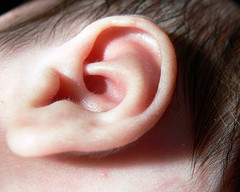
earFile under “elective implant technology that I don’t need but really wish I could afford anyway”: the bone-anchored next-generation hearing aid with audio jack input options.

Older-style hearing aids amplify all sounds, making it almost impossible for wearers to hear conversations in noisy environments. They also interfere with frequencies used by mobile and fixed phones and often emit high-pitched whistling sounds. But the newer processors, costing about $6000 each, shut out background noise, giving users up to 25 per cent better hearing, and can be attached directly to MP3 music players or wireless headsets for talking on the phone, Cochlear’s territory manager, Katrina Martin, said.

They were useful for people with congenitally blocked middle ears, chronic infections that had eaten away tiny bones in the middle ear used for sound conduction, or babies born with closed ear canals, she said.

The processors must be removed for showers or swimming but can last up to 15 years.

Once you’ve got that basic hardware installed, the sky’s the limit for crazy bolt-ons and extras. Real-time digital signal processing, on-board recording and playback… the first person to write an open-source filter for screening out people on public transport talking loudly into their phones is going to be very popular. [via BoingBoing; image by jessicafm]

NEW FICTION: GLASSFACE by James Trimarco

This month’s fiction offering here at Futurismic is a little darker than our last story. In “Glassface”, James Trimarco takes the theme of repressive immigration control and weaves in a story of personal redemption.

It’s moody and noir with a bitter-sweet flavour, and I like it a lot – we hope you do, too.

Glassface

by James Trimarco

The sun burns off the last of the yellow morning fog as the crane drops the shipping containers onto the pier. The pavement shudders with the deep boom of metal on asphalt, then the sound bounces off some buildings and hits us again, softer now. Then the hook lifts away and we head over for the usual routine.

Mackenzie hauls open the gate on the first container. Inside, it’s dark as a tomb.

“Okay, bionic boy,” he says. “You see anything?”

The joke hasn’t been funny for a couple months, and I let him know it.

“Uh oh!” he shoots back. “He’s cranky—better check his batteries!” When he laughs it sounds like he’s choking. I crawl into the container just to get away from it. Continue reading NEW FICTION: GLASSFACE by James Trimarco