Tag Archives: religion

Catholic Church bringing back indulgences

indulge-me

Full disclosure: I was raised Catholic. So maybe I could use one of these.  And when I told like-backgrounded friends and relatives about this New York Times story, the reaction was uniform: “You’re kidding.” No:

In recent months, dioceses around the world have been offering Catholics a spiritual benefit that fell out of favor decades ago — the indulgence, a sort of amnesty from punishment in the afterlife — and reminding them of the church’s clout in mitigating the wages of sin.

The fact that many Catholics under 50 have never sought one, and never heard of indulgences except in high school European history (Martin Luther denounced the selling of them in 1517 while igniting the Protestant Reformation), simply makes their reintroduction more urgent among church leaders bent on restoring fading traditions of penance in what they see as a self-satisfied world.

Pope John Paul II liked the idea of bringing them back, and Pope Benedict is even more enthusiastic. What indulgences are:

According to church teaching, even after sinners are absolved in the confessional and say their Our Fathers or Hail Marys as penance, they still face punishment after death, in Purgatory, before they can enter heaven. In exchange for certain prayers, devotions or pilgrimages in special years, a Catholic can receive an indulgence, which reduces or erases that punishment instantly, with no formal ceremony or sacrament.

There are partial indulgences, which reduce purgatorial time by a certain number of days or years, and plenary indulgences, which eliminate all of it, until another sin is committed. You can get one for yourself, or for someone who is dead. You cannot buy one — the church outlawed the sale of indulgences in 1567 — but charitable contributions, combined with other acts, can help you earn one. There is a limit of one plenary indulgence per sinner per day.

It has no currency in the bad place.

Confession is a prerequisite. Dammit. (Oops.)

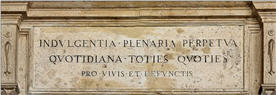
[Plenary indulgence. Inscription on the left transept of the Basilica of St. John Lateran (Rome): Wikimedia Commons]

Pope seeks to save humanity from gender theory

So, let’s see: a very rich man wearing a gaudy dress at the head of an organisation which shelters and hence implicitly condones child abuse says that saving humanity from transsexual or homosexual behaviour is as important as saving the environment. I guess that somewhere along the line my definitions of good and evil got a little mixed up… has anyone set up a website where we can send shoes to ol’ Benny?

Christmas post: Mary Magdalene’s perfume found?

This could be a marketing opportunity for somebody.

Franciscan archaeologists digging in the biblical town of Magdala in present-day Israel say they have uncovered vials of perfume similar to those used by Mary Magdalene, the woman believed to have washed the feet of Jesus.

…”[W]e have in our hands ‘cosmetic products’ from Christ’s time,” said [lead archaeologist Father Stefano] De Luca.

[Image: Wikimedia Commons]

Nanotech culture war in prospect?

A new study suggests that the use and deployment of nanotechnology may be the new frontline in “culture war”, research from the Yale Law School and the Project on Emerging Nanotechnologies suggests:

The determining factor in how people responded [to information about nanotechnology] was their cultural values, according to Dan Kahan, the Elizabeth K. Dollard Professor at Yale Law School and lead author of the study. “People who had more individualistic, pro-commerce values, tended to infer that nanotechnology is safe,” said Kahan, “while people who are more worried about economic inequality read the same information as implying that nanotechnology is likely to be dangerous.”

Another study shows religion also plays a part, with citizens of more religious countries being less enthusiastic about nanotechnology than more secular countries:

They found that countries where religious belief was strong, such as Ireland and Italy, tended to be the least accepting of nanotechnology, whereas those where religion was less significant such as Belgium or the Netherlands were more accepting of the technology.

Professor Dietram Scheufele from the Department of Life Sciences Communication at the University of Wisconsin, who led the research, said religious belief exerted a strong influence on how people viewed nanotechnology.

“Religion provides a perceptual filter, highly religious people look at information differently, it follows from the way religion provides guidance in people’s everyday lives,” he said.

[via Physorg, Boing Boing, the BBC, and Nature Nanotechnology here and here][image from timsnell on flickr]