Tag Archives: religion

Ancient temple suggests alternative civilization theory

An 11, 000 year old temple discovered in Turkey suggests an alternative theory of the development of cities and civilizations:

The megaliths predate Stonehenge by some 6,000 years. The place is called Gobekli Tepe, and Schmidt, a German archaeologist who has been working here more than a decade, is convinced it’s the site of the world’s oldest temple.

Scholars have long believed that only after people learned to farm and live in settled communities did they have the time, organization and resources to construct temples and support complicated social structures.

But Schmidt argues it was the other way around: the extensive, coordinated effort to build the monoliths literally laid the groundwork for the development of complex societies.

Also check out the pictures of the monoliths: haunting millennia-old artwork.

[story here, via Slashdot]

Pullman on the futility of censorship

Philip Pullman, celebrated author of His Dark Materials, talks sense on censorship:

The inevitable result of trying to ban something – book, film, play, pop song, whatever – is that far more people want to get hold of it than would ever have done if it were left alone. Why don’t the censors realise this?

Huzzah for human nature then.

He also makes some rather good comments on the nature and extent of religious authority:

Religion, uncontaminated by power, can be the source of a great deal of private solace, artistic inspiration, and moral wisdom. But when it gets its hands on the levers of political or social authority, it goes rotten very quickly indeed.

My basic objection to religion is not that it isn’t true; I like plenty of things that aren’t true. It’s that religion grants its adherents malign, intoxicating and morally corrosive sensations. Destroying intellectual freedom is always evil, but only religion makes doing evil feel quite so good.

I certainly don’t object to religious belief – but I do object to unaccountable power, which is the kind that many religious authorities possess.

[from The Guardian][image from Gullig on flickr]

Doug Rushkoff blogging at BoingBoing

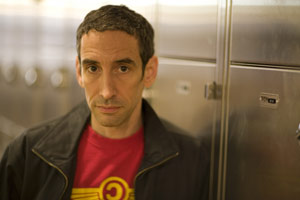
Douglas RushkoffThose of you who follow the Double-Boing may have noticed that they’ve started getting guest bloggers on board again. This week sees a visitation from Douglas Rushkoff; there are few thinkers and writers that I would recommend without reservation, but Rushkoff is one of them. [image from biography page of Rushkoff’s website]

He’s written (sometimes with great influence) on politics, cyberculture, religion, ethics, finance, viral marketing, reality hacking and all sorts of other stuff, and he never fails to come up with something challenging. So if you’re not a regular BoingBoing reader, I’d suggest grabbing the RSS feed, if only for this week. Here’s a snippet from his ‘Open-Source Democracy’ post:

Back when everyone was thinking about digital democracy as some sort of voting scheme or mass feedback polling operation, I wrote a short book called Open Source Democracy in an effort to extend people’s thinking beyond elections to include participation in civics. Yes, we have representatives, but they’re only good as their ability to respond to the needs that come from the bottom up.

Rushkoff’s a blogger in his own right, and a novelist too. More recently he did an excellent comic-format series on DC Vertigo called Testament – Old Testament fables meet dark near-future corporate dystopia. Recommended.

Evangelicals more rational than non-evangelicals?

ghost If we could just get rid of religion, we could march forward into a glorious future where everyone would think rationally and believe only what can be scientifically proven, right?

Wrong. At least, that’s what’s suggested by “What Americans Really Believe,” a study by Baylor University. In what seems to be a case of “you’ve got to believe in something or you’ll believe in anything,” the study shows that (in the words of Mollie Ziegler Hemingway, writing in the Wall Street Journal):

…traditional Christian religion greatly decreases belief in everything from the efficacy of palm readers to the usefulness of astrology. It also shows that the irreligious and the members of more liberal Protestant denominations, far from being resistant to superstition, tend to be much more likely to believe in the paranormal and in pseudoscience than evangelical Christians.

The Gallup Organization, under contract to Baylor’s Institute for Studies of Religion, asked American adults a series of questions to gauge credulity. Do dreams foretell the future? Did ancient advanced civilizations such as Atlantis exist? Can places be haunted? Is it possible to communicate with the dead? Will creatures like Bigfoot and the Loch Ness Monster someday be discovered by science?

The answers were added up to create an index of belief in occult and the paranormal. While 31% of people who never worship expressed strong belief in these things, only 8% of people who attend a house of worship more than once a week did.

Even among Christians, there were disparities. While 36% of those belonging to the United Church of Christ, Sen. Barack Obama’s former denomination, expressed strong beliefs in the paranormal, only 14% of those belonging to the Assemblies of God, Sarah Palin’s former denomination, did. In fact, the more traditional and evangelical the respondent, the less likely he was to believe in, for instance, the possibility of communicating with people who are dead.

Other studies have shown the same thing: according to a 1980 study published in Skeptical Inquirer, irreligious college students were by far the most likely to embrace paranormal beliefs, while born-again Christian college students were the least likely. Two years ago, another study published in Skeptical Inquirer showed that:

while less than one-quarter of college freshmen surveyed expressed a general belief in such superstitions as ghosts, psychic healing, haunted houses, demonic possession, clairvoyance and witches, the figure jumped to 31% of college seniors and 34% of graduate students.

Perhaps this is evidence for the “God gene,” something within the human genome that tends us toward belief in things we haven’t seen (or seen evidence for) ourselves. Perhaps it’s a by-product of our ability to imagine things that aren’t real–and thus a by-product of our ability to create fantasy and science fiction tales.

And perhaps it’s an indication devout atheists need to dig a little deeper into why people believe what they believe, because by aiming at the same oft-ridiculed Christian evangelicals, they’re missing a much bigger–and more gullible–target.

(Image: Wikimedia Commons.)

[tags]religion, atheism, paranormal, pseudoscience[/tags]

Why do people vote Republican?

nixonPsychologist Jonathan Haidt explores the question on The Edge, with eight responses from the Reality Club. This self-described liberal suggests:

Democrats would do well to read Durkheim and think about the quasi-religious importance of the criminal justice system. The miracle of turning individuals into groups can only be performed by groups that impose costs on cheaters and slackers. You can do this the authoritarian way (with strict rules and harsh penalties) or you can do it using the fairness/reciprocity foundation by stressing personal responsibility and the beneficence of the nation towards those who “work hard and play by the rules.” But if you don’t do it at all—if you seem to tolerate or enable cheaters and slackers — then you are committing a kind of sacrilege.

Afterwards, Howard Gardner wonders why left-wing societies have lower crime rates and more stable marriages; Michael Shermer decries what he calls liberal bias in academia; James Fowler wonders why people vote at all; Alison Gopnik asks what about the children; Roger Schank gets the last word:

Republicans do not try to change voter’s beliefs. They go with them. Democrats appeal to reason. Big mistake.

[Nixon by Rockwell; story tip: Eric Alterman]

Update: In light of stuff like this, at least one of the U.S. Presidential candidates has a website to register to vote or to confirm registration.  I haven’t found it on the other guy’s site, but I’m probably just overlooking it. [Thanks again, Todd]