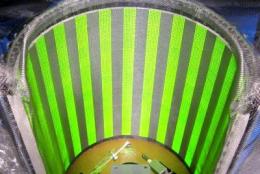
 As I’ve mentioned before, we’re entering a new phase of technological progress: engineers and technologists are not just seeking inspiration in the mechanisms of the natural world, but are actually reverse- and re-engineering biology to improve synthetic technology. In this case researchers in Germany are studying how bow flies perform their incredible feats of aerial acrobatics by creating a wind tunnel for blow flies (pictured):
A fly’s brain enables the unbelievable – the animal’s easy negotiation of obstacles in rapid flight, split-second reaction to the hand that would catch it, and unerring navigation to the smelly delicacies it lives on.
…
Yet the fly’s brain is hardly bigger than a pinhead, too small by far to enable the fly’s feats if it functioned exactly the way the human brain does. It must have a simpler and more efficient way of processing images from the eyes into visual perception, and that is a subject of intense interest for robot builders.
While researchers use biomimetic inspiration for the development of flying robots other scientists are working to reprogram existing biological technology, in this case altering bone marrow stem cells so that they function as retinal cells:
University of Florida researchers were able to program bone marrow stem cells to repair damaged retinas in mice, suggesting a potential treatment for one of the most common causes of vision loss in older people.
…
The success in repairing a damaged layer of retinal cells in mice implies that blood stem cells taken from bone marrow can be programmed to restore a variety of cells and tissues, including ones involved in cardiovascular disorders such as atherosclerosis and coronary artery disease.
For all the pessimism about the future of human civilisation, it is exhilerating to live in an era with so many opportunities and challenges.
[both from Physorg][image from Physorg]
 Continuing
  Feeling tiny insects crawling through your veins sounds like some sort of Burroughs-esque junk withdrawal nightmare (and with good reason), but
  DARPA are still at it busily inventing the all the science-fictional goodness we expect and deserve. Now they’re going in for programmable matter, of a similar flavour to that found in Fire upon the Deep by Vernor Vinge, Accelerando by Charles Stross, and Dune: The Butlerian Jihad by Brian Herbert and Kevin J. Anderson. The goal of the