Tag Archives: science fiction

One hundred years of cyborg solitude

21st September 2060; New Southsea, Disunited Kingdom

September is the old man’s favourite time of year. This morning New Southsea basks in the upper twenties as the summer sear fades out, and the high tides leave less silt in the streets. “Shorts weather, young lady,” he mumbles around his post-breakfast smoke, smiling in the sunlight as the post-grad girl clears away the crocks, boots up the base-unit for his ancient spex and helps him over to his scarred thriftwood desk. “Great day for an etymological celebration, I reckon.”

She can’t help but agree; he’s a grumpy old bastard a lot of the time, but his enthusiasm’s infectious when it takes him. Someone somewhere in New Southsea celebrates some marginal anniversary or festival every day of the year, but as obscure temporal landmarks go, today might take some sort of award. She’s surprised by how much she’s been looking forward to it… though again, she figures she’s just tuning into the old man’s vibes somehow. The reason seems inexplicably unimportant. Continue reading One hundred years of cyborg solitude

Help us out: which two Futurismic stories should we nominate for the Phoenix Pick Award?

Readers of Futurismic fiction, your assistance would be appreciated: Phoenix Pick are running a competition for original science fiction stories published online between July 2009 and June 2010, and we need your help to decide which two stories we should send in.

A bit of background, here: the Phoenix Pick Award is a new prize, exclusively for sf published online, and is unique in that the stories for consideration have to be submitted by the editors who originally published them, rather than by the authors themselves. The prize money for the winning story – guaranteed at a minimum of $US650, no less! – will be split between the story’s author and its publishing venue.

Now, each publishing venue can submit two stories from the eligibility period for consideration, and that’s where we need your help.

We obviously think all eleven stories we published between July 2009 and June 2010 are awesome, or we wouldn’t have published them (d’uh!), and picking favourites would be no fun at all. So I figure we call on you lot, the readers, and crowdsource the choices – what could be fairer than that?

So, here are all the eligible stories, so you can refresh your familiarity with them:

To nominate your two choices, please list them in order of preference (i.e. favourite, second favourite) in a comment below this post*. You’ve got until Sunday 10th October to make your choice; on that day, I’ll lock the comments, count ’em all up, and announce the two leading candidates to be put forward for the Award.

[ * I looked into using an embedded poll gizmo, but none of them really worked the way I wanted them to, and at least with comments made here I can check by IP address to be sure no one’s stuffing the ballot! ]

The in-jokes from way out

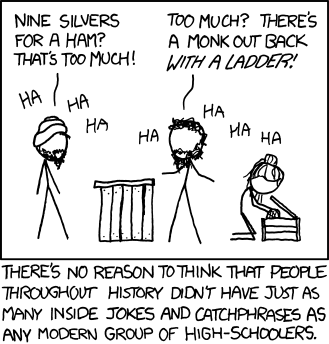
Today’s XKCD may not be one of the funniest ever, but as is often the way, it’s the not-so-funny ones that tend to get me thinking:

Inside joke - XKCD

And as always, it’s the mouseover text that gets to the real point:

I’ve looked through a few annotated versions of classic books, and it’s shocking how much of what’s in there is basically pop-culture references totally lost on us now.

Now, that’s a pretty ubiquitous aspect of popular culture he’s on about, but I think we can suggest that sf will suffer more strongly than regular mimetic novels from this problem when appraised by the readers of the future. Making sense of, say, Jane Austen’s work demands an understanding of the sociopolitical milieu in which it was written, but imagine trying to read Paolo Bacigalupi’s The Windup Girl a century from now (assuming, of course, that there’s still someone capable of reading it at that point). To fully grok the story and its commentary, the reader would need to understand not just the historical situation of the Noughties, but also the way the Noughties looked at the future, and (to a perhaps lesser extent) the way in which a work of sf tends to engage in a dialogue with its antecedents and contemporaries.

Of course, that’s partly true of almost any cultural sub-genre. And this here blog will read rather strangely in a century’s time, but (again assuming it’s still around to read, stuffed into a corner of a diamondite teracube in 2110’s equivalent of the Wayback Machine) there’d at least be the links there for context. But that assumes that the links aren’t dead either, of course… and that the reader would be bothered about checking that context. Hmmm. I seem to have just argued my way out of my own hypothesis; maybe Noughties sf in retrospect won’t look any weirder than any of its contemporary media. In fact, thinking about the music videos I’ve seen recently, it might get off quite lightly…

Even so, I quite fancy the job of knocking up hypertext Cliff’s Study Notes-style annotated versions of modern sf novels for the benefit of the cultural anthropologists of the near future… would anyone like to pay me to do that, please?

Related: Douglas Coupland pops in to the New York Times to coin some much-needed neologisms for the near future. I wonder if he has one for marginal book critics who portray popular post-modern authors as self-indulgent cynics?

Guilty Pleasures

Escapism gets a lot of bad press. Some mainstream critics use it as a derogatory term when dismissing genre literature; some serious genre writers go to great lengths to  prove that their books are more than “simple” escapism. However, escapism has its place.

Part of the reason we read science fiction is to be transported into new imaginative realms, and this is especially true in cinema. After a hard day of work, what better way to unwind than with an hour and a half of relatively mindless spectacle?

As we’re bombarded with doom-laden news reports and press anxiety over terrorism, global disaster, and societal collapse, films such as Cloverfield, Independence Day, and 28 Days Later provide us with a cathartic release. They enable us to explore our fears in a secure context. While watching the film, we can wonder “what would I do?”, and take reassurance from the fact that the protagonists and their families survive whatever disaster has befallen the world.

And then again, sometimes we just want to see a fleet of spaceships blow the living hell out of famous American landmarks.

In the 1950s, they called these films “B-movies”, and they primarily dealt with society’s fears concerning radiation (The Amazing Colossal Man), nuclear war (The Day The Earth Stood Still) and communism (Invasion of The Body Snatchers). Their modern counterparts, the Hollywood ‘blockbusters’, address our modern concerns in a similar way: with the focus primarily on entertainment.

Yes, they’re sensational and yes they’re frequently implausible; but they have their place. Gritty realism cannot transport us from the day-to-day world. When I’ve been writing all day and I need something to take my mind off the plot for a couple of hours, I don’t want a film I’m going to have to concentrate on, or one that reminds me how grim the real world can be. Instead, I’d rather sit down with a bowl of popcorn to watch Armageddon, Back To The Future, or Aliens.

Do you have films you revisit over and over again? What are your guilty viewing pleasures? Please feel free to share your recommendations in the comments section below.

Gareth L Powell is the author of the novels The Recollection and Silversands, and the short story collection The Last Reef. He is also a regular contributor to Interzone and can be found online at www.garethlpowell.com