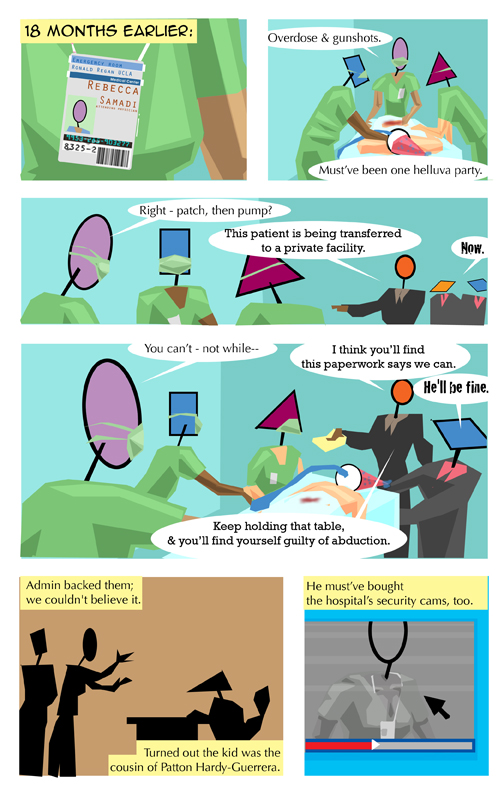


Personal Information is a new serial sci-fi webcomic from Sarah “Does Not Equal” Ennals.
Personal Information is a new serial sci-fi webcomic from Sarah “Does Not Equal” Ennals.
I meant to mention this a few months ago, but life got in the way. Still, better late than never, so:
Like books? Like science fiction books? Like electronic editions of science fiction books? Like getting stuff for free? Sure you do! So go sign up for the Phoenix Pick monthly free ebook coupon. This month’s freebie is “Arkfall” by Carolyn Ives Gilman, which was nominated for this year’s Nebula Award for Best Novella.
Phoenix Pick also does handsome dead-tree editions of rare, reissued or just plain obscure science fiction titles… much more handsome than their rather spartan and old-school website might suggest, in fact. And they’re not spammy, either; with your download code each month, you get informed as to what else has been released, and that’s it.
No obligations, no pack drill. Free ebooks. Thought you’d wanna know.
[ Full disclosure: Phoenix Pick sent me a copy of The World Beyond The Hill by the Panshins for review (and, to my shame, I still have yet to get round to reading it), but I was in no way obliged to do the above plug. Just honestly wanted to share the freebies. ]
I think we’ll end up looking back and deciding that the favourite critical riff of 2010 in science fiction is the one that goes “hey, look, we’ve won!” Here’s some highlights from a lengthy solo in the same key from io9‘s Charlie Jane Anders:
… the thing that jumps out at you when you read this new wave of lit authors doing SF is how aware they are of the genre. You’re not dealing with Philip Roth writing alternate history without ever having read any of it, or Margaret Atwood denying her SF is SF — Moody is, to some extent, paying tribute to science fiction. Charles Yu’s book is clearly about science fiction. Cronin’s book attempts to channel the style of Steven King as much as possible. Writing a science fictional book without acknowledging the genre would be missing the point for these authors — they’re writing about genre as much as they are about science fictional ideas.
[…]
Reading through a stack of these recent literary books, you’re left with the feeling that these two themes — technological dislocation and imperial collapse — are resonating in the consciousness of the book-reading classes, and any author who manages to exploit these themes in an evocative way will make it big. There’s a hunger for heartfelt, even disheartening, books set in the near future, and science fiction authors should be doing more deeply personal near-future stories if they want to catch this wave.
I’ve found myself becoming more and more frustrated with this particular meme, for reasons I’m not entirely able to articulate. I think it’s the underlying sense of patting-ourselves-on-the-back, a subtext of vindication that says “hey, we were right all along, and now everyone else is finally catching up and will have to acknowledge the fact that we were out in front before anyone else”. It’s the last part of that subtext that’s the problem, even if you argue (as I think you can, with a limited degree of success) that the first part is true. Yeah, sure, OK: the ivory tower denizens have looked down upon the works of the barbarians, and found them novel (pun intended). This is not a new thing, really. It’s cultural colonialism at best, and we all know how that works out in the long run: “literature” will use “science fiction” for as long as it’s expedient or interesting, no longer, and there’ll be no gratitude beyond that extended by the writers who’ve borrowed liberally from the toolshed. It’s not about genres, it’s about the stories that speak to readers and writers alike, which in turn is a function of the Zeitgeist – something that, by definition, doesn’t do a whole bunch of sitting still.
Interestingly, Anders ends this triumphalist piece by deliberately undermining the very constructs whose triumphs it seems to celebrate:
So it’s finally come true — the literature of the future has become the future of literature. Our collective literary consciousness is crying out for near-future books that are deeply personal, obsessed with technological change, and viciously satirical. We could just be seeing the first wave of a whole new tide of science fiction novels, with authors from both the artificially constructed “science fiction” and “literary” genres making equally wonderful contributions. Let’s hope so, anyway.
If there’s anything for science fiction fandom (and indeed for everyone else) to celebrate, it’s that there are more good books to read. Much as with the YA craze of the preceding few years, I’m really getting tired about arguing over which particular shelves those good books should or shouldn’t be found on… and the utopian “one day soon, there will be only one set of shelves!” riff just doesn’t wash with someone who’s worked in a public library, I’m afraid.
Maybe it’s to do with the geek psychology of feeling like underdogs or outsiders that causes it, but I worry that science fiction’s thirst for validation from those who once dismissed it out of hand is a sign that, rather than leading the literati into the near-future, it’s being charmed out of the driver’s seat by them. Are we in fact celebrating our own sunset, here?
I’m very pleased to welcome globetrotting flyer-in-the-face-of-convention Lavie Tidhar back to the digital pages of Futurismic, and once again it’s with a story that stretches – or at least seems to stretch – our guidelines to breaking point, upsetting a few apple-carts full of sacred cows along the way. “In Pacmandu” is something a little out of the ordinary, even for us… and perhaps even (dare I say it?) for Lavie himself.
Are you ready? Then begin!
It has been two weeks since the disappearance of the Wu expedition.
We are gathered at the sys-ops command module of the Berezhinsky Planetoid, Sigma Quadrant of the Guilds of Ashkelon universe. The light is soft. Music plays unobtrusively in the background. Outside the windows it is snowing lines of code.
Present in the command module: myself, CodeDolphin, Sergei and Hong.
Our task –
‘Find out the fuck happened.’ Continue reading NEW FICTION: IN PACMANDU by Lavie Tidhar


Personal Information is a new serial sci-fi webcomic from Sarah “Does Not Equal” Ennals.