Tag Archives: science fiction

An Old Enemy: Fighting Cancer

So how did I go from last month’s topic about geoengineering to cancer treatment? Well, for one, keeping the Earth healthy is a bit like doing the same for humans: harder than you’d think. Systems engineering on a fairly complex level that we don’t entirely understand. This is also a personal topic. Cancer used to be an academic concept for me. Not any more. Science fiction lost a brilliant voice to cancer earlier this year, when Kage Baker died of it. Now I have friends and family with cancer, and it has become a palpable evil rather than something distant that I don’t want, like elephantiasis or malaria. I’ve seen it, and I don’t like it. Continue reading An Old Enemy: Fighting Cancer

NEW FICTION: WINDSOR EXECUTIVE SOLUTIONS by Chris Nakashima-Brown and Bruce Sterling

Take one Futurismic alumnus (Chris Nakashima-Brown), one bona-fide science fiction legend (Bruce Sterling), and one grim meathook future in the United Kingdom, as monarchy, politics and altermodern culture smash together in the wake of economic collapse…

I don’t think I’ve ever been so proud to be publishing a story as I am of this one. It’s going to blow your mind, I promise. Now, read.

WINDSOR EXECUTIVE SOLUTIONS

by Chris Nakashima-Brown and Bruce Sterling

10 June 2026

JEKYLL Look, I can’t get you off the hook with these 140-character txt-msgs.

JACKAL Colonel Falstaff suspects I am press.  Since I failed that beltbomb test, well you know what

JACKAL you know what these devils will do to me!  Where would that leave you, Dr. Almighty Blogger?

JACKAL Leaking satellite shots of Prince Harry’s field maneuvers.  You call that “the news”?

JEKYLL No, my mercenary friend,  I do not.  So tell me what Falstaff wants.  Drugs, women, grain, petrol, lingerie?

JACKAL Save me, Jekyll.  You do owe me.

JEKYLL He’s very fond of beer, your Colonel?  I have thirty barrels of Nigerian Sorghum Stout.  Ready to move at your word.

JACKAL Falstaff wants a hot feed of the flesh of the Queen of England. Private and exclusive.  Falstaff is American.  You know how they are about royalty.

JEKYLL You lot are the Canterbury altar boys of our national death cult. Continue reading NEW FICTION: WINDSOR EXECUTIVE SOLUTIONS by Chris Nakashima-Brown and Bruce Sterling

The self-made myth of Michael jackson

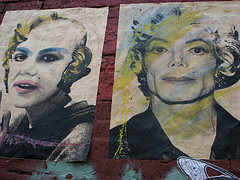
Jackson/Monroe/Warhol mashup posterI’ve never been a fan of Michael Jackson’s music, but I have something of a fascination with his status as a larger- (and weirder-) than-life public figure… a status that his recent death will probably do little to dull, at least in the relatively near-term, and possibly forever. [image by 416style]

As such, I heartily recommend you read this piece by Brian Dillon at The Guardian: “Michael Jackson: king of hypochondria” raises the point that some of the earliest weird tales about Whacko Jacko were in fact created (or at least authorised) by Jackson himself.

When pictures of his visit to the hospital for that purpose made their way to the National Enquirer, Jackson seems to have seen an opportunity to make himself appear more enigmatic in the public mind. It was a curious change in attitude, considering his previous anguished responses to rumours about his personal life: his alleged homosexuality, his supposed decision to have a sex change in the late 70s and the initial media reports that his obvious recourse to plastic surgery was spurred by a desire to look like his mentor Diana Ross. Whatever led Jackson to court notoriety now, the ruse certainly worked; it prompted just the first and perhaps least disturbing of the many bizarre stories that would emerge about him in the years to come.

Though it was not true, the “oxygen tent” story now seems to presage so much about Jackson’s decline that it is hard not to read the image that accompanied it as an emblem of his eventual predicament: reclusive, ailing and unable to reverse his toxic reputation for eccentricity and worse. For the young man in the photograph – whose skin is still brown, whose face has changed since his early 20s but not yet taken on the inhuman aspect of his middle age, whose dancer’s body is not yet emaciated – already resembles nothing so much as a sacred or royal corpse.

Almost every book I’ve read on postmodernism cites Madonna as the quintessential self-made multi-myth, shrugging symbolic identities on and off in order to surf the Zeitgeist and keep the punters interested. That’s somewhat similar to David Bowie’s perpetual reinvention of himself as a symbol (of himself, and of other things), though I’d suggest that Bowie was less interested in being a pop sensation than exploring new avenues that interested him, with a very variable success rate (Tin Machine, anyone?)…

But Jackson just kept grafting new bits on to the same image (literally as well as figuratively), and as such became something bigger than he or his organisation could truly control. I can’t help but feel that, as such, he somehow presaged the uncontrollable runaway meme phenomenons that are such a feature of global internet culture.

Furthermore, it makes him – to my mind at least – an intensely science fictional phenomenon, as well as a postmodern one (if there’s any serious difference between those two things, which I’m less and less sure of as the days go by). The story of Michael Jackson is inherently mediated by the preconceptions of the person reading him as a text, and by the choice of references they use in that reading. The “real” Michael Jackson eventually became such a tiny and insignificant part of the maelstrom of images and stories that surrounded him that he could probably have died long before he did without costing that story any weight or momentum.

There are so many riffs to play around Michael Jackson: riffs of identity-as-narrative (and narrative-as-identity), of the power of PR and dis/mythinformation, about our willingness to believe falsehoods if they tell us what we want to hear, about the increasingly intangible border between a product and its marketing, about becoming the story you tell about yourself, and about that story mutating once it’s too big to control, about self-fulfilling prophecies, about the lonely frightened people sat at the centre of the images we create of ourselves in the public sphere.

The story of Michael Jackson is a very sad one, however it’s told and whoever it’s told by… and it’s all the more sad because his story is, to a greater or lesser extent, our story too.

Chris Beckett: sf is not a genre, it’s a toolkit

British sf author Chris Beckett has been browsing through the BSFA survey book, and decided to respond to some of Charlie Stross’ comments contained therein regarding science fiction’s longevity and mutation:

I agree with [Stross] that it would indeed be ‘the trump of death’ to try and endlessly recreate the science fiction of a previous generation.  But I increasingly think that it is mistaken to think of science fiction as ‘a genre’ or ‘an art form’ (singular).   Think of  Orwell’s 1984, Ballard’s  Terminal Beach, a Star Wars movie,  Dan Dare, Tarkovsky’s Stalker, District 9…   Are they really all the same genre?  Hardly. But they are all science fiction as I would define it.

Rather than think of SF as a genre, perhaps we should think of it as a resource which can be used for many different purposes, as a pack of playing cards can be used for games from Bridge, to Poker, to Canasta to Snap and Old Maid.  SF’s continuing value as a means of telling stories and exploring ideas is illustrated by the frequency with which authors who don’t think of themselves as SF writers nevertheless make use of it (Orwell is a case in point, but see also Margaret Atwood, Kazuo Ishiguro, P.D. James, Doris Lessing etc etc.)

Stross is rather sniffy about this sort of thing.  He speaks of SF being ‘colonized by backpackers from the literary faculty, who appropriate the contents of the [SF] toy chest’.   But surely it is precisely the concern to cling onto our toys, to be pure,  to discourage miscegenation, which lead to the kind of death by staleness and repetition that he himself warns about?

Another iteration of a long-running (and probably interminable) debate, for sure… but I was intrigued by its serendipitous chiming with Tom Hunter’s comments about literary outliers in the Clarke Award shortlist earlier today:

I’ve always been drawn to the idea of there being a toolkit for science fiction rather than a manual, but even more than this I’m drawn to the idea that, these days, the science fictional element is simply part of a much larger toolkit for the work of making art and unpacking meaning from our world.

Perhaps I’m being a bit disingenuous, because both Chris and Tom are talking in parallel with my own theory that science fiction is a floating-point variable rather than a binary.

But what about you lot – do you think there is a distinct genre that can be labelled as science fiction, and if so, where (or how) do you draw the boundaries? Can leakage across those boundaries be prevented, and if so, is such prevention an admirable goal?

[ In the interests of full disclosure, I should point out that Chris Beckett is a client of mine, not to mention a jolly decent chap. ]