Tag Archives: social media

New rules for news

Via Chairman Bruce, here’s a list of 22 rules for the New New Journalism from Dan Gillmor at The Guardian. As Bruce points out, there more than a hint of the idealist networked society about them, but they’re still worth reading – think of it more as a manifesto for a society where journalism was actually meant to keep people informed rather than confused.

Here’s a few of my favourites:

2. We would invite our audience to participate in the journalism process, in a variety of ways that included crowdsourcing, audience blogging, wikis and many other techniques. We’d make it clear that we’re not looking for free labour – and will work to create a system that rewards contributors beyond a pat on the back – but want above all to promote a multi-directional flow of news and information in which the audience plays a vital role.

Nothing too new there, but the promise to acknowledge the origin of crowdsourced material is good.

7. We would replace PR-speak and certain Orwellian words and expressions with more neutral, precise language. If someone we interview misused language, we would paraphrase instead of using direct quotations. (Examples, among many others: The activity that takes place in casinos is gambling, not gaming. There is no death tax, there can be inheritance or estate tax. Piracy does not describe what people do when they post digital music on file-sharing networks.)

Translation: “we’ll not advance or defend the political and economic interests of businesses with obfuscation”.

14. The word “must” – as in “The president must do this or that” – would be banned from editorials or other commentary from our own journalists, and we’d strongly discourage it from contributors. It is a hollow verb and only emphasizes powerlessness. If we wanted someone to do something, we’d try persuasion instead, explaining why it’s a good idea and what the consequences will be if the advice is ignored.

Translation: “we’ll encourage people to think for themselves rather than spoon-feed them other people’s agendas”. Probably the bravest item on the list, and – sadly – the one that will lay any venue that adopts it open to being slaughtered by its competition. In a den of liars, honesty is suicide; these rules would be a great manifesto if you were founding a new civilisation on a distant planet, but trying to push them onto the existing media  infrastructure is probably an exercise in futility.

I suspect that if the character of media is going to change, it will do so because the bulk of those of us who consume it start making it as well… and even if that happens, there’s no guarantee that everyone’s going to share the same ideas about how it should be done.

If you could impose one new rule on journalism, what would it be?
SocNets == Groupthink?

Via those crazy kids at grinding.be comes an article whose writer analyses the culture of social networks and media with the “groupthink” criteria of Irving L Janis, coming to the conclusion that our favourite websites and communication channels may be (gasp!) gathering us into groups where the established and accepted truths remain unquestioned.

It’s not the first time the issue has been raised (and frankly I’ve given it greater credence on those occasions when I’ve seen it on sites who employ a copyeditor and/or whose side-barred “all-time most popular article” isn’t entitled “10 Ways To Have Fun With Boobs”) but my response remains the same: find me a human social construct or communication platform that doesn’t put vague ticks in most of those boxes.

Groupthink is a function of being human; it’s the phenomenon that makes party-based political systems not just possible but debilitatingly pervasive. Do social networks enable groupthink to take root? Sure they do – but I think it’s safe to say they offer more opportunity for dissent and debate than the old centralized broadcast media that they’re replacing ever did. As always, the problem isn’t technology, it’s people.

‘Microvolunteering’: Doing good through social media

tweetNobody expected Twitter to be as useful as it’s turned out to be. Maybe this will work, too. National Public Radio has a story about The Extraordinaires, which is not a 60s British spy show but a social-media enterprise that encourages brief bursts of volunteerism.
Through The Extraordinaries, you might be able to use your smart phone — while waiting in the dentist’s office or standing in the Dept. of Motor Vehicles line — to:

• translate a foreign-language document into English

• add identifying tags to photos and videos for a museum

• give advice to a college applicant

During your lunch break you could snap a picture of a pothole that needs patching and zap it to the proper authorities. You could report a dying elm to the parks-and-recreation department or spot a rare woodpecker for the Audubon Society.

“This is an organization that changes the paradigm,” says Jacob Colker, 26, co-founder of the San Francisco-based Extraordinaries. “We hope people might look differently at that ride on the bus and not just play video games.”

Skepticism is healthy, too, of course. I’m still on crowdsourcing 101, myself, but unintended consequences can sometimes be positive.

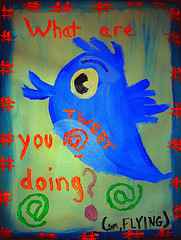
[What are you doing? by wharman]

Culture wars: Authors, social media and the tribes of entitlement

We all know that the web and social media are useful things for authors, enabling them to keep in touch with each other and their fans and – when used inventively – add some buzz and cachet to a newly published book.

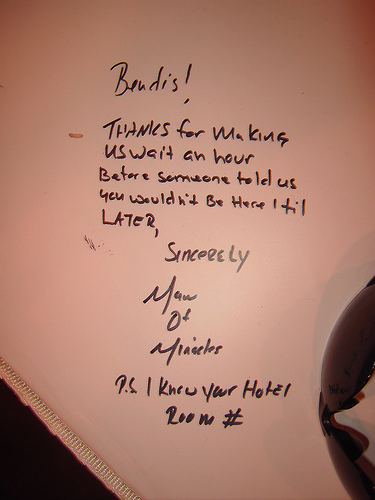
But – as with all things – there’s a dark side, and recent events have gotten me wondering whether the unprecedented level of access we have to the creators of our favourite cultural currency isn’t breeding a sense of entitlement above and beyond the appropriate. The trigger was this photo on Warren Ellis’ blog, showing a note written to comics maven Brian Michael Bendis from a disgruntled fan who’d not found him signing books when he expected him to be:

A "fan" note to Brian Bendis

Creepy and threatening – you can see why Ellis isn’t keen on doing convention appearances and signings (though woe betide the fan who hassled a cane-wielding Ellis in need of another Red Bull and nicotine fix).

Now, this sort of behaviour is hardly new, and as pointed out in the comments thread the root of the word “fan” is “fanatic”. But authors especially seem newly exposed by social media, because they’ve always been one of the less public types of artist – writers historically do not “perform” in public in the same way as musicians, for example, and would have been protected from a lot of the weirder communications from the outside world by having their publisher as an intermediary.

But not so much these days – look at the recent wave of bitching from George R R Martin’s fans when they discovered the next instalment of his current series would be delayed. You’d think that die-hard fans would be the first to sympathise with a creator’s need for a life beyond their work, but there’s a vocal minority who are anything but. As Scalzi points out, such people are fools – but the web has made them fools with metaphorical megaphones and your home address.

A related phenomenon seems to be arising on review and discussion blogs, something that Larry of OF Blog of the Fallen has labelled “The New Tribalism” – a situation where groups of fans with closely related passions fall into a kind of groupthink. This has its upsides – it’s that sense of tribe that motivates many fans in the first place, and there’s nothing wrong with discussing art you love with others who appreciate the same material – but there are downsides too, which manifest themselves as vocal disapproval of voices from outside the tribe (or occasionally within) who dare to criticise the tribe’s focus of interest.

This isn’t new either – as any member of any subculture anywhere will surely agree – but again the mobility and power of the phenomenon is amplified by the web. Debate around cultural opinions is a good thing, but mob psychology and the web’s potential for anonymity seems to be an open invitation to be taken to task for daring to have a different opinion to someone else.

Some of my concerns are professional in nature: I advise my clients about the the benefits of a strong web presence, and it’s almost shaming to have to confess that there’s this negative aspect to it. That said, I still hold that it’s worth the risks – why let a few bad apples spoil the barrel for everyone? Writers like Ellis and Scalzi have developed good tactics for dealing with trolling and tribalism; the primary component seems to be developing a thicker skin, though a strong sense of personal space and practiced rhetorical chops seem to be pretty useful as well.

But there’s a more Futurismic edge to it all as well, because it feels safe to assume that web-based creator-consumer relations are likely to become more prevalent as time goes by. As such, it’s not impossible to image a fandom with similar clout to the fabled Anonymous: what might said flashmob do in response to criticism of their totem? As the barriers between physical and informational realities become increasingly permeable, comment-thread flamewars and denial-of-service attacks would be just the start. Vernor Vinge’s Rainbows End features warring fandoms battling it out in augmented reality, with the action spilling out into damage to property and people; the more I think about it, the more plausible it becomes.

After all, we’re prone to going to war over ideologies; given the decline of interest in religion and politics among the younger and more net-native generations, it’s easy to see cultural affiliations taking their place. These culture-mobs could easily be great forces for fun and creativity, but the potential for the opposite to occur can’t be brushed aside. How might Brighton have looked had the mods and the rockers had mobile phones with web access to coordinate with?

A hashtag for genocide: Twitter, the Iran elections and the moral ambivalence of social media

We raised this subject in the wake of the Georgia revolution, but it’s worth bringing up again. In the light Twitter’s starring role in the current election protests in Iran, there’s much talk of the power of social media as a catalyst and enabler for social change, but as Jamais Cascio points out, the morality of a tool depends on the people wielding it… and it’s not hard to imagine it being put to much darker uses, much as other media have been before.

Not because I have any sympathy for Iran’s government, I should hasten to say, or because I see any threat coming from this particular use of Twitter. It scares me because of how close it aligns with something I noted in my talk at Mobile Monday in Amsterdam earlier this month, an observation that happened almost by accident.

In noting the potential power of social networking tools for organizing mass change, I thought out loud for a moment about what kinds of dangers might emerge. It struck me, as I spoke, that there is a terrible analogy that might be applicable: the use of radio as a way of coordinating bloody attacks on rival ethnic communities during the Rwandan genocide in the early 1990s. I asked, out loud, whether Twitter could ever be used to trigger a genocide. The audience was understandably stunned by the question, and after a few seconds someone shouted, “No!” I could only hope that the anonymous reply was right, but I don’t think he was.

Certainly a point worth considering; no doubt there’ll be a backlash – against Twitter, or whatever the latest flavour-of-the-moment equivalent is at the time – once more people start asking the same questions as Cascio has. It should be a self-evident truth, but we need to remember that technology alone won’t make the world a better place; it’s up to us to use it in the right ways.