Tag Archives: social media

Crowdsourced justice, or just Vigilantism2.0?

Anonymous vigilantism against Kenny GlennThere’s been a steadily increasing number of stories about “crowdsourced justice” of late, a phenomenon that arguably started in China but which is spreading across the world to anywhere that has a population with ready access to the internet.

For example, you may have heard about the 4chan crusade against one Kenny Glenn, a teenager foolish enough to post videos of himself abusing a kitten; Anonymous doesn’t respect many things, but it sure loves cats, and swiftly unearthed enough information about Kenny to land him in very hot water (and to get the cats rescued, natch).

An article at H+ Magazine takes an in-depth look at the phenomenon, which the Chinese refer to as the “human flesh search engine”:

Fortunately, human flesh search engines don’t end the lives of their victims, like the witch-hunts or lynching of the past.

(Erm… they don’t yet.)

We will not know for some time how these cyber-hunts will shape the future of our privacy, freedom of speech and sense of justice and security. But there is no doubt that these cases are just the beginning a vast social change taking place right now. What we can see from these incidents is that the flow of information will no longer be controlled and that the power of public outrage will not easily be quelled.

Kitten Killer of Hangzhou and her cameraman will walk away from their brutal act.. An apology is hardly appropriate recompense for the death of the tiny tortured feline. But these small stories will remain a part of our collective human memory and help guide the decisions of future societies, because the Internet does not forget, does not forgive and cannot be stopped. Ever.

While containing more than a mote of hyperbole, that final sentence is very telling – not because it is de facto true, but because many people believe it to be true. It’s that motivation combined with the ease of acting upon it en masse that gives human flesh search engines their power. [image sourced from Anonymous’ Kenny Glenn site]

And via SlashDot we find that it’s not just animal abusers who can become the focus of public ire, even in censorship-ridden China: the China Digital Times has a report regarding the dissemination of personal information about one Chen Hua, a deputy director of the Beijing Internet Propaganda Office who was foolish enough to boast of his own corrupt practices to a girl he was seeing “in a personal capacity”. Whether the story is true or not is irrelevant; word got out, the human flesh search engines dug up a lot of Chen’s personal details, and Beijing is now trying to contain the viral spread of said information… which makes me wonder yet again about how effective the blackout on the Tiananmen massacre really is.

Much as with any other technology, the uses to which the internet can be put are decided by the people with access to it; most of these cases could be argued to be ethically justified to a greater or lesser degree (though the lines are as fuzzy as ever), but that may not always be the case. The lord of the flies tends to follow us wherever we go, and I can’t see the transition to the digital world slowing him down too much.

Swine flu – panic, precautions and practicalities

flying pigWelcome to the 21st Century, wherein you will be informed of potential disasters more quickly than ever before… and, quite possibly, in indirect proportion to their actual threat. Unless you’ve been ignoring digital media completely for the last two days, you’ll already be aware of the swine flu outbreak in Mexico – but how much do you really know, and how much of that is actually useful? [image by aturkus]

New Scientist is a good place to start for a factual overview of the swine flu situation:

Should I worry about this flu?

That depends on two things: how severe the flu is, and how far it spreads. Its severity is still unknown. Those who died in Mexico were young adults who don’t often die of flu, so we know this virus can be serious. But it isn’t always bad: the cases picked up in the US were mild. Outbreak investigators are now trying to find out how many people have had the virus, and how many of those were seriously ill, to get an idea of how bad it is.

In other words, panic is not only unproductive but as yet unwarranted, despite being amplified by Twitter, whose rapidity and limited bandwidth is spreading fear faster than facts. Of course, there’s always some humour to be found in the darkest of situations.

That said, this is a serious situation and there is the possibility of a global pandemic, though without access to hard data it’s impossible for anyone to really assess the likelihood in anything more than hypothetical terms… which is doubtless why the conspiracy theorists are having such a frenzied field day.

But it’s grist for the mills of thinkers with a less alarmist bent, as well:

Swine flu, we could say, is a spatial problem – an epiphenomenon of landscape.

I’m reminded here of a point made recently by geographer Javier Arbona. Referring to the increasingly popular and somewhat utopian idea that, in the sustainable cities of tomorrow, agriculture will have returned to its rightful place in the city center, Arbona asks: “Did everyone think that so much lushness and farming envisioned in the city aren’t going to open up new Pandora’s boxes of infectious diseases and sanitation problems as we come into contact with more manure, more bacteria, and more wild animals that we urbanites are not at all ‘naturalized’ to?”

Thought experiments aside, the sensible thing to do is ignore anything repeated in hysterical terms by media outlets with a reputation reputation for sensationalist reportage, while making sensible and proportional preparations for the worst. Although at time of posting it is currently missing (in what is presumably a Wired CMS brainfart – ZOMFG kover-up kkkonspiracy!!!1), Bruce Sterling has an uncharacteristically level-headed and sensible analysis of the true global extent of the threat (in short: compared to the ongoing AIDS pandemic, swine flu at its worst will be a picnic); in the meantime, Charlie Stross links to some genuinely useful practical advice:

Oh, and if you want to know how to ride out a flu pandemic, Jim MacDonald explains how to tell flu from a cold, what you should have in your home in case you catch the flu, and how to wash your hands. Pay attention at the back: I don’t want to be needlessly alarmist but knowing how to wash your hands properly might just save your life.

The panic and hype around swine flu is certain to get louder before it gets quieter, especially once the daily tabloids take up the slack after the weekend, so let’s all try to keep a level head. Life can get messy, but it’s not a Michael Crichton novel.

What #amazonfail says about Twitter

amazonfail logoTwitter has definitely made the transition from inexplicable geek tool to mass-media buzz phenomenon (as indicated by the plethora of recent posts about it, both here and elsewhere).

The rapidity of Twitter’s rise (and, arguably, its seeming innocuousness) has allowed it to get the jump on organisations unprepared for its power, speed and influence – as demonstrated by the #Amazonfail debacle over the easter weekend.

Jeremiah Tolbert takes a look at #amazonfail, and determines that Twitter is almost the ideal medium for that sort of emergent protest, as well as a warning to organisations big and small that they need to learn to respond to criticism on microblogging networks as quickly as possible:

In the information void that existed on the weekend, many intentions were invented to explain. Right-wingers had collaborated to manipulate the system via tags. Amazon had capitulated to right-wingers and dropped the titles. It was a programming error. A massive conspiracy of internet pranksters manufactured it so that they could feed on the outraged tears of twitter users. And so on.

Much like Nature abhors a vaccum, the internet ahbors an absence of information.

Amazon’s lack of immediate response allowed the controversy to build to unprecedented levels. Rarely have I seen the internet move in one angry direction so effectively. It never would have moved this quickly in the time before Twitter. Email, texts, none of them had the perfect assembly of features and usability that Twitter does.

Much as we were discussing with respect to the Moldovan Twitter revolution, there’s no implicit morality in this system; it gets used to express the hopes, prejudices and fears of its users. Spiraltwist at grinding.be makes the point:

Forget the bot networks. Forget the viruses. All you need is a massive follower list (or enough people to cross pollinate their twitter streams with your message) and people clicking to take down or disrupt websites for a bit. Click. Click. Click.

There must be dozens of technothriller authors across the planet chewing their pencils in frustration at having been pipped to the post by reality on a particularly pertinent Zeitgest plot device…

Is Twitter a threat to morality and ethics?

Texting Are Twitter and other rapid-fire forms of media eating away at our moral and ethical cores?

Possibly, say the authors of a new study from a University of Southern California neuroscience group led by Antonio Damasio, director of USC’s Brain and Creativity Institute. (Via EurekAlert.)

In the study (being published next week in the Proceedings of the National Academy of Sciences Online Early Edition), the researchers used real-life stories to induce admiration for virtue or skill, or compassion for physical or social pain, in 13 volunteers (verifying the emotions through pre- and post-imaging interviews).

They found, using brain imaging, that while humans can respond in fractions of seconds to signs of physical pain in others, awakening admiration and compassion take much longer: six to eight seconds to fully respond to the stories of virtue or social pain, in the case of the study.

So, what does that say about the emotional cost of relying on a rapid stream of short news bits pouring into the brain through online feeds or Twitter?

Lead author Mary Helen Immordino-Yang puts it this way:

“If things are happening too fast, you may not ever fully experience emotions about other people’s psychological states and that would have implications for your morality,” Immordino- Yang said.

She worries that

fast-paced digital media tools may direct some heavy users away from traditional avenues for learning about humanity, such as engagement with literature or face-to-face social interactions.

Immordino-Yang did not blame digital media. “It’s not about what tools you have, it’s about how you use those tools,” she said.

(USC media scholar Manuel) Castells said he was less concerned about online social spaces, some of which can provide opportunities for reflection, than about “fast-moving television or virtual games.”

“In a media culture in which violence and suffering becomes an endless show, be it in fiction or in infotainment, indifference to the vision of human suffering gradually sets in,” he said.

Damasio agreed: “What I’m more worried about is what is happening in the (abrupt) juxtapositions that you find, for example, in the news.

“When it comes to emotion, because these systems are inherently slow, perhaps all we can say is, not so fast.”

How do you feel about that?

Take your time.

(Image: Wikimedia Commons.)

[tags]Twitter,social media, computers, communication, ethics, morality[/tags]

That Twitter revolution – is the web inherently democratic?

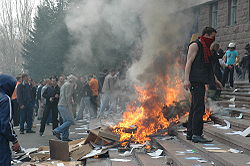
Chisinau riots, Moldova 2009Until last week you’d probably have been forgiven for thinking that Moldova was the country to which expensive tasks are outsourced in the Dilbert cartoons. Well, forgiven by anyone but a Moldovan, perhaps. [image from Wikimedia Commons]

But now Moldova has joined the ranks of former Soviet Bloc countries who’ve had a revolution or political upheaval that was enabled by modern social media and communications technology… and because a good headline always fits nicely into the Zeitgeist, it’s been billed as “the Twitter revolution”. That’s probably a gross oversimplification, though:

It seems unlikely, though, that Twitter was the key tool in a victory of “technology over tyranny”, if that is, in fact, what happened. For one thing, the Communist party in Moldova doesn’t have much in common with the Communists of old – Moldovan communist favor foreign direct investment and promoting entrepreneurship, though they’d like closer involvement with Russia and less with Romania. But to the extent that this was a technological “triumph”, it may have more to do with other social network tools – including blogs, LiveJournal and Facebook – than with Twitter.

Well, even if Twitter can’t take all the credit, hurrah for the inherently democratic potential of modern communications, right? Nicholas Carr would like you to hold on just a moment, though:

No doubt, the Moldovan protests will be used as an example of how the Net and, in particular, its social-networking and personal-broadcasting functions can be used to support popular uprisings and, more generally, the spread of democracy. And rightfully so. But before anyone gets carried away by the idea that the Net is a purely democratizing force, it would be wise to read a longer essay by Morozov, titled Texting Toward Utopia, in the new issue of Boston Review.

I tend to read things that Carr says are worth reading; he’s usually right. So here’s a snippet from that Morozov essay:

Much of the encouraging reporting may be true, if slightly overblown, but it suffers from several sources of bias. As it turns out, the secular, progressive, and pro–Western bloggers tend to write in English rather than in their native language. Consequently, they are also the ones who speak to Western reporters on a regular basis. Should the media dig a bit deeper, they might find ample material to run articles with headlines like “Iranian bloggers: major challenge to democratic change” and “Saudi Arabia: bloggers hate women’s rights.” The coverage of Egyptian blogging in the Western mainstream media focuses almost exclusively on the struggles of secular writers, with very little mention of the rapidly growing blogging faction within the Muslim Brotherhood. Labeling a Muslim Brotherhood blog as “undemocratic” suggests duplicity.

The point being that the Internet is just a tool; the democratizing force is a result of us expressing ourselves through it (and seeing our own reflection in the mirror).

Even so, it can’t be discounted entirely that the Internet and mobile phones have presented the opportunity for networked action and communication to people who even comparatively recently were unable to use technology to circumvent the controls of their governments. Which political cause is the “good” side of any such equation is, as always, a very subjective question.