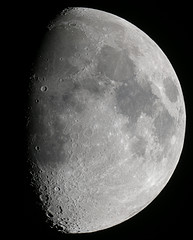
 Well, the new NASA budget from Obama and chums has certainly got people talking… mostly about the fact that the dream of returning astronauts to the Moon is off the table for the foreseeable future [image by ComputerHotline]. Wired has snippets from the budget summary:
“NASA’s Constellation program — based largely on existing technologies — was begun to realize a vision of returning astronauts back to the Moon by 2020. However, the program was over budget, behind schedule, and lacking in innovation due to a failure to invest in critical new technologies,” the budget summary concluded. “Using a broad range of criteria, an independent review panel determined that even if fully funded, NASA’s program to repeat many of the achievements of the Apollo era, 50 years later, was the least attractive approach to space exploration as compared to potential alternatives.”
However, it’s not a massive close-down operation: NASA’s budget has actually been increased, but earmarked for more practical and pragmatic science research, “sustainable exploration”… and keeping some older projects on the books:
Part of that commitment will involve a reprieve for the International Space Station. Instead of being deorbited in the middle of this decade, the ISS will be treated like a national laboratory, and used to pursue research on materials and long-term human habitation in space through at least 2020, with additional construction, including new infrastructure, planned beyond the end of the shuttle program. The budget also includes money for an extension of the shuttle through 2011, which will allow for the inevitable launch delays in its remaining five missions.
io9‘s Annalee Newitz points out that the prospects of the new budget are actually good for pro-exploration types, because it’s a realistic budget that eschews symbolic white-elephant achievements and glory-recapturing in favour of doing affordable things that will teach us lots of useful new stuff. She worries, however, about the fates of those whose expertise will be surplus to requirements now the Constellation project has been shelved:
One of the issues that concerns me the most is what will happen to all the talented NASA employees who have been working on Constellation and related projects. If NASA’s plan is to outsource the development of space vehicles that can carry human cargo, then thousands of jobs will evaporate. Florida alone anticipates losing 7,000 jobs when the Space Shuttle program ends next year. Earlier today Obama told reporters, “We expect to support as many if not more jobs with the 2011 budget,” but those will not be the same jobs. My hope is that some of this budget money that’s been allocated for private sector companies can also be used to place NASA engineers into private sector aerospace jobs. We need to encourage knowledge transfer from NASA to private industry. That way, aerospace companies won’t have to start from square one as they push humans into orbit.
Paging Ben Bova… Sam Gunn‘s time has come, perhaps. After all, there’s nothing to stop private enterprise achieving a Heinleinian dream and setting up a kind of frontier town based on Helium-3 mining and fast-and-loose land claims… well, nothing apart from the same practical difficulties and vast expense that have kept NASA away for the last four decades or so, anyway. But those difficulties don’t seem to be deterring the people behind the Open Luna Foundation [via MetaFilter], which…
… aims to return mankind to the moon through private enterprise. Initial goals focus on a stepped program of robotic missions coupled with extensive public relations and outreach. Following these purely robotic missions, a short series of manned missions will construct a small, approximately 6 person settlement based on a location scouted by the robotic missions. This settlement will be open for anyone’s use (private individuals to government agencies), provided they respect our ethical conduct and heritage policies.
You’ve got to admire the chutzpah, if nothing else… but I think I’ll hold off investing any money in that operation for a little while yet. But it begs the question: if NASA’s putting the Moon on a back burner, who’s going to make it there next? Private enterprise libertarians like Open Luna? China, India, Brazil? Anyone?
 I had to agree with Jay Lake when he Tweeted that