Tag Archives: space

The physics of space battles

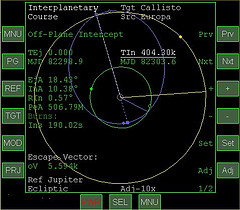
Interplanetary course plotting software screenshotWe all know that space battles as depicted in films and television tend to reuse the paradigms of more familiar planet-side combat types – the naval manoeuvres of Star Trek, for example, or the dog-fighting planes of Star Wars. But what would real combat between space-faring civilisations actually involve, strategically and tactically?

Well, Joseph Shoer’s the man to ask! He’s an aerospace engineer and physicist, and he recently wrote a post running through the main considerations of realistic space combat – everything from the difference between engagements in orbit and engagements in “deep space”, to why kinetic weapons are more efficient than explosive payloads, and plenty more in between. If you’re a fan or writer of space opera, it’s a must-read; here’s a taster.

First, let me point out something that Ender’s Game got right and something it got wrong. What it got right is the essentially three-dimensional nature of space combat, and how that would be fundamentally different from land, sea, and air combat. In principle, yes, your enemy could come at you from any direction at all. In practice, though, the Buggers are going to do no such thing. At least, not until someone invents an FTL drive, and we can actually pop our battle fleets into existence anywhere near our enemies. The marauding space fleets are going to be governed by orbit dynamics – not just of their own ships in orbit around planets and suns, but those planets’ orbits. For the same reason that we have Space Shuttle launch delays, we’ll be able to tell exactly what trajectories our enemies could take between planets: the launch window. At any given point in time, there are only so many routes from here to Mars that will leave our imperialist forces enough fuel and energy to put down the colonists’ revolt. So, it would actually make sense to build space defense platforms in certain orbits, to point high-power radar-reflection surveillance satellites at certain empty reaches of space, or even to mine parts of the void.

Go read the whole thing! Hat tip to Ian Sales on Twitter. [image by FlyingSinger]
High above the Earth? Drug consumption on the ISS

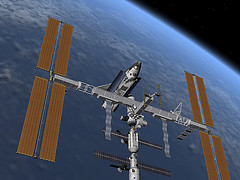
A digital rendering of the International Space StationThere may be little to no consumption of alcohol aboard, but there’s plenty of drugs on the International Space Station – albeit not for recreational purposes. The Discovery Space blog has a list of the contents of the ISS pharmaceutical kit-bag, of which this is just one [via SlashDot]:

Tranquilizers: […] astronauts keep a few tranqs on hand in case anyone goes all suicidal or psychotic in space. NASA recommends binding the individual’s wrists and ankles with duct tape (ever the space traveler’s friend!), strapping them down with a bungee cord and, if necessary, sticking them with a tranquilizer. Sure, it hardly makes for a civilized evening aboard ISS, but it beats someone blowing the hatch because they think they saw a something crawling on one of the solar panels.

Good old NASA, always thinking ahead. If you’re still curious about the astronaut lifestyle, Bruce Sterling has written a piece based on an interview with Nicole Stott that sums up what it’s like to live in space:

The time you spend in outer space will change your blood and hormone levels, and your bones and muscles will slowly waste away. A three-month stay is optimal; six months is pushing it. You’re going to need to get in shape and remember to pack light.

With that understood, let’s settle in. Built over the course of ten years by a wide variety of contractors­­—–and still a work in progress—–the ISS is a hodgepodge trailer camp graced with quite a lot of Russian design. It features two basic living elements: big round tubes, trucked up there in the American Space Shuttle, and smaller knobby tubes, fired up on other people’s rockets. All these pods have been snapped together, mostly end to end, or, as you’ll say on the station, “fore and aft.”

In a nutshell: it’s not exactly a five star hotel. But you know what?

I’d still go tomorrow if they gave me the chance. [image by FlyingSinger]

Charlie Stross: we’re probably never going to build starships

an unlikely spaceshipHere’s a second piece of punditry for your Monday morning, this time from the inimitable Charlie Stross. He’s been poking the traditional sf mythology of the starship with a sharp stick over the last few months, and the end result is a suggestion that – as far as realistic speculation about the future is concerned – we need to recognise the starship as the nautical metaphor it really is, and face up to the fact that the only plausible way we could reach other stars is through tiny “starwisp” probes made of memory diamond substrate. [image by Brenda Starr]

Again, the whole piece is well worth your time (if only to see that Stross has sat down and run the numbers on it), but here’s the coup de grace:

… yes, I think human interstellar exploration (and yes, maybe even colonization) might be possible, after a fashion. But to get there, we’re going to have to master at least two entire technological fields that don’t yet exist, even before we start trying to blast compact disc sized machines up to relativistic velocities. And that’s without considering the difficulty of how to cram an industrial infrastructure capable of building more of itself, of a machine capable of surviving in deep space — the equivalent of those 300,000 NASA technicians and engineers — into the aforementioned CD-sized machine …

If we succeed in doing it, it’s going to look nothing like the Starship Enterprise. Or even New Horizons. The whole reference frame we instinctively assume when we hear the word “ship” is just so wrong it’s beyond wrong-ness: it’s on a par with Baron Munchausen’s lunar exploits as seen in light of the Apollo Program. We need a new handle for discussing and analyzing such a venture. And the sooner we consign the “-ship” suffix to the dustbin of failed ideas, the better.

If Stross is right, then the only sf writer of my experience who has written truly plausible descriptions of post-human exploration beyond the solar system is Greg Egan… can anyone suggest any others?

But just in case Stross has put you on a downer with his debunking, here’s a potential antidote in the form of scientists speculating about using the Hawking radiation from small man-made black holes as a power source for interstellar propulsion. One of them even goes so far as to suggest that the sweet-spot in the physics that informs the theory implies that we live in “a universe optimised for building starships”…

NEW FICTION: SPIDER’S MOON by Lavie Tidhar

Almost every short fiction venue worth its salt will have some sort of guidelines as to what sort of material they’re looking for… but I suspect almost every editor will confess that, when the story is good enough, the guidelines can flex a little to allow it through.

That’s exactly what happened with “Spider’s Moon” by globe-trotting star-ascendant Lavie Tidhar, which is set in a slightly deeper future than we usually deal with here at Futurismic. But its core concerns are closer to home, and it’s a strong tale well told – so we’re proud to be publishing it for you to read. Enjoy!

Spider’s Moon

By Lavie Tidhar

Night, a full spider’s moon in the sky; hundreds of lanterns hung along the river, and the smell of saffron and garlic and dried lemongrass filled the air; a warm night, candles burning on street corners with offerings of rum and cooked rice, the hum of electric motorbikes, the murmur of a sugarcane machine as it crushed stalks to make the juice.

Ice tinkling in glasses; on small plastic chairs people sat by the river, drinking, talking. A hushed reverie, yet festive. Hoi An under the spider’s moon, French backpackers singing, badly but with enthusiasm, while one of their number played a guitar.

Save me from the raven and the frog, and show me safely to the river’s mouth, O Naga, he thought. Frogs had never been his favourites. Green and slimy, and always too loud. Like rats, almost. Like green, belligerent rats. Continue reading NEW FICTION: SPIDER’S MOON by Lavie Tidhar

Karl Schroeder deflates further Mars FUD

After dismantling the suggestion that a Mars mission is too inherently dangerous for humans to undertake, Karl Schroeder has a new targetScience Daily announces a paper that claims that we can’t go to Mars because the spacecraft will fill up with nasty bacteria and make everyone sick [via SlashDot]:

Frippiat and colleagues based their conclusions on studies showing that immune systems of both people and animals in space flight conditions are significantly weaker than their grounded counterparts. They also reviewed studies that examined the effects of space flight conditions and altered gravity on virulence and growth of common pathogens such as Salmonella, E. coli and Staphylococcus. These studies show that these bacteria reproduce more rapidly in space flight conditions, leading to increased risk of contamination, colonization and serious infection.

The basic facts there are quite true, but they’re being deployed alongside some invidious assumptions, as Schroeder points out:

This doesn’t mean that space flight is intrinsically dangerous.  It means that badly shielded tin-can environments that aren’t spun for gravity are a bad idea.  And that is quite a different conclusion.

Prolonged exposure to zero gravity weakens the immune system, so don’t expose astronauts to prolonged zero gravity.  Invest in some research into how to spin the spacecraft.  Then spin the spacecraft.

Secondly, shield the damn things.  The only reason why radiation is considered an issue is because it’s expensive to transport heavy shielding into orbit. One solution would be to use lunar water; simply put bags of the stuff around the ship.  That makes it heavier and hence requires more fuel… but now the problem can be seen for what it is, a simple problem of launch costs.

Spaceflight is not bad for our health.  Cut-rate spaceflight that avoids the obvious solutions is.

Those obvious solutions are, of course, a function of the launch cost issue – there’s a solution for pretty much everything if you can just get the necessary hardware up into orbit, but that’s not an option while we’re constrained by the limitations of rocketry.

I suspect that we’ll get there eventually, provided we survive our short- to medium-term future. After all, sailing ships were almost impossible to keep disease-free at first, until some smart minds got focussed on fixing the problems – and the motives for those fixes were profit and colonial expansion, which are likely to be exactly the same factors that propel us out of the gravity well. Perhaps the commercial space operators will break out of the rocketry box, given the chance.