Tag Archives: space

UK government to part-finance manned Mars mission?

marsI know, it sounds pretty far fetched – but evidently all this stirring talk of great achievements has gotten someone hot under the collar, as Wired UK gives the (apparently exclusive) news that the UK government may change its policy on funding contributions to the ESA in favour of supporting manned missions, possibly someday sending a Brit along on a manned mission to Mars:

… Drayson said that the review would not result in a larger budget for space research in the UK, but could reverse the country’s refusal to fund manned missions. He said the European Space Agency’s (ESA) selection of a British astronaut, Tim Peake, for its astronaut training programme and the agency’s work towards a mission to Mars would help to capture the public imagination.

[…]

To date, the UK has only supported robotic explorations in space, and stipulated that the £180 million that it pays towards the work of ESA is not used for manned space programmes. As a result, the first Briton in space, Helen Sharman, travelled to the Mir space station on a Soviet rocket in 1991 as part of a privately funded mission. Other Britons who have also reached space did so by changing their nationality to become American or by going as space tourists with Russian space shuttles.

Drayson hopes to change this stance, but acknowledged that any UK manned mission would be the result of a collaboration with other nations. “Reaching Mars will be a huge scientific challenge but it won’t be done without a global effort,” he said.

The consultation will also look at whether the current UK space body, British National Space Centre (BNSC), should be replaced by a new British space agency. Drayson suggested that the new agency will be called Her Majesty’s Space Agency.

HMSA… sounds like something from an as-yet-unwritten Warren Ellis comic. Who knows what will actually come of it – the UK government will say anything that they think has a hope of raising a smile at the moment – but it’s quite gratifying to think that we might get involved more seriously with space exploration. Sadly I’m now way too old and unfit to even consider revitalising my childhood dream of being an astronaut… I doubt they’d need a blogger, anyway. *sigh* [image from Physorg]

But hey, I’ll bet Paul McAuley’s pretty stoked by the news; only yesterday, he was suggesting that a Mars mission should be reinstated as a long term goal for human space exploration:

Not because it’s easy; because it’s hard. Not because the Russians (or Chinese) might get there first. Cold War imperatives like that died when the Berlin Wall came down. No, we should send an international mission, for all humankind.

[…]

Impossibly ambitious? Foolishly optimistic? Maybe. A waste of money better spent on problems right here on Earth? These guys don’t think so. And hey, there are always going to be problems here on Earth, and most of the money will stay right here, employing an army of specialists and engineers, stimulating new technologies. There’s been a large amount of looking back, these past weeks, and regret for what might have been, if the Apollo programme hadn’t been abandoned. Let’s not make the same mistake again.

And, as pointed out at The Guardian, there’d be no shortage of volunteers for a manned Mars mission, even if it were made plain that it was a one-way ticket:

“You would find no shortage of volunteers,” said John Olson, Nasa’s director of exploration systems integration. “It’s really no different than the pioneering spirit of many in past history, who took the one-way trip across the ocean, or the trip out west across the United States with no intention of ever returning.”

[…]

Nasa is currently bound by Kennedy’s directive to bring its astronauts home, Olson said. But the other nations rapidly developing space programmes may shed the constraint, as could the commercial companies that may supplant national efforts. “Space is no longer for power and prestige; it’s truly for economic benefit,” the Apollo 11 flight director Eugene Kranz said. “The technology that emerges from high-risk, high-profile, extremely difficult missions is the technology that will keep the economic engine of our nation continuing to go through the years.”

With currently foreseeable technology, a round trip to Mars launched from a lunar outpost would take two to three years – a journey of six to nine months each way and a year-long mission on the surface.

If I was even close to meeting the selection criteria, I’d volunteer without a second thought.

But in the meantime, while we’re stuck here on Earth, how about a little mood music, eh? This video features a bootleg recording of Pink Floyd’s lost “lunar landing jam”, which they played out live as part of the BBC’s covergae of the Apollo landings [thanks to DailySwarm]. Get yer interplanetary blues on…
Forty years since Armstrong’s one small step – where next?

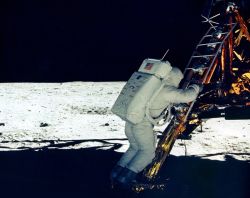
Buzz Aldrin begins his moonwalkI’m too young to join in the first-hand reminiscences of the Moon landings, but it’s still an event that played a huge role in my imaginative development – as it doubtless did for many other geeks and science fiction fans. [image courtesy NASA]
I think the Apollo project’s biggest symbolism for me is that of the bitter ironies of human technological achievement: to have sent a man into space, had him walk on the Moon and come back safely is quite simply a staggering achievement by whatever metric you choose to use; to have only found the motivation and political will to do so because of a geopolitical/ideological pissing match is rather sad. And it’s that very motivation that ensured us never returning to Luna, as Tom Wolfe points out:

Everybody, including Congress, was caught up in the adrenal rush of it all. But then, on the morning after, congressmen began to wonder about something that hadn’t dawned on them since Kennedy’s oration. What was this single combat stuff — they didn’t use the actual term — really all about? It had been a battle for morale at home and image abroad. Fine, O.K., we won, but it had no tactical military meaning whatsoever. And it had cost a fortune, $150 billion or so. And this business of sending a man to Mars and whatnot? Just more of the same, when you got right down to it. How laudable … how far-seeing … but why don’t we just do a Scarlett O’Hara and think about it tomorrow?

And that NASA budget! Now there was some prime pork you could really sink your teeth into! And they don’t need it anymore! Game’s over, NASA won, congratulations. Who couldn’t use some of that juicy meat to make the people happy? It had an ambrosial aroma … made you think of re-election …

But hey – this site’s about the future, so let’s look forwards, eh? Former NASA administrator Alan Stern reckons that private industry is the future of spaceflight, and that sub-orbital tourism might be ubiquitous in another decade or so:

I think that when anyone can fly in space, rather than just those that governments choose to send in to space, it’s going to really revolutionize, not only how we look at it, but it’s going to be an accelerant to the desires to have even more of that.

The prices start off pretty high – it’s tens of millions of dollars to fly in space, but those prices will come down, and fly sub-orbitally, ticket prices are in the range of a couple hundred thousand dollars, but those are going to come down a lot to I think over time. I expect that 10 years from now, they’ll be a fraction of that.

And it turns out there may be another motivational force to pull us back to the Moon – if we ever manage to crack commercial fusion power generation, we’d be able to rake up a whole lot of fuel up there:

… the Moon’s soil is rich in helium-3, which comes from the outer layer of the Sun and is blown around the Solar System by solar winds. The element is rarely found on Earth, unlike on the Moon, where it is heavily accumulated because it is pushed away by the Earth’s magnetic poles.

[…]

Reserves of helium-3 on the Moon are in the order of a million tonnes, according to some estimates, and just 25 tonnes could serve to power the European Union and United States for a year.

That’s a whole lot of fuel… but it’s still a finite resource, and historically those tend to lead to trouble and strife of some sort as the world’s powers jostle for the biggest slice of the pie. At least if colonialism reaches the Moon there won’t be any natives to exploit introduce to civilisation…

… none that we know of, anyway.

Space is the place

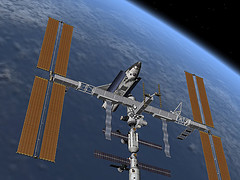
CGI rendering of the International Space Station Thanks to the anniversary of the Apollo Moon landings, everyone’s talking about space at the moment – and it’s still as contentious and passionate a subject as ever. [image by FlyingSinger]

Charlie Stross looks back at the Moon landings and decides that despite the huge advances in technology since the 60s, NASA’s proposed Constellation Moon landing program is unlikely to come off:

Today we lack a vital resource that both Wernher von Braun and Sergei Korolev took for granted: thousands of engineers with the experience of designing, building, and launching new types of rocket in a matter of years or even months. We used to have them, but some time in the past 40 years they all retired. We’ve got the institutions and the data and the better technology, but we don’t have the experience those early pioneers had. And I’m betting that the process of rebuilding all that institutional competence is going to run over budget. While NASA’s Constellation program might work, and while it could deliver far more valuable lunar science than Apollo ever did, it will inevitably cost much more than NASA’s official estimates suggest, because it’s too big a project for today’s NASA — NASA, and indeed the entire space industrial sector in the USA, would have to grow, structurally, to make it work.

Elsewhere, Paul McAuley laments the ‘disposable space truck’ model of space flight, saying it’s:

like building an ocean liner to cross the Atlantic and setting fire to it when you reach New York.

Meanwhile, SpaceX have just completed their first commercial satellite launch, successfully putting a Malaysian Earth-imaging sat into orbit.

SpaceX landed a NASA contract for hauling cargo up to the ISS some time ago, but it looks like they won’t be able to rely on that as a long-term entry on the balance sheet, as Bruce Sterling points to an article in the Washington Post wherein NASA’s space program manager announces the controversial plan to de-orbit (and hence destroy) the International Space Station when the budget runs out in 2016:

Suffredini raised some eyebrows when, at a public hearing last month, he declared flatly that the plan is to de-orbit the station in 2016. He addressed his comments to a panel chaired by former aerospace executive Norman Augustine that is charged by the Obama administration with reviewing the entire human spaceflight program. Everything is on the table — missions, goals, rocket design. And right there in the mix is this big, fancy space laboratory circling the Earth from 220 miles up.

The cost of the station is both a liability and, paradoxically, a virtue. A figure commonly associated with the ISS is that it will ultimately cost the United States and its international partners about $100 billion. That may add to the political pressure to keep the space laboratory intact and in orbit rather than seeing it plunging back to Earth so soon after completion.

Apparently physicist and vocal space critic Robert Park suggests palming off the money-eating white elephant on the Chinese instead. I’d have thought auctioning it off to the highest bidder would have made more sense, and I’m pretty sure there’s be some interested parties – China included, but plenty of non-state parties also.

And finally, via Warren Ellis comes something for flicking your geek switches – HFradio.org can supply you with space weather updates via Twitter. As Ellis remarks, “it’s like the Shipping Forecast for space”… now all we need is a way to convert it to an audio stream. Anyone got a zero-g Nabaztag?

Scale

Here’s a bit of sensawunda for your Saturday. Spend ten minutes and think about the size of universe, starting at the home base of our own Sun and moving on out into mind-boggling infinities…

Most of this stuff will be familiar to Futurismic readers, I imagine, but the images are good, and I still get that sf-nal kick from being reminded of the incredible and momentary insignificance of our own existence. [via MetaFilter]

Space-based solar again

solar eclipseSpace-based solar power is about as science fictional as an energy solution can be, but that doesn’t seem to be stopping people from trying to make it a reality. We mentioned Solaren’s combined energy platform and hurricane killer idea back in April; now here’s PowerSat, who (naturally) have their own unique selling point:

Most proposals for space-based solar have involved a constellation of satellites, each transferring those 17MW to a central unit for transmission back to earth. This adds to the complexity of the system and means at least one satellite has to integrate a very large amount of power. PowerSat hopes to avoid all that. The satellites will receive a pilot signal from the ground and use that to coordinate their energy-carrying return signal to the ground-based receiver. “The satellites act as a radio frequency cloud to create a phase array of phased arrays,” Maness says.

When the microwave signal hits the ground, the transmission from each satellite should be additive—all of which dramatically cuts down the weight and complexity of the hardware that has to be put into orbit.

There are, of course, concerns about the effects of the power transmission beams when they reach the surface, but PowerSat are convinced (after researching thoroughly) that there would be no harm to humans, animals or anything else living. However, the beam would certainly knock out your mobile phone signal – which is a pretty minor flaw, but one that’s bound to create a significant obstacle to PowerSat’s plans… [image by James Jordan]