Tag Archives: space

Swimming at the strip mall

Macro-Sea dumpster swimming poolAs regular readers will know, I get a kick out of stories about the reclamation of disused and abandoned urban spaces. BoingBoing flagged up a rather cute and apolitical example – an organisation called Macro-Sea that transforms defunct strip malls into community spaces, most notably by building public swimming pools out of industrial-sized dumpsters.

As Jocko and I continued our correspondence I quickly learned that Steve was right (not that I ever doubted him), the pool project was a small part of something much larger. Macro-Sea has been involved with a number of artists, architects and retailers across the country working to transform defunct strip malls. “By stripping and altering its [strip malls] common architectural features, adding community space and involvement, and carefully selecting and curating vendors and the space itself Macro-Sea hopes to create and promote a place for people to shop, meet, learn, and engage with one another.” Sounds like a good plan to me and I’ve seen it happen successfully before, in Sao Paulo, Brazil a few years ago.

This project is conceptually connected to Chairman Bruce’s squelettes, and to the theory of the Temporary Autonomous Zone. As cities expand, there will be more and more of these dead spaces scattered around, and I’d like to see people making imaginitive use of them rather than waiting for the authorities to scrape together the cash to build some sterile new development… or, more likely, a new mall to replace the old. [image borrowed from article at ReadyMade Magazine]
Inflatable tower to reach the edge of space

Step aside, space elevator evangelists – here’s an idea for joining the earth’s surface to space that’s much simpler, cheaper and safer than a big ribbon of carbon nanotubes.

A team of Canadian researchers have proposed a hollow tower constructed from the inflatable tubular modules that are used in some modern spacecraft, which – if built on top of a suitable mountain – could reach 20 kilometers above the Earth’s surface and act as a staging point for space launches… or a tourist destination with much lower risks and costs than suborbital rockets.

The team envisages assembling the structure from a series of modules constructed from Kevlar-polyethylene composite tubes made rigid by inflating them with a lightweight gas such as helium. To test the idea, they built a 7-metre scale model made up of six modules (see image). Each module was built out of three laminated polyethylene tubes 8 centimetres in diameter, mounted around circular spacers and inflated with air.

To stay upright and withstand winds, full-scale structures would require gyroscopes and active stabilisation systems in each module. The team modelled a 15-kilometre tower made up of 100 modules, each one 150 metres tall and 230 metres in diameter, built from inflatable tubes 2 metres across. Quine estimates it would weigh about 800,000 tonnes when pressurised – around twice the weight of the world’s largest supertanker.

Of course, the caveat is that this is just a theory at the moment – but it at least has the merits of being based entirely on existing technology. It seems that inflating things to reach space is quite the fashion at the moment…

Romania’s balloon-launch moonshot

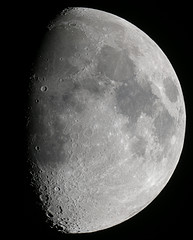
The MoonIt’s been a while since space exploration was the sole province of national behemoths like NASA, despite the relative infancy of the commercial space sector. A small budget might prevent you from launching human payloads, but there’s still plenty of options at the bottom end of the funding scale… along with some tantalising enticements for an outfit with big dreams[image by ComputerHotline]

Romanian company ARCA is one such outfit, and they’re taking a stab at the Google-funded Lunar X Prize using comparatively cheap and simple technology:

a balloon that can carry ARCA’s European Lunar Explorer (ELE) space probe into the upper atmosphere, eliminating the need for a traditional launch pad and allowing ARCA to launch close to the equator from a sea platform. The “0” pressure balloon design is similar to a giant black hot-air balloon that uses solar energy to heat the air inside, instead of the burner that normal hot-air balloons use.

Once the balloon soars above 11 miles (18 km), the three-stage rocket slung below will fire and boost itself into low Earth orbit. ELE will then travel to the moon and deploy its Lunar Lander, which resembles a knobby rubber ball that uses its own rocket engine to ensure a soft landing.

ARCA’s lander itself isn’t really designed to do much when (or rather if) it arrives on the Lunar surface; because of the way the X Prize is defined, reaching the Moon is more important than achieving anything there. But as with most private space-launch initiatives, it’s all about proof-of-concept – once they know they can make the journey, they can start thinking about what to cart along next time.

Balloon-launch projects always remind me of Zion Cluster from William Gibson’s early novels, which – if I remember correctly – was colonised by exactly this sort of cheap-and-cheerful bootstrap approach.

The lost cosmonauts of Russia’s black space program

Russian Wostock space rocketOK, this isn’t strictly a science fictional post, but it’s just that interesting a story – and a well-told one, too – that I thought it deserved sharing here, where I think it’ll be appreciated. It’s the tale of two Italian radio geeks, and how they accidentally became the ears of the West within Russia’s space programmes – the one that’s common knowledge, and the ones that were kept quiet.

It is the ultimate in Cold War legends: that at the dawn of the Space Age, in the late 1950s and throughout the 1960s, the Soviet Union had two space programmes, one a public programme, the other a ‘black’ one, in which far more daring and sometimes downright suicidal missions were attempted. It was assumed that Russia’s Black Ops, if they existed at all, would remain secret forever.

The ‘Lost Cosmonauts’ debate has been reawakened thanks to a new investigation into the efforts of two ingenious, radio-mad young Italian brothers who, starting in 1957, hacked into both Russia’s and NASA’s space programmes – so effect­ively that the Russians, it seems, may have wanted them dead.

True, or bunk? I don’t know – but it’s a damned good story. Go read it – it’ll be fifteen minutes well spent. [via the indispensable MetaFilter; image by James Duncan]

The first watery exoplanet?

An alien coastline?I’ll wager you’ve caught at least a hint of this story already: astronomers reckon they’ve located the first serious candidate for a water-bearing exoplanet:

… new calculations – made possible by the discovery of “[Gliese 581] e” – show that the larger planet is squarely within the so-called “habitable zone,” neither too far nor too close to the star around which it orbits to support life.

“Gliese 581 d is probably too massive to be made only of rocky material, but we can speculate that it is an icy planet that has migrated closer to its star,” said co-author Stephane Udry, a professor at Geneva University, in Switzerland.

“It could even be covered by a large and deep ocean – it is the first serious ‘waterworld’ candidate,” he said.

A waterworld, eh? As Gareth L Powell put it, maybe we should dispatch Kevin Costner immediately

More seriously, a wet Gliese 581 d is only a possibility as yet, but it’s a possibility that shifts the odds on there being life elsewhere in the universe. When (or perhaps I should say “if”) we manage to confirm the presence of liquid-phase water on other planets, we’ll have to concede that the likelihood of life evolving elsewhere is not as remote as was once thought… which will doubtless be immensely upsetting to some people, but makes me feel pretty good. [image by Paulo Brandão]