Tag Archives: space

DIY space photos

stratosphereThis is really neat, via Slashdot, some Spanish students have sent a camera on a balloon up into the stratosphere, with excellent results:

Taking atmospheric readings and photographs 20 miles above the ground, the Meteotek team of IES La Bisbal school in Catalonia completed their incredible experiment at the end of February this year.

Building the electronic sensor components from scratch, Gerard Marull Paretas, Sergi Saballs Vila, Marta­ Gasull Morcillo and Jaume Puigmiquel Casamort managed to send their heavy duty £43 latex balloon to the edge of space and take readings of its ascent.

Read and see more here.

[from the Telegraph, via Slashdot]

Cleaning up in orbit: ways to remove proliferating orbital crud

map of orbiital debris around Earth - courtesy NASASpace isn’t empty at all – it’s full of crap, much of it (unsurprisingly) put there by us. And much like the rubbish we leave elsewhere, orbital junk is becoming a serious problem:
The volume of man-made space debris has grown so large that scientists say garbage now poses a bigger safety threat to the U.S. space shuttle than an accident on liftoff or landing. The International Space Station occasionally fires thrusters to dodge junk.

So, what can you do? There are plenty of ideas, many of which sound like they were ganked straight from old sf dime novels:

Among the suggestions: launching big nets and large magnets to snag refuse, or using high-energy lasers to atomize debris. None of these ideas is feasible. Magnets would be useless because spacecraft contain almost no iron. Nets are almost uncontrollable. Blasting debris, meanwhile, would simply create smaller remains that would be tougher to track and produce a vast haze of shrapnel, experts say.

In short – the jury’s still out, and the problem still needs fixing. If this was a Ben Bova story, some plucky risk-taking entrepreneur would step in and make his fortune in short order…

… from which we can only conclude that life isn’t a Ben Bova story (at least, not yet). [via SlashDot; image coutesy NASA]

Chinese to launch military space station

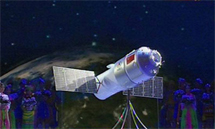
china_stationThe Chinese government has announced its intention to launch two space stations over the next two years, one for civil use and one for military activities:

The design, revealed to the Chinese during a nationally televised Chinese New Year broadcast, includes a large module with docking system making up the forward half of the vehicle and a service module section with solar arrays and propellant tanks making up the aft.

The concept is similar to manned concepts for Europe’s Automated Transfer Vehicle.

While used as a target to build Chinese docking and habitation experience, the vehicle’s military mission has some apparent parallels with the U.S. Air Force Manned Orbiting Laboratory (MOL) program cancelled in 1969 before it flew any manned missions. MOL’s objectives were primarily reconnaissance and technology development.

This is all due to happen in the same year that NASA is phasing out the space shuttle: how will Chinese progress in space affect US space policy?

[from SPACE.com via Slashdot][image from SPACE.com]

Well, that was a close one…

… but you probably didn’t even notice it. Earlier this week, we apparently came within a cosmological gnat’s whisker of colliding with an asteroid of similar size to the one that caused the Tunguska astrobleme:

The asteroid, dubbed 2008 DD45, whizzed just 72,000 kilometres above the Earth’s surface. That is less than a fifth of the distance to the Moon and just twice the distance to geosynchronous satellites.

Yikes. It was first reported on Saturday; that’s all the warning we might have had. And had it been a bit bigger, it could have caused a planetary extinction event that would make the climate crisis look like a tea-party. Chalk another one up to human luck, eh?

You think the Earth is rare? I got a dozen just like it out back…

Planet EarthOne of the better known responses to the Fermi Paradox is the Rare Earth hypothesis – the supposition that our planet is rare or unique in its ability to harbour life, and that hence we are unlikely to encounter life-forms elsewhere beyond our own biosphere. [image by Aaron Escobar]

Well, George Dvorsky isn’t having any of it.

I’ve always thought, however, that given cosmologically large numbers that this sort of thinking is symptomatic of our small minds and limited imaginations. It’s easy for us to throw up our hands and sheepishly declare that we’re somehow special. Such a conclusion, however, needs to be qualified against the data involved, and by the mounting evidence in support of the notion that ours appears to be a life-friendly universe.

Dvorsky goes on to attack the assumptions of Rare Earthers methodically.

It’s a myth, for example, that it took life a long time to get going on Earth. In reality it was quite the oppoite. Our planet formed over 4.6 billion years ago and rocks began to appear many millions of years later. Life emerged relatively quickly thereafter some 600 million years after the formation of rocks. It’s almost as if life couldn’t wait to get going once the conditions were right.

This isn’t to say that Dvorsky thinks that we’re being visited by little green men on a regular basis, though; he has a more worrying idea about why we’ve not heard from our neighbours yet.

My feeling is that the Rare Earth hypothesis is a passing scientific fad. There’s simply too much evidence growing against it.

In fact, the only thing going for it is the Fermi Paradox. It’s comforting to think that the Great Silence can be answered by the claim that we’re exceptionally special. Rare Earth steers us away from other, more disturbing solutions –namely the Great Filter hypothesis.

Of course, only evidence of alien civilisation will ever answer Fermi’s famous question; it’s always struck me as a kind of science fictional restatement of the argument for the existence of god. Maybe that’s why it’s such a fascinating subject for debate? A bit of teleology never fails to get people thinking…