Tag Archives: space

Space-borne solar-powered hurricane killer

Hurricane Reduction System diagramOK, folks, here’s your weird and way-out patent application for the week: a method for destroying or weakening hurricanes by beaming a heat ray at them from an orbital platform.
Maybe it is crazy, but that same company, Solaren, took a first step in that direction this week when it inked a deal with the northern California utility, PG&E, to provide 200 megawatts of power capacity transmitted from orbit in 2016.

That’s just the start though:

By heating up the upper and middle levels of an infant hurricane, they say they could disrupt the flows of air that power the enormous storms. Air warmed by tropical waters flows up through a hurricane and is vented through the eye into the upper atmosphere. Theoretically, you could heat up the top of the storm and lower the pressure differential between layers, resulting in a weaker storm.

Thanks to regular commenter Robert Koslover for tipping me off to that one; I think HAARP just got a serious relegation in the tin-foil hat weather-modification paranoia league. And it makes the Vatican’s planned solar plant look a bit pathetic by comparison, eh? [image ganked from linked article]

Garden on the moon

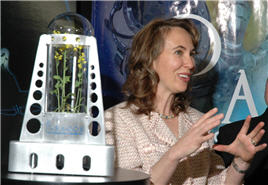
grand-lunar“The Selene Gardening Society,” anybody? Two corporations want to grow vegetables and flowers in a bell jar-like miniature laboratory greenhouse on the moon.

The “Lunar Oasis” has a certain poetry going for it.  “Imagine a bright flower or a plant in a crystal clear growth chamber on the surface of the Moon, with the full Earth rising above the Moonscape behind it...” says Paragon Space Development founder and Biosphere 2 veteran Jane Poynter. Plants have never been grown in a fraction of Earth’s gravity.

Candidates for the experiment besides flowers include aquatic plants and also the unpoetic brassica family (which includes cabbage, broccoli, brussels sprouts).  The garden could be sprouting as early as 2012.The project is a contender for the Google’s $30 million lunar robotics prize.

H.G. Wells, Pierre Boulle, Steve Erikson, and presumably Busby Berkeley must be smiling.

[Image: Grand Lunar (OK, U.S. Rep.) Gabrielle Giffords with lunar greenhouse prototype, Paragon Space Development]

Travel to Mars… without ever leaving the parking lot

MarsSo, do you think you could cope with the cramped conditions and prison psychology that would be an inevitable part of a manned mission to Mars and back?

Well, here’s the test – we’ll lock you in a fake space capsule that’s sitting in a parking lot somewhere outside of Moscow for about a hundred days with five other people and watch you through cameras to see how you get on.

The idea is for the 550 cubic-metre “ground exploration complex” (GEC) to recreate as closely as possible the atmosphere of a spacecraft racing through the solar system, bombarded by cosmic radiation. Any return flight to Mars – at least 34 million miles from our planet – would take between 18 months and three years, including landing and exploration.

The volunteers – four Russians, a French airline pilot and a German army engineer – will be kept under constant camera surveillance to record the physical and psychological impact of their time in the isolation chamber.

Isn’t this lifted wholesale from a J G Ballard story? You’re surely going to get some industrial-grade cabin fever going on…

Mark Belokovksy of the IMBP admitted the psychological pressure of living in close quarters with five other human beings could crack even the toughest guinea pigs.

“Tension is inevitable,” he said candidly. The fact the 105-day “flight” will be a single-sex trip on this occasion may be a blessing. During a similar experiment in 1999 the participants were given vodka to celebrate New Year’s Eve: two members then got in a fist fight after one tried to kiss a female volunteer from Canada.

Yeesh; the green-eyed monster in outer space, no less. I wonder where I can find details about that Canadian experiment – I’m curious to know whether the women fared any better at the isolation than the men did. Would an all-female crew be more stable, or less? How about a crew of eunuchs?

But if you’ll permit me a brief flight of fancy, mashing up this story with that half-remembered Ballard piece and the Moon hoax conspiracy theories: I wonder if it would be possible for a government with sufficient space capability to run an entirely faked CGI Mars mission that fooled everyone, even the cosmonauts themselves? [image by jasonb42882]

Oddball galaxy discovered

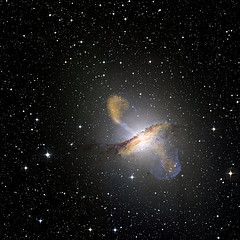
The Centaurus A galaxySeems there’s always something new to discover in the field of astronomy. The latest nugget of cosmological excitement is a tiny, dark-matter-free and closely-packed galaxy out in the direction of the Sombrero:

“It was only the size of a star cluster – which typically contain about one million stars – but it shone as brightly as a small galaxy. This indicated the object was an ultra-compact dwarf galaxy, a very unusual object, possibly containing 10 million stars,” he said.

[snip]

“There is much debate in the astronomical community about how these things form. The prevailing theory is that they are dwarf galaxies that have been stripped of their outer halo of stars by the gravitational forces of the large parent galaxy, leaving only the bright inner core of stars. But we think it may be something else: a massive star cluster that has formed independently,” Hau explains.

Another unusual aspect of the ultra-compact dwarf galaxy is that it is very old – perhaps 10 billion years, indicating it was formed in the early stages of the universe, when things were all the more violent and energetic. Furthermore it appears to consist mainly of stars, rather than the still-enigmatic dark matter, which dominates the mass of most galaxies.

Small it may be, but SUCD1 is hardly peaceful, spitting out a powerful stream of X-rays. The team believes this to be the first time that X-ray emissions have been clearly detected from an ultra-compact dwarf object.

So, not your average ball of stars, then. And it may well turn out to be a natural (if freakish) example of the way the universe evolved…

… but indulge me a minute here, OK? An object much smaller than a normal galaxy, but which shines as brightly as one; an unusual topography of stellar density; an absence of the dark matter we’re accustomed to finding in such objects; a fierce source of X-ray emissions. You know that theory that says we’re most likely to find other advanced civilisations by looking for evidence of mega-engineering projects on the scale of Dyson Spheres and so on? Well, if I was one of the guys at SETI, I’d be booking some radio telescope time to scope out that little dwarf cluster.

Just sayin’. 😉

[Yeah, I know it’s probably just the first weird little galaxy of its type we’ve seen. But what can I say? I like Greg Egan novels. Image by thebadastronomer; it’s not of the galaxy in question, I’m afraid, but it is very pretty.]