Tag Archives: space

Should Mars be treated like a wildlife preserve?

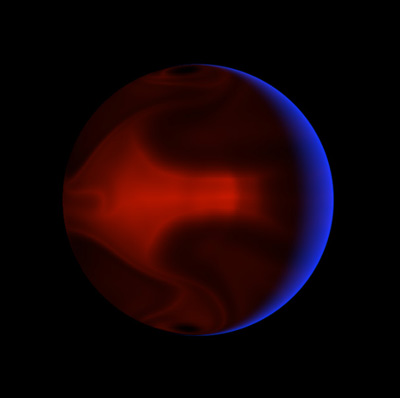
MarsFinding life on Mars would be pretty awesome, right? Of course it would – but it would also mean we’d have to change the way we work on the red planet, because of the ethical can of worms presented by contaminating a whole new biosphere.

We’ve already contaminated it, though – all of our probes and landers are likely festooned with Earthside microbes. Now some planetary scientists recommend that, should life be found, we remove or destroy our Martian hardware and keep things pristine:

He warns that Earth life could be reawakened if weather conditions on the planet change. This could happen as a result of periodic swings in the planet’s tilt, or if humans purposely alter the Martian environment, which, ironically, they might do to make conditions cosier for any Martian life they might discover. Microbes on subsurface drills in search of liquid water could also contaminate potential Martian habitats.

Here’s Jamias Cascio’s response:

… if life is found, definitely. No question. If fossilized life is found, also definitely, since that could mean dormant life, waiting for a Mars Spring.

If there’s no evidence of past or present life found… the question becomes more difficult. I always kind of sympathized with the Reds over the Greens in Kim Stanley Robinson’s Mars trilogy, but I also believe that establishing a human foothold off of Earth is a wise long-term survival strategy.

Could we justify changing the Martian climate, knowing that — as with Earth — such changes are irreversible?

The answer to that will depend on circumstance, I guess; it’s worth considering that the sort of political climate that would lead to greater exploration of Mars might well be the sort of climate that produces colonial attitudes. And the colonial era was pretty big on resource exploitation… [image by chipdatajeffb]

What do you think – should Mars be preserved pristine?

US and Russian satellites collide

satellite_dieOn Tuesday a satellite owned by the US company Iridium collided with an inoperative Russian satellite nearly 780 km above the Earth:
The risk to the International Space Station and a shuttle launch planned for later this month is said to be low.

The impact produced massive clouds of debris, and the magnitude of the crash is not expected to be clear for weeks.

There are thousands of man-made objects orbiting the earth, but this is thought to be the first time two intact spacecraft have hit each other, the BBC’s Andy Gallacher in Miami says.

Unfortunately as Earth orbit becomes more and more crowded (the number of orbiting objects larger than 10 cm reached 10, 000 in 2007 and is still increasing) it increases the risk of a cascade effect, where one collision results in a cloud of debris that go on to cause more collisions resulting in millions of tiny fragments resulting in a major and ongoing hazard to space exploration.

Given the risk of hindering future space exploration – is it worth pushing for an Earth orbit cleanup (and is such an idea even feasible)?

[from the BBC][image from Joe Hastings on flickr]

Drake equation crunched – 361 civilisations in our galaxy alone?

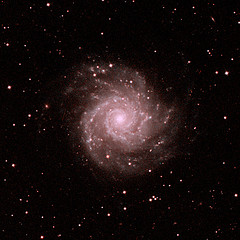
Messier-74 galaxyHey, great news for SETI fans! The latest work on the Drake equation suggests that we can all get our Fox Mulder on:

The current research estimates that there are at least 361 intelligent civilisations in our Galaxy and possibly as many as 38,000.

Awesome! Wait, what?

Even with the higher of the two estimates, however, it is not very likely that contact could be established with alien worlds.

Ah. Bugger.

Of course, the Drake Equation is only as good as its input data, and much of that remains wildly speculative. But the above is the result of factoring in the sudden rash of exoplanet discoveries we’ve made in the last few years; according to Centauri Dreams, the little we’ve learned about them means we can simulate the potential parameters of their atmospheres in order to guess how statistically likely they are to harbour the potential for life. Even that’s mostly guesswork, though:

… in biological terms, we are even more up the creek, since we base our thinking on observations of a single biosphere, our own. To keep the number of free parameters to a minimum, Forgan works with “a biological version of the Copernican Principle,” the notion that our Terran biosphere is not special or unique, so that we can think about life on other worlds as sharing many of the same characteristic parameters.

So keep watching the skies, folks! And don’t forget the hypothesis of Futurismic‘s own Mac Tonnies, which suggests that what we think of as extraterrestrials may in fact be something much more local… [image by jimkster]

Fermi Paradox solved?

fermi images Enrico Fermi asked a question that has troubled those searching for signals from extraterrestrial civilizations ever since: if the universe is teeming with advanced civilizations (as some solutions to the famous Drake equation would indicate), were are they? (From the physics arXiv blog via Improbable Research.)

Reginald Smith of the self-established Bouchet-Franklin Institute in Rochester, New York state, says in this paper, submitted to the International Journal of Astrobiology, that something is missing from the calculations: how far a signal from an advanced civilization can travel before it becomes too faint to hear. Factoring that in, he finds that:

Assuming the average communicating civilization has a lifetime of 1,000 years, ten times longer than Earth has been broadcasting, and has a signal horizon of 1,000 light-years, you need a minimum of over 300 communicating civilization in the galactic neighborhood to reach a minimum density.

Which means that even if there are a couple of hundred advanced civilizations in our galaxy, it’s quite likely none of them will ever notice the others…and our efforts at searching for extraterrestrial intelligence may be doomed.

(Image: Reginald Smith.)

[tags]astrobiology,SETI,aliens,space[/tags]