Tag Archives: space

Is there life on Mars? Atmospheric methane says ‘maybe’

MarsAfter last year’s long-awaited confirmed discovery of water on the red planet, David Bowie comes another step closer to finding the answer to his question: NASA called a press conference today to announce that they have, in partnership with some university science teams, “achieved the first definitive detection of methane in the atmosphere of Mars”.

So what’s the big deal with that? Basically, there’s two reasons you might find methane in a planetary atmosphere: geological activity or biological activity. It’s going to take a lot more work to discover which of the two is the culprit in the case of Mars (and the NASA announcement does a better job that I can of explaining it all), but either option is pretty exciting to space nerds… after all, it’s not all that long ago that we pretty much assumed the whole planet was inert.

And as a side-tangent, this is great political timing from NASA, whether accidental or deliberate – with a new president about to enter the White House with promises to shake things up, announcements like this get everybody talking about space with that old-school sensawunda I remember from my childhood… and given the bleak state of the news headlines at the moment, something to make us look up from the mundane for a moment can only be a positive. Something big to dream about. [image by chipdatajeffb]

I mean, just think – life on Mars! It’s like something out of a science fiction novel, isn’t it? 😉

Russia blasting biomass at Martian moons

Earth-Mars montageWhile the Western world waits to see what President-Elect Obama does with the US space program, the Russians are getting busy with a Mars mission of their own.  Due for launch in October, the charmingly-named Phobos-Grunt mission will be robot-manned, of course, but there will be earth lifeforms aboard, albeit very tiny ones:
LIFE [Living Interplanetary Flight Experiment] is intended to help better understand the nature of life, its robustness, and its ability – or not – to move between planets. The journey will be a test of one facet of the “transpermia” hypothesis. That is, the possibility that life can voyage from planet to planet inside rocks blasted off one planetary surface by impact, to land on another planetary surface.

Don’t worry, though; they’re not going to break the 1967 Outer Space Treaty by infecting Mars with Earth biology. Or at least they’re not going to do it deliberately – but that’s not stopping a few NASA types getting a bit hot under the collar about the whole business:

… I am uncomfortable with sending native tundra samples so close to Mars, because this is a location on Earth that could possibly contain organisms capable of adapting to Martian conditions,” and to do so “seems ill-advised,” Conley told SPACE.com.

Well, we surely don’t want to corrupt Mars with Earth microbes if we can avoid it. But how much of that discomfort is rooted in the Planetary Society using a Russian mission arther than a NASA one, I wonder? [superb montage image by Bluedharma]

Space shuttles for sale – $42million o.n.o.

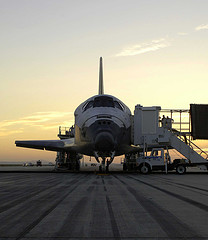
space shuttle on runwayStart scrimping and saving, US citizens, because 2010 will present you with an opportunity to purchase a piece of space memorabilia without peer – a used space shuttle. [image by D’amico Rodrigo]

Also, you’ll need to ally yourself with the right sort of organisation: a science museum, perhaps, or a university. NASA won’t sell them to any old interested party with $42 million in used banknotes, you see… or at least, that’s the plan at the moment while they scout for potential buyers. If there aren’t many interested parties, maybe your independent bid will be taken more seriously.

So why not go for it? The buying price includes the cost of stripping out all the toxic and hazardous materials, as well as flying it to a US airport of your choice – worry-free bargains like this are one of the upsides to the economic slump, I guess.

The Lunar landgrab – who owns the Moon, anyway?

the moonAfter a few decades of relative hiatus, there’s been a distinct increase of traffic around the Moon of late, and that has legal types scenting potential work in the offing. Once we start colonising our sister satellite – whether in person or via robot proxies – how do we decide who the territory belongs to?

Luckily for us, one Virgiliu Pop is already on the case. He’s a research specialist at the Romanian Space Agency (Romania has a space agency? Who knew?) who has been looking into the laws that might, by precedent, affect lunar settlements… and he reckons it’s rugged individualism and the pioneer spirit that will win the day:

“Homesteading is likely to transform the lunar desert in the same manner as it transformed the 19th Century United States,” he said. “Space is indeed a new frontier calling for individualism rather than collectivism, and its challenges need to be addressed with a legal regime favorable to property rights.”

As many empires have learned the hard way, maintaining control over distant colonies is no easy trick – and when the colony is at the other end of a steep gravity well, that’s only going to be more true. Anyone fancy a sweepstake on the period between first Lunar colony and first colonial secession? [image by jurvetson]