Tag Archives: surveillance

UAV drones for the Texas/Mexico border

When you’ve got a nice new hammer, everything looks like a nail: Statesman.com reports that the US government is about to cave in to pressure from Texan politicos and agree to supply UAV drones for surveillance duties along the border with Mexico:

If approved, the unmanned aircraft in Texas would add to the federal government’s existing border effort, which includes a handful of other unmanned aircraft, 20,000 Border Patrol agents, about 650 miles of border fence and 41 mobile surveillance systems, according to Customs and Border Protection.

The plane, which is made by General Atomics Aeronautical Systems and officially called a Predator B, is able to spot illegal border activity and send images in real time to border officials.

At that point, Border Patrol agents could be dispatched, according to Customs and Border Protection.

This story via Chairman Bruce, who remarks:

The fun part will come when these unmanned aerial vehicles are copied by narcotrafficantes and loaded with cocaine.

I think there’ll be a few other “fun parts”, though not quite so headline-worthy. Lot of kids along that border are going to get real proficient with low-tech ballistics and backyard camouflage, for instance. I wonder how good at differentiating between “illegal border activity” and “activity near a border” the hardware and operators will be? And how long it’ll be before those drones have some sort of payload, pour discourager les autres?
Fooling facial recognition software: the Adam Ant method

This one’s been doing the rounds for a few days, but I thought I’d throw it out for those of you who’ve not seen it yet: some graduate research suggests that stylised facial decoration and make-up (a la eighties New Romo band promo shots and cyberpunk bandwagon movies) may be a simple and effective counter-response to the increasing ubiquity of surveillance cameras with facial recognition software [via Technoccult].

Cleaning up for Street View

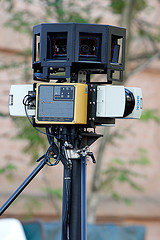
Google Street View camera arrayThe city of Windsor in Ontario, Canada has apparently requested Google reshoot some of its Street View footage in order to remove a murder scene (complete with Do Not Cross police tape barriers and bloody bandages) from the public record, prompting Mike Masnick of TechDirt to wonder

[… whether] towns and cities are going to start to “prepare” for Google Street View cars coming through and make sure that everyone is on their best behavior

Seems pretty likely, doesn’t it? [image by sfmine79]

The threat of being seen without one’s “make-up” on has always been around. For instance, I can still remember the way every school I ever attended spent a week gussying the place up and drilling the students in advance of the government inspectors, which was probably one of my earliest cognitive dissonance awakenings – what was the point of inspections if they only occurred after a metaphorical wash’n’brush-up? Why not just, y’know, improve things generally rather than making a last-minute effort once a year*?

This feeds into the idealistic notion that ubiquitous transparency is a good thing, I suppose: if every city (or school, or whatever) knew it could be inspected (or Street View’d) at any time without warning, then perhaps they’d be more likely to fix problems at the root cause instead of sweeping the problems under the rug before the visitors arrive.

Of course, that’s a massive oversimplification of a very complex issue, but the Windsor story is a harbinger of institutional panics yet to come; much as technology could enable nation-states to turn themselves into panopticons, the spotlight can also be pointed in the other direction. The next few decades will be all about the struggle between individuals and corporate or geo-political entities to filter and control their realities as presented to the rest of the world… which is why I’m fairly convinced that augmented reality will be the multi-planar battlefield of manifold and fractal ideological struggles between citizens, states and corporations.

[ * The answer is very obvious now, of course, with the benefit of experience (and the cynicism toward institutions and bureaucracy that it engenders), but for a naive and nerdy seven year old, it was a baffling condundrum. Pity my poor parents attempting to explain these moral grey areas and fundamental societal flaws to a child with no better an instinctive or empathetic grasp of human nature than the Borg… ]

Please Rob Me: what’s the big panic, exactly?

Unless you’ve been sleeping under that hypothetical internet-proof rock for the last 24 hours, you’ve probably caught wind of the charmingly-named Please Rob Me, a site that aggregates publicly-available Twitter updates which announce that their creator has left their home empty while they go somewhere else. The theory here is that, by announcing you’re not at home, you’re openly inviting some nefarious evil-doer to burgle all your stuff in your absence; what a terrible indictment of geolocational status updates and public announcements of your daily comings and goings, AMIRITE?

Well, frankly, no. Even someone as poorly versed in crime literature (be it fictional or factual) as myself is aware that an experienced and/or smart burglar tends to “case the joint” carefully before doing the job. And while Please Rob Me might make it possible to know when someone’s out of the house without surveilling it from across the street, that’s its only advantage… assuming that said burglar is willing to take an internet status update as a surety, which – were I a burglar – I certainly wouldn’t do.

So, yes – Please Rob Me may be a useful way of highlighting the fact that many people who geolocate themselves publicly on the web haven’t thought about the implications of that information being publicly available (which is what its creators meant it to do, if I’ve understood their “why” page properly), but it isn’t a sign that there’ll be a sudden swarm of Twitter-combing burglary crews hitting the luxury pads of Silicon Valley high-flyers while they’re slurping up lattes downtown.

If your house is worth robbing, and if it’s being targetted by the sort of burglar who doesn’t just operate on the basis of pure opportunism, then that burglar will find a way of knowing when you’re out of the house, whether that be through watching your Twitter stream or the more old-school (not to mention tried, tested and reliable) method of keeping an eye on the place for a week or so and learning your daily routine. Public geolocation might make that easier to do at a distance, but when their freedom is at stake, I expect the more cautious burglars – the ones who are likely to get away with burgling rich people’s houses at least once, in other words – aren’t going to rely on 140 characters and a GPS tag before crowbarring your back door.

Privacy and lifelogging are important issues, but the alarmist tabloid-esque flapping over Please Rob Me is actually obscuring the important parts of those issues, not bringing them to the forefront. So let’s think things through before hitting the big red button marked ‘technophobia’, shall we?

UK police to deploy military UAV drones, snoop more effectively

US Air Force UAV droneFuturismic readers resident outside the UK may wonder why exactly it is that I keep battering on about the omnipresent surveillance systems that are saturating this silly little island. After all, if I’m not doing anything wrong, I should have nothing to fear, right?

Well, if believing that helps you sleep at night, then you carry on. In the meantime, I hope you’ll not object to me becoming steadily more nervous about such systems being put into the hands of a clueless, corrupt bureaucracy of a government. Am I overstating the case here? I don’t know – but how would you feel if you heard your police force were investing in the same sort of UAV surveillance drones that have proven so popular with the “peacekeeping” forces currently stationed in Afghanistan and Iraq?

Better yet, wait until you hear exactly what they want them for:

… for the ­”routine” monitoring of antisocial motorists, ­protesters, agricultural thieves and fly-tippers, in a significant expansion of covert state surveillance.

I suppose we should at least be grateful that the ubiquitous yet hollow catch-all of “terrorism” doesn’t turn up in that list. But there’s more:

… the partnership intends to begin using the drones in time for the 2012 Olympics. They also indicate that police claims that the technology will be used for maritime surveillance fall well short of their intended use – which could span a range of police activity – and that officers have talked about selling the surveillance data to private companies. A prototype drone equipped with high-powered cameras and sensors is set to take to the skies for test flights later this year.

The Civil Aviation Authority, which regulates UK airspace, has been told by BAE and Kent police that civilian UAVs would “greatly extend” the government’s surveillance capacity and “revolutionise policing”. The CAA is currently reluctant to license UAVs in normal airspace because of the risk of collisions with other aircraft, but adequate “sense and avoid” systems for drones are only a few years away.

I try very hard to keep Futurismic free of my soap-boxing these days, and I hope you’ll accept my apologies if this post has bored, baffled or offended you. But Futurismic‘s also the biggest soap-box I have access to, and I honestly believe this sort of creeping totalitarianism must be called out in public at every available opportunity. Governments that profess to be democracies should remember that respect is a two-way street. [image by ebrkut]