Tag Archives: surveillance

Money can buy privacy… and surveillance

CCTV camerasThe world may be becoming something of a panopticon, but you can always buy yourself a safe haven… provided you’ve got the necessary cash, of course. Russian billionaire businessman Roman Abramovich isn’t feeling the credit crunch, it seems, as one of the latest additions to his private “yacht” (which looks bigger than most commercial passenger ferries, to be honest) is a laser-screening system for preventing sneaky photography:

The 557-foot boat Eclipse, the price tag of which has almost doubled since original plans were drawn to almost $1.2 billion, set sail this week with a slew of show-off features, from two helipads, two swimming pools and six-foot movie screens in all guest cabins, to a mini-submarine and missile-proof windows to combat piracy.

It might not seem like somebody with such ostentatious tastes would crave privacy, but along with these expensive toys, Ambramovich has installed an anti-paparazzi “shield”. Lasers sweep the surroundings and when they detect a CCD, they fire a bolt of light right at the camera to obliterate any photograph. According to the Times, these don’t run all the time, so friends and guests should still be able to grab snaps. Instead, they will be activated when guards spot the scourge of professional photography, paparazzi, loitering nearby.

Now, you’ll not see me shedding any tears for the poor paparazzi, but that’s some potentially nasty technology right there. For example, the UK government has become obsessively paranoid about photography of late – where might they decide to install something similar? Y’know, to prevent terrorism?

Somewhat further down the financial scale (and hence more accessible to the anxious middle classes), technologies are now available to surveil your own children at all times – like a GPS-enabled wristwatch that will plot your youngster’s location on Google Maps [via SlashDot]:

The watch, which is designed in bright colours to appeal to children, can be tightly fastened to a child’s wrist and sends an alert if forcibly removed.

Parents can see the location of their child on Google maps by clicking ‘where r you’ on a secure website or texting ‘wru’ to a special number. Safe zones can also be programmed with parents being alerted if their child strays outside this zone.

The makers of the num8 watch claim it gives peace of mind to parents and makes children more independent but critics say tagging children like this is a step too far in paranoia about child safety.

File me under the latter bracket, please – although I suppose tracking your kids via GPS is slightly preferable to keeping them shut in the house all the time in response to tabloid-inflated fears about predators. Whichever smart and exploitative bugger manages to mash up this technology with an overlay map of suspected paedophiles will be raking in the money… probably enough to buy a photo-screened yacht. [image by killbox]

Which highlights the real problem, I think – the supposed security of real-time surveillance, and the immunity to it, are both functions of affluence.  Will the gap between rich and poor become increasingly defined by the degree to which one can chose one’s place in the panopticon?

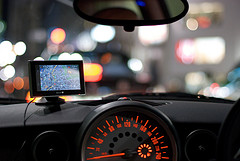
Would you accept in-car surveillance for cheaper insurance?

car dashboard, TokyoSometimes it feels like there’s a camera watching us everywhere we go… and maybe the next step will be cameras watching us as we go between places, too. If you thought the idea of allowing the cable companies to watch you watching TV so they can serve you more relevant advertising was a bit weird, then try this for size: an insurance company offering to install a camera in your car so as to lower your premiums once you start letting your teenager borrow it. [via SlashDot, image by w00kie]

Of course, the TeenSafeDriver Program insists that no data would be gathered on other drivers of the same vehicle… just like the cable companies insist that their watching of the watchers would be benign and unobtrusive. Yet somehow I’m still reminded of the vampiric cliché: you’re only at risk if you invite them in to the house.

My immediate thought was “who’d be mad enough to sign up for that?” But then I thought back to Jan Chipchase’s post about augmented reality marketing:

nobody’s going to stick an advertising driven augmented reality lens in their eye, right? How about for ‘free’ healthcare monitoring? Or because speed-dating is so much more fun when you have real time sexual preference look-ups on the people you’re looking at?

The TeenSafeDriver people have evidently sussed that you need to incentivize an intrusive technology if you want to roll it out successfully; I’ll be interested to see if similar schemes gain any traction in these times of lean finance.

Also worthy of note to any business nerds in the audience: this looks like an interesting iteration of the Andersonian “Free” business model, with the insurance company gambling the cost of the camera installations against the increased sign-up volume it hopes to obtain by offering the reduced premiums. I really have no idea whether it’ll catch on… but if it does, the car insurance landscape is going to change very fast.

Swarming to it

iswarm4One of my favourite[1] plausible science fictional tropes is that of tiny robotic insects. The latest step towards their instantiation has been taken by researchers in Sweden, Spain, Germany, Italy, and Switzerland as they put forward their conception of how swarms of mass-produced robotic fleas could be used for surveillance, cleaning, and medical applications:

The technique involves integrating an entire robot – with communication, locomotion, energy storage, and electronics – in different modules on a single circuit board.

In the past, the single-chip robot concept has presented significant limitations in design and manufacturing. However, instead of using solder to mount electrical components on a printed circuit board as in the conventional method, the researchers use conductive adhesive to attach the components to a double-sided flexible printed circuit board using surface mount technology.

The circuit board is then folded to create a three-dimensional robot.

I can imagine that once this sort of technology matures it will herald a profound change for society. An Orwellian Panopticon where everyone and everything is traced and followed and tracked will become a practicable possibility. Privacy will become one of the most valuable commodities on the planet, with the richest and most powerful people cowering in enclaves sterilized against micro-invaders.

[1]: In that I enjoy them as part of a story and am not entirely ambivalent to their actuality.

[from Physorg][image from Physorg]

Eyes in the sky: ubiquitous real-time aerial surveillance

Watchkeeper - British unmanned aerial vehicleThe United States Army has seen a lot of success with airborne surveillance systems in recent years, and it’s given them the taste for more. Wired’s Danger Room blog takes a look at the current state of the art as well as the latest ground surveillance specifications DARPA is bandying around to potential contractors:

In February we reported on Darpa’s Autonomous Real-time Ground Ubiquitous Surveillance – Imaging System (ARGUS-IS ), a 1.8 gigapixel flying eye which will be mounted in a 500-pound pod carried by a Predator or A160 Hummingbird robocopter. The ARGUS-IS makes for an impressive camera, with the resolution and processing power to track a large number of separate items including “dismounts” — people on foot — over a wide area, as well as “a real-time moving target indicator for vehicles throughout the entire field of view in real-time.”

But ARGUS-IS is already looking old. Now the Army is asking for something even more powerful. In a new request for solicitations, it outlined the concept for a novel visible/infrared sensor that will cover a much larger area on the ground — with much higher resolution.

The sensor is required to be lightweight with low power consumption and to have significantly lower operating costs compared to existing systems, and must be able to operate from small aircraft, either manned or unmanned. In terms of specifics, the Army is looking for 2.3 gigapixels running at two frames per second. By my reckoning, this suggests continuous coverage of area of around sixty-two square miles at 0.3m resolution with a single sensor. That’s quite a step up from Angel Fire, which covers a tenth of the area at much lower resolution.

That’s a lot of detail, for sure. And we can probably assume that the bulk of the aircraft carrying the hardware will in fact be unmanned; The Guardian reports that the US is now training more drone operators than bomber and fighter pilots combined.

Three years ago, the service was able to fly just 12 drones at a time; now it can fly more than 50. At a trade conference outside Washington last week, military contractors presented a future vision in which pilotless drones serve as fighters, bombers and transports, even automatic mini-drones which attack in swarms.

Five thousand robotic vehicles and drones are deployed in Iraq and Afghanistan. By 2015, the Pentagon’s $230bn (£140bn) arms procurement programme Future Combat Systems expects 15% of America’s armed forces to be robotic. A recent study ‘The Unmanned Aircraft System Flight Plan 2020-2047’ predicted a boom in drone funding to $55bn by 2020 with the greatest changes coming in the 2040s.

“The capability provided by the unmanned aircraft is game-changing,” said General Norton Schwartz, the air force chief of staff. “We can have eyes 24/7 on our adversaries.”

The article has a jaw-dropping closer, too:

In Wired for War, author Pete Singer speculates the machines are harbingers of a new era of “cost-free war”.

“It’s an historic change,” said Singer. “Going to war has meant the same thing for 5,000 years. Now going to war means sitting in front of a computer screen for 12 hours. Then you go home and talk to your kids about their homework.”

Yeah, cost-free war! Awesome! Well, it’s not cost-free for the brown people caught in the crossfire, but hey, it’s hard to care about them so much when they’re just pixels on a screen, AMIRITE? [main story via NextBigFuture; image by skuds]