Tag Archives: surveillance

Smallest ever free-flying device

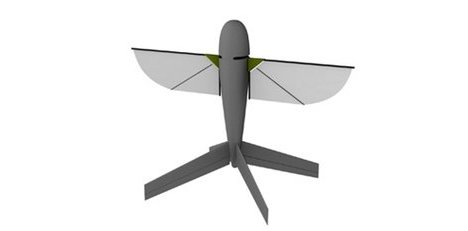
smallest-uavThe world’s smallest free-flying device has successfully flown. The DARPA-commissioned nano-air-vehicle flew TK without external support:

Aeronvironment has released a video that shows its “nano air vehicle” (NAV), which is the size of a small bird or large insect, hovering indoors without such crutches and under radio control. “It is capable of climbing and descending vertically, flying sideways left and right, as well as forward and backward, under remote control,” says the company….
Their ultimate ask is a ten-gram aircraft with a 7.5cm wingspan, which can carry a camera and explore caves and other potential hiding places. “It will need to fly at 10 metres per second and withstand 2.5-metre-per-second gusts of wind”

The micro-ornithopter/robot-insect concept has plenty of precedants in science fiction, and is another example of engineers borrowing from nature to solve engineering problems.

[from New Scientist, via Wired UK][image from ubergizmo]

They’ve got a TV eye on you

Much as we all bemoan the relentless increase of surveillance technologies in our countries, it appears that the cable TV companies are confident that we’ll just invite it in to our homes if there’s enough of an incentive. After all, who wouldn’t want a set-top DVR unit with a camera so it could tell how many people were watching, guess what demographics they were from and then serve them more relavent advertising?

Prime Sense, an Israel-based company founded in 2005 that raised $20.4 million in “B” round funding last May, showed off a 3D camera that can hook into a cable set-top or any other display with a USB interface.

The camera, powered by Prime Sense’s chip, projects an infrared (IR) field into the room to help determine what’s in front of the camera, going as far as identifying which “users” are sitting in front of the TV, based on their thermal images.

That said, they’re looking at other less intrusive capabilities as well:

… cable’s interest in Prime Sense might also extend to its “virtual touch” system, which “projects” a keyboard or another interface near the user, allowing him or her to navigate video program guides or move content around using hand gestures instead of pressing buttons on a remote control.

Prime Sense, however, is in the hardware business, hoping to get its technology built into a wide range of set-tops and gaming consoles. It’s in the process of working with third-party developers to create apps for its 3D-sensing technology, according to Suneil Mishra, Prime Sense’s VP of sales and marketing for the U.S., who discussed the technology during a conference call earlier today. He says Prime Sense is ready to start mass production, with some undisclosed customers already in the pipeline.

Hmmm. Maybe I’m just more paranoid than most. How many of you would install one of these systems in full knowledge of its surveillance capabilities? [via TechDirt]

Our new cyborg insect overlords

livesilkmothContinuing the robotic insect theme: researchers in Japan are developing the means to recreate the brains of insects in electronic circuits and thus modify existing insect brains to perform useful tasks, like finding narcotics, and earthquake victims:

In an example of ‘rewriting’ insect brain circuits, Kanzaki’s team has succeeded in genetically modifying a male silkmoth so that it reacts to light instead of odour, or to the odour of a different kind of moth.

Such modifications could pave the way to creating a robo-bug which could in future sense illegal drugs several kilometres away, as well as landmines, people buried under rubble, or toxic gas, the professor said.

Kanzaki also observes how remarkably adaptable biological organisms are:

“Humans walk only at some five kilometres per hour but can drive a car that travels at 100 kilometres per hour. It’s amazing that we can accelerate, brake and avoid obstacles in what originally seem like impossible conditions,” he said.

Our brain turns the car into an extension of our body,” he said, adding that “an insect brain may be able to drive a car like we can. I think they have the potential.

It certainly raises interesting questions about how to achieve intelligent machinery: why reinvent the wheel creating strong AI? We can reverse engineer animals that fly or hunt then adapt them to our purposes.

[from Physorg][image from Physorg]

Eye in the sky – commercial satellites trace Sudanese arms purchases

Europe seen from space at nightWell, maybe ubiquitous global surveillance isn’t all bad. Remember that big load of tanks and armaments that Somalian pirates scored from a Ukranian cargo ship and subsequently ransomed back? Well, two magazine reporters used commercial imaging satellites to chase down their final destination, proving in the process that they were en route to the breakaway government of South Sudan:

Images captured by DigitalGlobe satellites in March 2009 showed 33 tanks parked at Kahawa Barracks northeast of Nairobi. In parallel, satellite imagery captured from southern Sudan showed tracked vehicles, parked under camouflage, at a Sudan People’s Liberation Army (SPLA) compound northeast of Juba, the capital of South Sudan. Jane’s observed that SPLA attempts to conceal the location “were deliberate and masterful, but dimensional analysis, tracked-vehicle scarring and the staging of three vehicles in a tactical perimeter established the concealed vehicles as tanks.”

It’s not particularly good news – governments tooling up for nasty regional conflicts never is – but it’s the sort of news we’re better off having than not. Maybe the UN should be funding more similar satellites so as to keep an eye on governments who are somewhat economical with the truth about their military build-ups? [image by woodleywonderworks]

Maybe we could use them to keep Obama and Medvedev honest with regards to their nuclear disarmament agreement… provided the whole thing isn’t a carefully orchestrated publicity play in the first place, natch.

Injectable arphid will let satellites track you world-wide (and maybe kill you)

injectable RFID implantCausing a bit of a stir over in Germany is a patent filed by a Saudi Arabian gentlemen for a form of subcutaneous RFID chip which would allow remote global tracking of the person into whom it was injected.

The patent application – entitled “Implantation of electronic chips in the human body for the purposes of determining its geographical location” – was filed on October 30, 2007, but was only published until last week, or 18 months after submission as required by German law, she said.

“In recent times the number of people sought by security forces has increased,” the Jeddah-based inventor wrote in his summary.

The tiny electronic device […] would be suited for tracking fugitives from justice, terrorists, illegal immigrants, criminals, political opponents, defectors, domestic help, and Saudi Arabians who don’t return home from pilgrimages.

Not too shocking on the surface, but it was one of the optional upgrades that caused the law firm representing the application to drop the case quickly:

After subcutaneous implantation, the chip would send out encrypted radio waves that would be tracked by satellites to confirm the person’s identity and whereabouts. An alternate model chip could reportedly release a poison into the carrier if he or she became a security risk.

Cute… thankfully the German patent system would probably have bounced the application on ethical grounds, but you don’t need a patent to make or use something like this.

And as science fictional as it blatantly is, it’s the political implausibility that stands out rather than the technological. Sadly, chipping people like we tag pets is likely to become quite the fashion in the more repressive nation-states of the world, but there’s certain to be a lively black market trade in removing and deactivating them too. [via Technovelgy; image by Nadya Peek]