Tag Archives: technology

Eyes in the sky: ubiquitous real-time aerial surveillance

Watchkeeper - British unmanned aerial vehicleThe United States Army has seen a lot of success with airborne surveillance systems in recent years, and it’s given them the taste for more. Wired’s Danger Room blog takes a look at the current state of the art as well as the latest ground surveillance specifications DARPA is bandying around to potential contractors:

In February we reported on Darpa’s Autonomous Real-time Ground Ubiquitous Surveillance – Imaging System (ARGUS-IS ), a 1.8 gigapixel flying eye which will be mounted in a 500-pound pod carried by a Predator or A160 Hummingbird robocopter. The ARGUS-IS makes for an impressive camera, with the resolution and processing power to track a large number of separate items including “dismounts” — people on foot — over a wide area, as well as “a real-time moving target indicator for vehicles throughout the entire field of view in real-time.”

But ARGUS-IS is already looking old. Now the Army is asking for something even more powerful. In a new request for solicitations, it outlined the concept for a novel visible/infrared sensor that will cover a much larger area on the ground — with much higher resolution.

The sensor is required to be lightweight with low power consumption and to have significantly lower operating costs compared to existing systems, and must be able to operate from small aircraft, either manned or unmanned. In terms of specifics, the Army is looking for 2.3 gigapixels running at two frames per second. By my reckoning, this suggests continuous coverage of area of around sixty-two square miles at 0.3m resolution with a single sensor. That’s quite a step up from Angel Fire, which covers a tenth of the area at much lower resolution.

That’s a lot of detail, for sure. And we can probably assume that the bulk of the aircraft carrying the hardware will in fact be unmanned; The Guardian reports that the US is now training more drone operators than bomber and fighter pilots combined.

Three years ago, the service was able to fly just 12 drones at a time; now it can fly more than 50. At a trade conference outside Washington last week, military contractors presented a future vision in which pilotless drones serve as fighters, bombers and transports, even automatic mini-drones which attack in swarms.

Five thousand robotic vehicles and drones are deployed in Iraq and Afghanistan. By 2015, the Pentagon’s $230bn (£140bn) arms procurement programme Future Combat Systems expects 15% of America’s armed forces to be robotic. A recent study ‘The Unmanned Aircraft System Flight Plan 2020-2047’ predicted a boom in drone funding to $55bn by 2020 with the greatest changes coming in the 2040s.

“The capability provided by the unmanned aircraft is game-changing,” said General Norton Schwartz, the air force chief of staff. “We can have eyes 24/7 on our adversaries.”

The article has a jaw-dropping closer, too:

In Wired for War, author Pete Singer speculates the machines are harbingers of a new era of “cost-free war”.

“It’s an historic change,” said Singer. “Going to war has meant the same thing for 5,000 years. Now going to war means sitting in front of a computer screen for 12 hours. Then you go home and talk to your kids about their homework.”

Yeah, cost-free war! Awesome! Well, it’s not cost-free for the brown people caught in the crossfire, but hey, it’s hard to care about them so much when they’re just pixels on a screen, AMIRITE? [main story via NextBigFuture; image by skuds]

Keep your doctor close to your heart: the wi-fi pacemaker

diagram of the heartEarlier this year I mentioned round-the-clock in-body medical monitoring as an imminent transhuman reality, but I didn’t think it’d be quite so fast.

OK, so it’s not a full suite of biomonitors, but a new design of pacemaker talks wirelessly to an internet-connected basestation in the home, sending all the data it gathers directly to the outpatient’s doctor:

So, basically, this patient can provide a full report on the condition of her heart without even leaving home – without doing anything, actually, since the pacemaker reports automatically – and the doctor is able to perform regular check-ups without seeing the patient at all. In fact, since routine pacemaker checks are typically done every six months, the wireless device offers a much greater level of monitoring and care than ever before.

The logical next step here is to make the basestation into some kind of expert system that can deal with routine changes of circumstance without having to involve a busy meat-doctor. Perhaps next time there’s a global epidemic we’ll just be able to breathe into a little device and have it tell us whether we have swine flu or a bit of a cold, followed by advice on how to respond to it. [image found via koreana]

The ethics of autonomous devices

heart_surgeonThe Royal Academy of Engineering in the UK says that the imminent rise of autonomous and semi-autonomous cars, robotic surgeons, planes, war machines, software agents, and public transport systems raises important ethical and legal questions:

Professor Stewart and report co-author Chris Elliott remain convinced that autonomous systems will prove, on average, to be better surgeons and better lorry drivers than humans are.

But when they are not, it could lead to a legal morass, they said.

“If a robot surgeon is actually better than a human one, most times you’re going to be better off with a robot surgeon,” Dr Elliott said. “But occasionally it might do something that a human being would never be so stupid as to do.”

Professor Stewart concluded: “It is fundamentally a big issue that we think the public ought to think through before we start trying to imprison a truck.”

And when and if true AI or artificial general human-level intelligences show up, will they commit crimes, and if so, who will be responsible?

[from the BBC][image from Wonderlane on flickr]

Smallest ever free-flying device

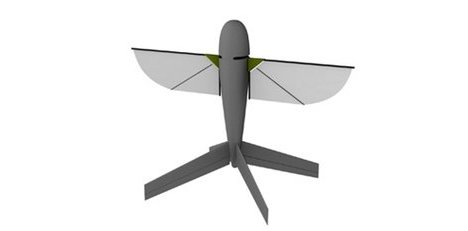
smallest-uavThe world’s smallest free-flying device has successfully flown. The DARPA-commissioned nano-air-vehicle flew TK without external support:

Aeronvironment has released a video that shows its “nano air vehicle” (NAV), which is the size of a small bird or large insect, hovering indoors without such crutches and under radio control. “It is capable of climbing and descending vertically, flying sideways left and right, as well as forward and backward, under remote control,” says the company….
Their ultimate ask is a ten-gram aircraft with a 7.5cm wingspan, which can carry a camera and explore caves and other potential hiding places. “It will need to fly at 10 metres per second and withstand 2.5-metre-per-second gusts of wind”

The micro-ornithopter/robot-insect concept has plenty of precedants in science fiction, and is another example of engineers borrowing from nature to solve engineering problems.

[from New Scientist, via Wired UK][image from ubergizmo]

They’ve got a TV eye on you

Much as we all bemoan the relentless increase of surveillance technologies in our countries, it appears that the cable TV companies are confident that we’ll just invite it in to our homes if there’s enough of an incentive. After all, who wouldn’t want a set-top DVR unit with a camera so it could tell how many people were watching, guess what demographics they were from and then serve them more relavent advertising?

Prime Sense, an Israel-based company founded in 2005 that raised $20.4 million in “B” round funding last May, showed off a 3D camera that can hook into a cable set-top or any other display with a USB interface.

The camera, powered by Prime Sense’s chip, projects an infrared (IR) field into the room to help determine what’s in front of the camera, going as far as identifying which “users” are sitting in front of the TV, based on their thermal images.

That said, they’re looking at other less intrusive capabilities as well:

… cable’s interest in Prime Sense might also extend to its “virtual touch” system, which “projects” a keyboard or another interface near the user, allowing him or her to navigate video program guides or move content around using hand gestures instead of pressing buttons on a remote control.

Prime Sense, however, is in the hardware business, hoping to get its technology built into a wide range of set-tops and gaming consoles. It’s in the process of working with third-party developers to create apps for its 3D-sensing technology, according to Suneil Mishra, Prime Sense’s VP of sales and marketing for the U.S., who discussed the technology during a conference call earlier today. He says Prime Sense is ready to start mass production, with some undisclosed customers already in the pipeline.

Hmmm. Maybe I’m just more paranoid than most. How many of you would install one of these systems in full knowledge of its surveillance capabilities? [via TechDirt]