Tag Archives: technology

Universal robot operating system: well, they’re too late to call it Android

robotAs evidenced by the number of posts we end up doing about them, robots are a real growth industry. Which is all well and good, but the folks in R&D departments everywhere have a problem.

In a nutshell, it’s interoperability: each robot is developed in isolation, meaning valuable resources are expended replicating functionalities that others have already nailed down. What they need is a common and standardised robot operating system.

This sorry state of affairs is set to change. Roboticists have begun to think about what robots have in common and what aspects of their construction can be standardised, hopefully resulting in a basic operating system everyone can use. This would let roboticists focus their attention on taking the technology forward.

[…]

On top of all this, each robot has its own unique hardware and software, so capabilities like balance implemented on one robot cannot easily be transferred to others.

Bourcier sees this changing if robotics advances in a manner similar to personal computing. For computers, the widespread adoption of Microsoft’s Disk Operating System (DOS), and later Windows, allowed programmers without detailed knowledge of the underlying hardware and file systems to build new applications and build on the work of others.

Programmers could build new applications without detailed knowledge of the underlying hardware

Bringing robotics to this point won’t be easy, though. “Robotics is at the stage where personal computing was about 30 years ago,” says Chad Jenkins of Brown University in Providence, Rhode Island. Like the home-brew computers of the late 70s and early 80s, robots used for research today often have a unique operating system (OS). “But at some point we have to come together to use the same resources,” says Jenkins.

And there’s already an open-source type system being developed… as well as a Microsoft alternative, for those who fancy paying a license fee for robots that are vulnerable to trojans and spyware, one assumes.

If we’re to extend the analogy of the current robotics industry being like the computer industry of the early eighties, I wonder if we can expect generic clone hardware to start appearing in response to a demand from maker-businesses and hobbyists? [via PlausibleFutures; image by woordenaar]
Next-gen hearing aids have iPod jacks

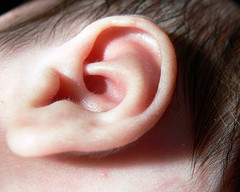
earFile under “elective implant technology that I don’t need but really wish I could afford anyway”: the bone-anchored next-generation hearing aid with audio jack input options.

Older-style hearing aids amplify all sounds, making it almost impossible for wearers to hear conversations in noisy environments. They also interfere with frequencies used by mobile and fixed phones and often emit high-pitched whistling sounds. But the newer processors, costing about $6000 each, shut out background noise, giving users up to 25 per cent better hearing, and can be attached directly to MP3 music players or wireless headsets for talking on the phone, Cochlear’s territory manager, Katrina Martin, said.

They were useful for people with congenitally blocked middle ears, chronic infections that had eaten away tiny bones in the middle ear used for sound conduction, or babies born with closed ear canals, she said.

The processors must be removed for showers or swimming but can last up to 15 years.

Once you’ve got that basic hardware installed, the sky’s the limit for crazy bolt-ons and extras. Real-time digital signal processing, on-board recording and playback… the first person to write an open-source filter for screening out people on public transport talking loudly into their phones is going to be very popular. [via BoingBoing; image by jessicafm]

Joe Robot vs. the Volcano: the spiderbots of Mount St Helens

Mount St Helens shrouded in cloudIn order to keep a close eye on Mount St. Helens, the NASA JPL people have built and deployed a bunch of networked “spiderbots” which negotiate a peer-to-peer network between each other in order to pass data back to base.

Fifteen spiderbots, so-named because of the three spindly arms protruding from their suitcase-sized steel bodies, were lowered from a helicopter to spots inside the crater and around the rim of Mount St Helens, an active volcano in the US state of Washington, in July.

Each has a seismometer for detecting earthquakes, an infrared sensor to detect heat from volcanic explosions, a sensor to detect ash clouds, and a global positioning system to sense the ground bulging and pinpoint the exact location of seismic activity.

Once in place, the bots reached out to each other to form what is known as a mesh network. “It’s similar to the internet,” says Steve Chien, the principal scientist for autonomous systems at JPL. “You just lay them out, and they figure out the best way to route the data.”

Smart idea: install a remote monitoring system and instruct it to drop you a line with any problems… up to and including any problems with the system itself as well as the volcano, one assumes.

Obviously the expense means that this sort of system is currently only of use in high-risk and high-budget applications, but it’s no great mental stretch – given the rapid advances of networking technology – to imagine entire states or countries blanketed with similar monitoring frameworks.

Then make the data public, bolt on an API and distribute something like the SETI@home software, and everyone with some spare processor cycles can help keep an eye on geological instabilities. Similar systems (or perhaps even the same devices) could be used to provide communications infrastructure in the aftermath of a disaster, too. [image by christmaswithak]

Scaled-elextric: slot cars for transport

slot-carToday’s dose of technocratic mass-transport conceptual design is brought to you by German designer Christian Förg. His Speedway Transport System is inspired by slot cars of his youth:

Förg’s Speedway Transport System concept uses a network of linear electric motors to propel cars along the highway.

He sees us driving around in futuristic dual-mode electric cars with small motors for city driving. When we’re ready to leave town, a contact-free linear motor would propel the car over long distances with a drifting magnetic field. Förg says linear motors would work under our existing roadways, complementing – not replacing – existing automotive technology.

“This means that you can use the roads with normal cars and also at the same time for the Speedway system,”

If this ever gets taken up it’ll be interesting to see what alternative uses the street finds for this technology.

A slight non-sequitur: Will Hutton writes in the Guardian on the dire state of the UK rail network, and how in order to remain economically competitive, Britain must invest in the kind of high-speed rail they have in Europe.

[via Wired][image from Wired]

First artificial organelle

artificial_organelleResearchers have developed an artificial cellular organelle to aid in the development of artificial synthesis the life-saving anti-clotting drug heparin:

Scientists have been working to create a synthetic version of the medication, because the current production method leaves it susceptible to contamination–in 2008, such an incident was responsible for killing scores of people. But the drug has proven incredibly difficult to create in a lab.

Much of the mystery of heparin production stems from the site of its natural synthesis: a cellular organelle called the Golgi apparatus, which processes and packages proteins for transport out of the cell, decorating the proteins with sugars to make glycoproteins. Precisely how it does this has eluded generations of scientists.

To better understand what was going on inside the Golgi, Linhardt and his colleagues decided to create their own version. The result: the first known artificial cell organelle, a small microfluidics chip that mimics some of the Golgi’s actions.

As well as the utility of being able to produce drugs in this way, it is impressive the degree of control that can be exerted over the matter:

The digital device allows the researchers to control the movement of a single microscopic droplet while they add enzymes and sugars, split droplets apart, and slowly build a molecule chain like heparin.

[from Technology Review, via KurzwailAI][image from Technology Review]