
Tag Archives: technology

The road to post-scarcity

geodesic architectureIt seems that nothing can prevent Futurismic fiction regular Jason Stoddard from looking for the silver lining to every cloud – even beyond his fictional output. [image by dno1967]

Point in case: his recent article for transhumanist/futurist organ H+ Magazine, which glories in the sprawling title “First Steps Towards Post scarcity: or Why the Current Financial Crisis is the End of the World As We Know It (And Why You Should Feel Fine)“.

A lot of the ideas Stoddard raises will be familiar to science fiction readers, and many of his points are made by looking at the current situation from a different angle to the fashionable mode of doom and gloom. For example:

We’re also already starting to see some examples of near post-scarcity. Consider computers and communications. If you’re willing to use a computer that’s a couple of years old, you can probably find a hand-me-down for free, and then happily talk to your friends around the world on Skype using free public wi-fi.

Or consider that in the last Depression, the main worry was simply getting enough food. Today, the marketplace is more worried about maintaining the marketing budgets of 170 different kinds of toothpaste than about ensuring that everyone has toothpaste. There’s a lot of padding in the system. Couple a financial crisis with this overweight, inefficient system, and you have the stage set for the first transition to post-scarcity: a comprehensive rethink of our concept of value.

You could easily accuse the piece of being Panglossian, but I’m inclined to think that’s a deliberate rhetorical gambit on Stoddard’s part – countering an excess of negativity with a big slice of sf-nal optimism. I’m not that confident that we’ll end up in a nanotech-powered utopia devoid of all wants and needs within my lifetime, but then I’m also not convinced that we’re going to slouch our way into a scenario of global misery and decline. As usual, reality will probably end up somewhere in between the two idealised poles of punditry… but I’m not ashamed to admit I hope it ends up closer to Stoddard’s vision than many of the others.

Flexible speakers

speakerFollowing on from yesterday’s thin ‘n’ see-through supercapacitors now we have thin ‘n’ shiny speakers from researchers at Warwick University:

Engineers claim their new ultra-thin speakers, as well as looking good and being easy to conceal, will also deliver clearer, crisper sound.

The loudspeakers could replace public address systems in passenger terminals and shopping centres.

They could also be used as speaking posters to deliver adverts.

Cheers for clearer tannoys. Jeers for annoying talking posters.

[from the BBC][image from the BBC]

Smart dust, er, dew

Smart Dew electronic bugHere’s another military sf trope to add to the list of fictional gadgets gradually becoming a battlefield reality. This time it’s the turn of smart dust… though the team at Tel Aviv University have called it ‘smart dew’ instead:
Dozens, hundreds and even thousands of these Smart Dew sensors – each equipped with a controller and RF transmitter/receiver – can also be wirelessly networked to detect the difference between man, animal, car and truck.

[snip]

Each individual “dew droplet” can detect an intrusion within a parameter of 50 meters (about 165 feet). And at a cost of 25 cents per “droplet,” Prof. Shapira says that his solution is the cheapest and the smartest on the market.

A part of the appeal of Smart Dew is its near-invisibility, Prof. Shapira says. “Smart Dew is a covert monitoring system. Because the sensors in the Smart Dew wireless network are so small, you would need bionic vision to notice them. There would be so many tiny droplets over the monitored area that it would be impossible to find each and every one.”

Not quite the nanoscopic modular machines of fiction, then, but surely their primitive progenitors. Not to mention another example of military hardware that will litter disputed regions for years to come… somehow I doubt they’ve done much planning about how to retrieve them all once their job is done. [image from linked article]

Your transhuman future: 24/7 body monitoring

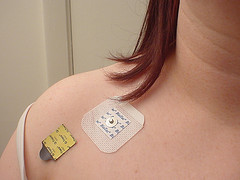
medical monitoring tagsCutting-edge medical hardware can scan and analyse our bodies with incredible accuracy, allowing doctors to diagnose and treat many of the illnesses that come as part of our mortal meatware. But these things can only be seen if we’re looking for them; we’d catch many more diseases and defects if we could be monitored constantly, rather than just when we visit a doctor or clinic.

Unfortunately (or fortunately, depending on your point of view) we’re a long way off from having nanotech swarming through our bloodstreams, but there are companies and research groups working to build realtime medical monitoring systems for the human body. SingularityHub rounds up a handful of them and takes a look at their current projects; here’s a description of one from Proteus Biomedical:

Proteus ingestible event markers (IEMs) are tiny, digestible sensors… Once activated, the IEM sends an ultra low-power, private, digital signal through the body to a microelectronic receiver that is either a small bandage style skin patch or a tiny device insert under the skin. The receiver date- and time-stamps, decodes, and records information such as the type of drug, the dose, and the place of manufacture, as well as measures and reports physiologic measures such as heart rate, activity, and respiratory rate.

So, till pretty crude by science fictional standards, but surely an improvement on being wired up to a room-full of medical monitors to record the same data. As nanotech and molecular genetic engineering converge, we’ll doubtless see systems like this become more powerful and more prevalent, at least in the richer countries.

SingularityHub points out one of the big benefits of this sort of monitoring, namely the vast tranches of data it would supply to medical researchers. But there’s a flip-side that need to be considered, namely privacy. Futurismic‘s own Sven Johnson reported back earlier this month from a possible future where biometric body scans of millions of US citizens was leaked to the public; think of the repurcussions of even more intimate data being exposed. [image by HouseOfSims]

And how about insurance? Once this sort of detailed medical data is available, it’ll become a mandatory part of your application for health coverage, and you can bet your boots that the insurance houses will use every little warning indicator as an excuse to bump up your premium… or deny you a policy completely.

Happy Ada Lovelace Day

adaIt’s late in the day in my time zone, but maybe not too late to celebrate women’s contribution to technology.

In a nutshell:

Today has been declared Ada Lovelace Day, a celebration of women in technology named after the first computer programmer. Born Augusta Ada Byron—yes, that Byron—she was schooled in mathematics at her mother’s insistence and, as Wikipedia says, her “interest in mathematics dominated her life even after her marriage.” (OMG NO WAY. ::facepalm::)

And here’s a list of inspirations, including none other than Xeni Jardin.

The BBC also has a roundup, with a link to a swell map of the tubes.

Feministing lists some notable achievers, too.

And if this puts you in a steampunk mood, check out the Babbage Engine, or an amazing pictorial from Wired last year.

[Portrait of the lady, Wikimedia Commons]