Tag Archives: technology

Technology Review lists 2007’s 10 most exciting technologies

Poster_of_Alexander_Crystal_Seer Every year, Technology Review lists the 10 technologies the magazine’s editors “find most exciting—and most likely to alter industries, fields of research, and even the way we live.” (Via Kurzweil AI.)

Here’s 2007’s Top-10 list:

  1. Peering into Video’s Future – With the Internet being swamped by digital video, peer-to-peer networks may be the answer.
  2. Nanocharging Solar – Cheap photovoltaics through quantum-dot solar power.
  3. Invisible Revolution – The magic of metamaterials.
  4. Personalized Medical Monitors – Computer-automated diagnostics for individuals.
  5. Single-Cell Analysis – Analyzing differences between individual cells could make for better medical tests and treatments.
  6. A New Focus for Light – New optical antennas that focus light could bring us DVDs that hold hundreds of movies.
  7. Neuron Control – A genetically engineered switch lets scientists turn selected parts of the brain on and off–which could lead to new treatments for depression and other disorders.
  8. Nanohealing – Stopping bleeding, aiding recovery from brain injury–nanofibers hold life-saving promise.
  9. Digital Imaging, Reimagined – “Compressive sensing” could help make the capture of digital images more efficient.
  10. Augmented Reality – Digital information, superimposed on the real world. (And you thought people listening to iPods all the time were annoying… )

(Image: Wikimedia Commons.)

[tags]technology,inventions,predictions[/tags]
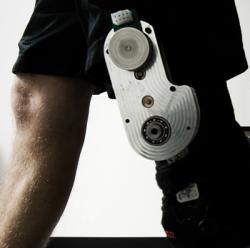
A bracing walk will charge your phone

Power-generator-knee-brace File under “gimme one of those” – a Canadian university team has developed a knee brace device that harnesses the movement of the leg while walking to produce 5 Watts of power. [Image from linked NewScientist article]

That’s enough to run ten mobile phones at once, apparently (though why you’d ever need more than one isn’t clear … I kid, I kid). From the article:

“The generator does not significantly increase the effort required for walking, says Max Donelan of Simon Fraser University in Burnaby, Canada, who led its development.

“Muscles spend about the same amount of time working as brakes as they do working as motors,” he explains. The device is designed so it only generates electricity during the “braking” phase of each step. This is when the leg is being unbent and is decelerating, just before the foot touches the ground.

The device works similarly to hybrid and electric cars, Donelan points out. They boost efficiency by generating electricity from energy expended during braking – known as regenerative braking.”

A device that saves on my electricity bill and encourages me to exercise? It’s the ultimate accessory for the self-sufficient cyberpunk-around-town – where do I sign?

The future is … expensive

pile-of-dollar-bills Wired’s Gadget Lab blog has a piece on science fictional technologies or engineering projects that are within our grasp in almost every way … except financially. It’s a decent enough blend of informative and snarky that I can forgive the use of the term “sci-fi” in the title … 😉

Floating cities, Transatlantic tunnels … it’s kind of sad to think that, as the commenters there keep pointing out, most of the projected costs would vanish into the budget for the Iraq “liberation” and rattle around like a ball bearing in an oil tanker. Also pointed out is the conspicuous absence of the space elevator – I seriously want to see one of those built before I die. [Image from stock.xchng]

Additional bonus! The last two entries in the Wired piece are about rail guns and space travel; frequent Futurismic commenter Brian Wang combines the two in a post about the potential of rail guns to be used as economical launch systems to lift payloads to orbit.

Scientists create dynamic holographic display

3ddisp_hol Scientists from the University of Arizona have figure out how to make holographic displays, viewable without special eyeware, that can be erased and rewritten in a matter of minutes. (Via PhysOrg.)

Dynamic hologram displays could be made into devices that help surgeons track progress during lengthy and complex brain surgeries, show airline or fighter pilots any hazards within their entire surrounding airspace, or give emergency response teams nearly real-time views of fast-changing flood situations or traffic problems, for example…and no one yet knows where the advertising and entertainment industries will go with possible applications…

The prototype display is only four inches by four inches and only comes in red, but larger displays in full colour are considered possible. The researchers are aiming for a one-foot-by-one-foot display next, then a three-foot-by-three-foot display. Eventually they hope to be able to display life-sized holographic images of humans that can be updated every few minutes.

Watch a video here.

The researchers point out that a great deal of data is lost when three-dimensional information, such as that collected by an MRI or CAT scan, is displayed in two dimensions on a flat computer monitor. As they say, “…when we develop larger, full-color 3-D holograms, every hospital in the world will want one.”

And two minutes after the first one is installed, hospital staff will be referring to the room it’s placed in as the “holodeck.”

(Image: University of Arizona.)

[tags]medicine,optics,holograms,technology[/tags]

A touchless computer interface

home-finger-604x220

There’s not a lot of technical detail about exactly how this works, but a company called Elliptic Labs is developing a very science-fictiony touchless computer interface (Via Gizmodo):

Elliptic Labs is paving the way for use of computers and screens without touching, simply with the finger or hand in the air. Manipulate images, play computer games, control robotics or use touch screens without touching or without holding a hardware control unit.

Their technology is based on the work of Dr. Tobias Dahl from the University of Oslo, who is also the company’s founder. According to the website, their technology can recognize “with high precision” the position and properties of a finger or hand or other object up to 1.5 meters away from the sensors, which can be placed on or next to a monitor: no need for a clunky “data glove” or anything on the hand at all. The company says the technology is so compact it could even be fitted on to a mobile phone. You can view video demonstrations of it here.

Since I’m a Windows user I’ve occasionally made rather violent hand gestures at my computer, but it’s never taken the slightest notice. Perhaps that’s about to change.

(Image: Elliptic Labs)

[tags]technology, computers[/tags]