Tag Archives: UK

UK police to deploy military UAV drones, snoop more effectively

US Air Force UAV droneFuturismic readers resident outside the UK may wonder why exactly it is that I keep battering on about the omnipresent surveillance systems that are saturating this silly little island. After all, if I’m not doing anything wrong, I should have nothing to fear, right?

Well, if believing that helps you sleep at night, then you carry on. In the meantime, I hope you’ll not object to me becoming steadily more nervous about such systems being put into the hands of a clueless, corrupt bureaucracy of a government. Am I overstating the case here? I don’t know – but how would you feel if you heard your police force were investing in the same sort of UAV surveillance drones that have proven so popular with the “peacekeeping” forces currently stationed in Afghanistan and Iraq?

Better yet, wait until you hear exactly what they want them for:

… for the ­”routine” monitoring of antisocial motorists, ­protesters, agricultural thieves and fly-tippers, in a significant expansion of covert state surveillance.

I suppose we should at least be grateful that the ubiquitous yet hollow catch-all of “terrorism” doesn’t turn up in that list. But there’s more:

… the partnership intends to begin using the drones in time for the 2012 Olympics. They also indicate that police claims that the technology will be used for maritime surveillance fall well short of their intended use – which could span a range of police activity – and that officers have talked about selling the surveillance data to private companies. A prototype drone equipped with high-powered cameras and sensors is set to take to the skies for test flights later this year.

The Civil Aviation Authority, which regulates UK airspace, has been told by BAE and Kent police that civilian UAVs would “greatly extend” the government’s surveillance capacity and “revolutionise policing”. The CAA is currently reluctant to license UAVs in normal airspace because of the risk of collisions with other aircraft, but adequate “sense and avoid” systems for drones are only a few years away.

I try very hard to keep Futurismic free of my soap-boxing these days, and I hope you’ll accept my apologies if this post has bored, baffled or offended you. But Futurismic‘s also the biggest soap-box I have access to, and I honestly believe this sort of creeping totalitarianism must be called out in public at every available opportunity. Governments that profess to be democracies should remember that respect is a two-way street. [image by ebrkut]

Tax ’em back into town?

The UK iteration of Wired is doing a themed issue entitled “Rebooting Britain”, kicking around ideas for changing the face of an already-changing nation for the better. Many of them could be more broadly applied to any Western/developed nation, but a few of them address issues that are somewhat more unique to the UK. For example, Britain is apparently one of the very few nations where the percentage of people living in cities is not increasing; this doubtless has a lot to do with deep-rooted notions of the romance and allure of country living that inform the English psyche, though the increasing proliferation of surveillance and petty bureaucracy in urban areas may well be a contributing factor too.

But the rural lifestyle is disproportionately expensive from an environmental perspective; people who live in the country need to drive further and more often, they need to use more energy for heating their homes, and so on. So, P D Smith suggests, why don’t we tax the rural lifestyle heavily to encourage people back into more efficient city living?

To create a low-carbon economy we need to become a nation of city dwellers. We tax cigarettes to reflect the harm they do to our health: we need to tax lifestyles that are damaging the health of the planet – and that means targeting people who choose to live in the countryside. We need a Rural Living Tax. Agricultural workers and others whose jobs require them to live outside cities would be exempt. The revenue raised could be used to build new, well-planned cities and to radically upgrade the infrastructure of existing cities.

We have an opportunity to create an urban renaissance, to make cities attractive places to live again – not just for young adults, but for families and retired people, the groups most likely to leave the city.  Turning our old cities into “smart cities” won’t be easy or cheap, but in a recession this investment in infrastructure will boost the economy. We need to learn to love our cities again, because they will help us to save the planet.

It’s a nice idea and well-meant, but there are some pretty obvious flaws to the suggestion. First and foremost, Smith seems to have overlooked the fact that the affluent middle classes who are at the centre of the migration into the countryside are the most politically active slice of the UK population, and no government in its right mind (if such a thing exists) is going to risk alienating them by crushing their dreams of “getting away from it all” with their hard-earned money.

Another problem is the assumption that country living is necessarily less energy efficient. As the months pass, more and more middle-class jobs will fall into the sphere of knowledge work, making them ideally suited for telecommuting… which is something that businesses looking to save on their payroll overheads are starting to wake up to. Offer the chance to work from home in exchange for a smaller pay-packet, and there’ll be a significant take-up.

Plus country houses – while usually bigger and less efficient than city dwellings – are more easily retrofitted for energy efficiency, and more likely to have that money spent on them by their owners rather than by government grants – if there’s a clear economic benefit to investing in a “greener” household, you can bet your life the middle class will be all over it like a rash, especially once a few trendsetters start doing it and trumpeting the benefits.

And let’s not forget that homes in the countryside are theoretically closer to domestic sources of food; with a little logistical planning and some smart entrepreneurship, even small villages could become efficient nexuses for local produce distribution. Hell, they could even start aiming for self-sufficiency and community agriculture, like the Pennines town of Todmorden, which is showing signs of successfully shifting toward community farming and a “locavore” lifestyle [via Global Guerrillas, of all places].

In short, there are definite downsides to the British rural exodus, but using the blunt instrument of tax to reverse it is bound to fail. Better still, surely, to embrace the rural shift and let economics do the hard work for you?

Designer drugs develop faster than designer legislation

pillsI’m not sure whether I’m supposed to be proud or ashamed of this one, but apparently Britain has been declared the “designer drugs capital of Europe” by the EU drug agency. [image by Greencolander]
This new generation of online “head shops” is at the centre of a rapidly growing market in highly potent synthetic drugs, such as Spice, that mimic the effects of illegal substances such as cannabis and ecstasy.

European drug agency officials are also alarmed by the way the online retailers are reacting to moves to ban individual “legal highs” by rapidly marketing alternatives. Officials say it is like trying to hit a moving target.

Well, d’uh – do you really expect them to just sit there in the firing line waiting to be picked off? I think what we’re seeing here is something like a singularity for the recreational chemicals industry, whereby the legal machinery of the countries that most want to control such substances moves too slowly to control the exponentially faster response to market demand. It’s a whack-a-mole gig – knock one substance into the ground, and two more pop up to replace it.

I’d hardly be the first to suggest that perhaps this rapid response in the balance of supply and demand is the first nail in the coffin lid of attempts to banish recreational drug-taking, but given the UK government’s laughable unwillingness to heed the suggestions of the drug policy advisors that it appointed, I’m not going to be the first voice they ignore, either.

But I think it’s safe to say that drugs – designer or otherwise – are not going to go away any time soon, legislation or otherwise. So what’s a beleaguered incumbent government to do – quietly admit defeat and lose the vote of the hand-wringing middle classes, or pour away time and resources doing a King Canute impersonation?

Is there anyone among Futurismic‘s readership who can say with a straight face that more restrictive legislation will prevent drug abuse, in the UK or anywhere else? If so, tell us how and why in the comments. Feel free to suggest new alternatives to legislation, as well.

Crime may not pay, but perhaps watching for it might

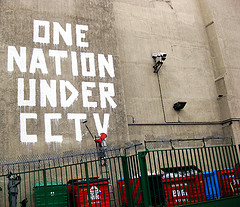
"one nation under cctv" by BanksyAs much as things may be tough in the States right now, at least you can all get a good laugh watching the UK slide towards becoming a pseudo-totalitarian panopticon state. [image by JapanBlack]

Via Cheryl Morgan comes news of the latest iteration of our enthusiastically participatory society of snoops and spies – crowdsourced CCTV crimespotting, with fabulous monetary prizes to be won!

The cameras’ owners will pay a fee to have users watch the footage. The scheme, Internet Eyes, is being promoted as a game and is expected to go “live” next month with a test run in Stratford-upon-Avon.

Subscribers will be able to register free and will be given up to four cameras to monitor.

Eventually the consortium behind the idea hopes to have internet users around the world focused on Britain’s 4.2 million security cameras, waiting to see and report a crime in return for cash prizes.

[…]

Subscribers will try to collect points by monitoring cameras in real time. If they see anything suspicious, they will click a button to send a still picture and text message to the camera’s owner.

The owner will then send a feedback e-mail to the person reporting the incident, indicating whether there has been a crime or suspected crime.

Users will be awarded one point for spotting a suspected crime and three if they see an actual crime. They can also lose points if the camera operator decides that the alert was not a crime.

Good grief… it’s much like the crowdsourced surveillance of the US border with Mexico, only with cash incentives. And the thing is, recent research suggests that cash incentives are actually counterproductive in situations where our ethical stance plays a part [via TechDirt]:

incentives affect what our actions signal, whether we’re being self-interested or civic-minded, manipulated or trusted, and they can imply—sometimes wrongly—what motivates us. Fines or public rebukes that appeal to our moral sentiments by signaling social disapproval (think of littering) can be highly effective. But incentives go wrong when they offend or diminish our ethical sensibilities.

This does not mean it’s impossible to appeal to self-interested and ethical motivations at the same time—just that efforts to do so often fail. Ideally, policies support socially valued ends not only by harnessing self-interest but also by encouraging public-spiritedness. The small tax on plastic grocery bags enacted in Ireland in 2002 that resulted in their virtual elimination appears to have had such an effect. It punished offenders monetarily while conveying a moral message. Carrying a plastic bag joined wearing a fur coat in the gallery of antisocial anachronisms.

However, no one in the upper echelons of the business and gubernatorial spheres seems to have taken any notice of this, or of any of the other psychological research of the last few decades that has continually flagged up the same problem… I guess that a clear conscience is no suitable incentive for removing one’s own pre-existing incentives package. Go figure.

Immigrant UK waste turned back at Brazilian docks

shipping containersOnly the other day we were talking about tracking trash to find out where it goes. Well, it turns out it’s not just people that end up immigrating into countries that don’t want to deal with them; the Brazilian environment agency Ibama is demanding that 1,400 tonnes of hazardous waste – everything from rotting food, used condoms and dirty hypodermics – be repatriated to the UK where it came from.

Among the rubbish were the names of many British supermarkets, and UK newspapers were also clearly identifiable.

Ibama officials say they want the waste sent back to the UK.

“We will ask for the repatriation of this garbage,” said Roberto Messias, Ibama president. “Clearly, Brazil is not a big rubbish dump of the world.”

Reports in the UK media say the waste was sent from Felixstowe in eastern England to the port of Santos, near Sao Paulo, and two other ports in the southern state of Rio Grande do Sul.

The Brazilian companies that received the waste said they had been expecting recyclable plastic, The Times reported.

I guess this is the nation-state version of the rocks-in-an-iPod-box scam. Hopefully it’ll get harder for organisations to pull off this kind of switcheroo without getting caught by shipment tracking systems… but while there’s money to be made, you can guarantee they’ll keep trying it on. I expect corruption is a large part of the problem – as much at the UK end as elsewhere. [via SlashDot; image by bejnar.net]