Tag Archives: urban

The future is local: Braddock, Pennsylvania

"We will grow" - the bridge to BraddockWe’ve been talking a fair bit about urban decline and decay, and efforts to repurpose collapsing cities.

Now, here’s an example of a dying town trying to go its own way – Braddock, Pennsylvania was once a flourishing steel town, home to Andrew Carnegie’s first free library. Now it has a population of under 2,500, and the axe of a proposed freeway hangs heavily over its neck. 2005 saw John Fetterman become Mayor, and he’s now working to bring “the kind of outside energy, ideas, and interest from the artistic, urbanist, and creative communities” to the town. [hat-tip to Justin Pickard; image by Hryck.]

In other words, if you’ve been reading along with Cory Doctorow’s serialised novel Makers over at Tor.com, or following Chairman Bruce‘s ongoing obsession with “stuffed animal” architecture and squatter culture, Fetterman’s plans will look pretty familiar. Whether Braddock can reinvent itself as a counter-cultural artist’s enclave remains to be seen, but you’ve got to salute the determination of a man willing to work at making it happen. When your government can’t (or won’t) help you, you’ve got to help yourself.

A loosely related story from Canada sees five Ontario grocery stores abandoning their franchisee status in favour of becoming a cooperative organisation that focusses on stocking the local produce that corporate policy previously prevented them from selling. Are we seeing the first trickles of a global landslide toward massive decentralisation, and a return to economies driven by community and proximity? [via MetaFilter]

Bucky Fuller would be proud: geodesic urban agri-architecture

We’re starting to see a lot of these urban agriculture concepts cropping up (arf!); the Plantagon is (or, rather, might be) a geodesic dome containing a spiral ramp covered with fresh-grown foodstuffs, and its designers believe its food output would pay for its construction.

Plantagon: geodesic urban greenhouse

According to Plantagon, the farm “will dramatically change the way we produce organic and functional food. It allows us to produce ecological [food] with clean air and water inside urban environments, even major cities, cutting costs and environmental damage by eliminating transportation and deliver directly to consumers. This is due to the efficiency and productivity of the Plantagon greenhouse which makes it economically possible to finance each greenhouse from its own sales.”

No word on how exactly the Plantagon system works, but the company says that consulting engineering firm Sweco has helped untangle the technical kinks of the project. Plantagon hopes to have its first vertical farm up and running within three years.

Call me cynical, but I doubt the Plantagon as it appears here will ever make it into production. That said, the sheer number of urban agriculture concepts that are being kicked around at the moment suggests that there’s enough interest in the idea for it to become a reality at some point in the relatively near future… once pragmatism and the harsh economic truths of the world beyond the drawing-board brainstorm have shaved down the budgets a little bit, perhaps. [image by Plantagon]

Or maybe the construction of urban farms will be started in blazes of publicity and viridian glamour, only for the funding to be pulled (or embezzled, or just plain “lost”) half-way through, leaving huge Ballardian lumps of unfinished futurism lying around on the urban landscape, waiting to be colonised and turned into squelettes

Swimming at the strip mall

Macro-Sea dumpster swimming poolAs regular readers will know, I get a kick out of stories about the reclamation of disused and abandoned urban spaces. BoingBoing flagged up a rather cute and apolitical example – an organisation called Macro-Sea that transforms defunct strip malls into community spaces, most notably by building public swimming pools out of industrial-sized dumpsters.
As Jocko and I continued our correspondence I quickly learned that Steve was right (not that I ever doubted him), the pool project was a small part of something much larger. Macro-Sea has been involved with a number of artists, architects and retailers across the country working to transform defunct strip malls. “By stripping and altering its [strip malls] common architectural features, adding community space and involvement, and carefully selecting and curating vendors and the space itself Macro-Sea hopes to create and promote a place for people to shop, meet, learn, and engage with one another.” Sounds like a good plan to me and I’ve seen it happen successfully before, in Sao Paulo, Brazil a few years ago.

This project is conceptually connected to Chairman Bruce’s squelettes, and to the theory of the Temporary Autonomous Zone. As cities expand, there will be more and more of these dead spaces scattered around, and I’d like to see people making imaginitive use of them rather than waiting for the authorities to scrape together the cash to build some sterile new development… or, more likely, a new mall to replace the old. [image borrowed from article at ReadyMade Magazine]

Domed cities and super-squellettes

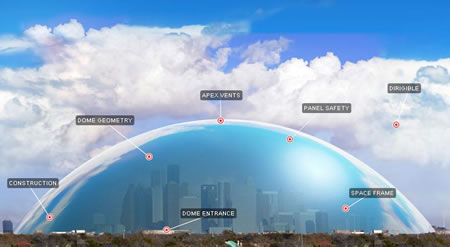
Here’s another classic science fiction trope being upgraded to serious proposition: the domed city. The Discovery Channel has apparently been doing a program about mega-engineering, and one of the subjects was a proposal to hide Houston beneath a dome to protect it from the effects of an increasingly erratic climate.

Houston dome concept

Sadly there’s not much detail about the hows and whys (they want you to watch the program, natch), and the sheer overload of Flash content on the DC site keeps crashing my browser. But the dome sure looks pretty – from the outside, at least. [via Technovelgy]

Meanwhile, if you want a more gritty and realistic look at the city landscapes of the near-future you should be tagging along with Bruce Sterling, who’s currently obsessed with emergent, repurposed and interstitial urban spaces and is producing a quality stream of links as a result. One of the latest nuggets is about the favelas of Caracas, Venezuela – built in and around a failed Modernist tower-block project and almost entirely maintained by its residents without government support or funding.

Downsizing the city

Abandoned building, Flint, MichiganTough times call for tough decisions: faced with long-term urban decline accelerated by the global economic SNAFU, the US Government is considering razing sections of some failing cities in order to keep them from collapsing. What were once bustling industrial towns  are now underpopulated, underfunded and poorly maintained, and pruning them back like a rosebush might just enable them to survive.

Mr Kildee said he will concentrate on 50 cities, identified in a recent study by the Brookings Institution, an influential Washington think-tank, as potentially needing to shrink substantially to cope with their declining fortunes.

Most are former industrial cities in the “rust belt” of America’s Mid-West and North East. They include Detroit, Philadelphia, Pittsburgh, Baltimore and Memphis.

In Detroit, shattered by the woes of the US car industry, there are already plans to split it into a collection of small urban centres separated from each other by countryside.

“The real question is not whether these cities shrink – we’re all shrinking – but whether we let it happen in a destructive or sustainable way,” said Mr Kildee. “Decline is a fact of life in Flint. Resisting it is like resisting gravity.”

If things don’t get a lot better very soon, I imagine there will be some small cities that collapse entirely, littering the country with hollow remnants of the late industrial age, a series of Twentieth Century ghost-towns inhabited by wildlife and a few back-to-the-land loners. Meanwhile the larger cosmopolitan centres – anywhere with a diverse enough economy to attract a newly itinerant workforce – will presumably keep growing as the ongoing urbanisation of the world gathers pace.

It’ll be interesting to see whether we’ve gotten much better at urban planning in the last half century or so; many of Britain’s planned cities of the post-war period were less than glowing successes, as the architectural philosophies of the day were based on principles that we’d now consider naive at best. But downsizing for survival is a time-honoured tactic in nature as well as economics; perhaps we’re living in the last days of suburbia. [via Slashdot; image by NESJumpman]