Tag Archives: urban

Living in the past… literally

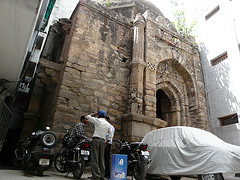
a tomb in New DelhiVia Geoff “BLDGBLOG” Manaugh we discover that people in India long ago found a solution to a shortage of affordable housing – they colonise ancient tombs and monuments, much to the chagrin of archaeologists and historians.

The city [New Delhi] is also home to tens of thousands of homeless people, and millions more who are desperately poor. Many of the otherwise homeless have made the reasonable assessment that the stout marble walls of the tombs and shrines and mausoleums that litter the city make a much nicer home, especially in monsoon season, than the sidewalk.

Some seek only temporary shelter. But others such as nine families living inside a federally protected monument called the Atgah Khan tomb, built in 1566, are so thoroughly ensconced that they can produce title deeds going back generations. They have plastered the walls, had the crypt wired to run the television and installed a fine kitchen, with wood cupboards built into the handy arched recesses.

It’s a tough call to make; history must be valued and protected, but people have to live somewhere. How can you tell a homeless family that they can’t live in an otherwise unoccupied building – you, with your job in archaeology and your apartment to go home to? You do it because it’s your job, of course, and because you believe that history must be preserved – but it can’t be much fun. [image by varunshiv]

And as the world becomes increasingly urbanised, perhaps we’ll see this sort of behaviour occuring in comparatively affluent Western cities as the less fortunate arrive in droves to seek employment and shelter. Imagine the Lincoln monument thronging with a small town of migrants from the former corn belt, or the huge family tombs of London’s great cemetaries repurposed into ersatz condominiums, always occupied by a few of the family’s oldest and youngest members to prevent claim-jumping newcomers…

Zipf’s Law – modelling the megalopolis

Taipei urban skylineMore statistical sensawunda in the urban environment. Remember us mentioning that guy who suggested that cities can be considered  as super-organisms? Well, a mathematician chap called Stephen Strogatz dropped into the New York Times blogs to talk about Zipf’s Law and other statistical phenomena that surround our urban environments:

The mathematics of cities was launched in 1949 when George Zipf, a linguist working at Harvard, reported a striking regularity in the size distribution of cities. He noticed that if you tabulate the biggest cities in a given country and rank them according to their populations, the largest city is always about twice as big as the second largest, and three times as big as the third largest, and so on. In other words, the population of a city is, to a good approximation, inversely proportional to its rank. Why this should be true, no one knows.

[…]

For instance, if one city is 10 times as populous as another one, does it need 10 times as many gas stations? No. Bigger cities have more gas stations than smaller ones (of course), but not nearly in direct proportion to their size. The number of gas stations grows only in proportion to the 0.77 power of population. The crucial thing is that 0.77 is less than 1. This implies that the bigger a city is, the fewer gas stations it has per person. Put simply, bigger cities enjoy economies of scale. In this sense, bigger is greener.

The same pattern holds for other measures of infrastructure. Whether you measure miles of roadway or length of electrical cables, you find that all of these also decrease, per person, as city size increases. And all show an exponent between 0.7 and 0.9.

Now comes the spooky part. The same law is true for living things. That is, if you mentally replace cities by organisms and city size by body weight, the mathematical pattern remains the same.

It looks as if there’s a lot of things that mathematical analysis could tell us about the cities we live in. The question is, are these properties inherently emergent, or could we design our urban environments more effectively and adjust some of those efficiency values in the process? [image by tylerdurden1]

Little lost robot

Robots have been mobile for decades, but they’ve only ever been able to go places for which they had a map or set of directions stored. That’s all changed thanks to a team of roboticists from Munich, who’ve built the first robot that can be unleashed into unfamiliar territory without a map. How does it complete its journey? It asks for directions, of course:

ACE uses cameras and software to detect humans nearby, based on their motion and upright posture. As it closes in on a likely helper, ACE’s “head” – bearing a touchscreen and a second screen displaying an animated mouth – turns to face the chosen person.

A speaker working in sync with the animated mouth is used to get the person’s attention and to ask them to touch the screen if they want to help. Willing guides are then asked to point the robot in the correct direction, with the response being analysed by posture recognition software. Direction set, ACE says “thank you” before trundling off.

Pointing, rather than telling the robot where to go, avoids confusion caused by the fact that the robot and the facing pedestrian each have a different sense of left and right.

Although it interacted with 38 people over a period of nearly five hours – ACE did eventually reach its destination. In fact, the team report that the robot was making very good progress until it reached a busy pedestrian area where its own popularity became a problem.

The current rarity of mobile robots in public spaces is obviously a big factor here; in a few more decades, we may barge past lost robots on the pavement as quickly and guiltily as we do homeless people or street-drunks.

The principle on display here is that of robot-human interaction in order to gather environmental data to complete a task or journey, which is all well and good, but it’s a proof-of-concept more than anything else. If all you needed was a robot that could navigate an unfamiliar cityscape, it’d be far easier to kit it out with good visual sensors and a GPS unit.

Hell knows this would be useless for military applications; if your super-killbot had to stop at every enemy checkpoint to ask the way to headquarters, I dare say the best place it would end up would be a long long way from anything at all… [story via regular commenter Evil Rocks; apologies to Paul McAuley for the headline]

The city considered as a very large organism

Roads - the veins of the living city?A few days ago Cosmic Variance was plugging a talk by a chap called Geoffrey West, a complex-systems boffin, which sounded like it had some very interesting angles. Here’s an extract from his abstract:

to what extent are cities or corporations an extension of biology? Are they “just” very large organisms? Analogous scaling laws reflecting underlying social network structure point to general principles of organization common to all cities, but, counter to biological systems, the pace of social life systematically increases with size. This has dramatic implications for growth, development and particularly for sustainability: innovation and wealth creation that fuel social systems, if left unchecked, potentially sow the seeds for their inevitable collapse.

Man, I love this sort of stuff; that’s the sort of question that pushes the same buttons as good science fiction, at least for me. So much so, in fact, that I’ve spent much of the holiday weekend here in the UK expounding similar ideas to inebriated friends, accompanied by brisk hand-waving. There’s a certain innate logic to the analogy that I feel anyone who’s lived a long time in one city – or maybe many – would instantly glom onto. Of course the city is alive, of course it is a system, an organism – how could it be anything else? [image by Nrbelex]

Once that assumption is agreed, though, the challenge is to work out what that actually means in human terms – which is more of a book-sized challenge than one suitable for a blog post, I suspect[1]. But I’m leaping ahead here, assuming that everyone feels the same way; maybe it sounds daft to you.

So, tell me: do you think cities can be considered to have a kind of life of their own, an organismic existence of emergent phenomena? Or is this a case of anthropomorphic projection? Or maybe both at once?

[ 1I’m imagining some sort of hybrid authorial chimera of Jeff VanderMeer, Geoff Manaugh and Mervyn Peake, with a sprinkling of Bicycle Repairman-era Chairman Bruce for the techno-weirdness element… ]

Global warming and our urban future

ghg-tables1Worldchanging reports on yet more evidence of urban living being less carbon-intensive than suburban living:

The authors of this study, published in The Journal of Urban Planning and Development, quantified the emissions from building materials and construction, home heating and power demands, and transportation energy, in both urban suburban neighborhoods in the Toronto metro area. And they found that downtown residents use radically less energy, and consequently emit about two-thirds less climate-warming CO2 than their suburban counterparts.

I had been vaguely aware that the suburban lifestyle produced more greenhouse gases, but the extent is surprising.