Tag Archives: vehicle

I don’t know how to drive it, but it looks pretty wild

Concept cars are rather like science fiction – in that they never quite come true, and they say more about the time in which they’re designed that the time in which they would supposedly exist.

But that’s half the fun of designing them, I guess, and it looks like there’s still plenty of folk in the auto industry’s blue sky labs who know how to dream big… or who play a lot of computer games. Pink Tentacle has a bunch of concept vehicle drawings (or rather renderings) from Mazda, Toyota, Nissan and Honda that look like a mash-up of Akira, Wip3out and Stephan Martiniere; if this is what the freeways of 2050 will look like, crossing the street is going to be a crazy experience.

Mazda Motonari RX vehicle concept

That’s the Mazda Motonari RX; to quote Pink Tentacle:

The vehicle drives sort of like a street luge. Acceleration and direction is determined by two armrest mounted control points, and the vehicle’s exoskeletal frame shape-shifts in accordance with the position of the driver’s arms and legs when enveloped in the seat. Four omnidirectional wheels allow 360 degrees of movement, and the tread expands or contracts to suit the driving conditions. A “haptic skin” suit consisting of millions of microscopic actuators enables the driver to experience the road psycho-somatically while receiving electrical muscle stimulation from the onboard AI guidance system (or other remotely located drivers).

No mention of how much a tank of gas will cost… though Toyota’s design apparently sidesteps the issue by being “powered by pollution”.

There’s a certain irony implicit in the automobile industry being one of the last bastions of sleek’n’shiny futurism in these times of bright green thinking; I’d love to see streets full of things like this, but I’m not going to hold my breath.
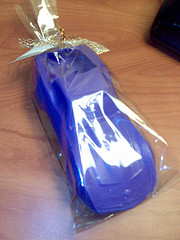
Biofueled car might have been a senseless waste of chocolate

chocolate-carIt’s not quite the “chocolate-fueled car” that the headline from the indispensable PhysOrg.com promises. What we have instead may be close enough — a car its makers claim can reach 145 miles per hour,

powered by waste from chocolate factories and made partly from plant fibers….

The steering wheel is made out of plant-based fibers derived from carrots and other root vegetables, and the seat is built of flax fibre and soybean oil foam. The body is also made of plant fibers….

Scientists at the University of Warwick say their car is the fastest to run on biofuels and also be made from biodegradable materials. It has been built to Formula 3 specifications about the car’s size, weight, and performance.

[Image: Never Eat Purple Chocolate by i’m george]

What BitTorrent can teach you about highway traffic control

highway vehicle headlightsThe guys at the RIAA may loathe BitTorrent with an unholy passion, but researchers at the University of California have found another use for the peer-to-peer protocols that could win it a lot more fans. In a nutshell, you fit cars with wireless modems and make them into a peer-to-peer network that works to reduce traffic jams:

Their Autonet plan would center around ad hoc networks of vehicles and roadside monitoring posts supported by 802.11 technology (the prototype uses 11b). The vehicles would essentially be the “clients” in such a system and feature graphical user interfaces to pass along information to drivers.

The caveat at the moment is that not enough roads have the monitoring infrastructure available to make the system work all the way from the big highways to the small streets. But given the proliferation of monitoring technology, not to mention the continuing (if now more muted) promises of municipal wi-fi networks, that can’t be far off. [via SlashDot; image by IM SNOT REAL]

Of course, what might make even more sense would be investing in the public transport networks so there was less traffic in the first place…

From bottles to bricks – recycling plastics into architecture

POLLI-brick - recycled plastic architectural componentOne of the less-feted stars of this year’s CES was the POLLI-Brick, an example of how recycling might be used to make something useful. The POLLI-Brick is an oddly-shaped plastic building block which…

… features a unique interlocking cylindrical shape and […] is created from around four recycled PET plastic bottles. The shape incorporates a great deal of air; thereby providing the thermal and sound insulation.

Besides their potential use as architectural components, they can be fitted with LED lamps in their cavities to provide mood lighting, or be used as plant pots. All good stuff, for sure – I’m all for reusing stuff we usually throw away -but one can’t help but feel that they’re going to look rather unfashionable rather fast, like last season’s rave club decor. Few things age as badly (and obviously) as architecture. [image borrowed from linked GizMag article]

And while we’re on the subject of recycling… oil prices may be low again at the moment, but they’re unlikely to stay that way forever. The prudent person plans ahead… so maybe you’d be interested in step-by-step instructions for converting your Honda Accord to run on organic trash, a bit like the Mr Fusion unit on the Back to the Future Dolorian? [via MetaFilter]

The price of revenge – pranking speed cameras

UK-style GATSO traffic speed cameraYet again, the street finds its own use for things – even the things installed by The Man to make the street safe. Students in Maryland in the US have hit upon the idea of making up fake license plates for their cars which match those of someone on whom they wish to exact a bit of revenge, and then driving past the automatic speed cameras in the area at high speeds. End result? The unsuspecting victim is automatically sent a ticket for speeding, even though they didn’t do it. [via SlashDot]

Of course, we Brits have our own version of the same system, but over here people clone the plates of similar vehicles for the purpose of avoiding their own fines; they’re not so bothered about who ends up paying them, so long as it’s not them.

Remember, folks: state-owned automated surveillance systems. If you’ve done nothing wrong, then you’re perfectly safe.

Well, mostly. [image by 91RS]